

What if choosing a short break wasn’t about stepping away from your loved one, but about creating a space where you both can truly flourish? It’s natural to feel a pinch of guilt or a wave of confusion when you start looking into ndis respite care options. You want to ensure your family member is safe, happy, and growing, while you take the time you need to maintain your own wellbeing. We understand that this balance is delicate, and finding a provider you trust with your loved one’s unique needs is your top priority.
In this guide, we’ll show you how NDIS respite care can provide a nourishing break for carers while creating joyful, growth-filled experiences for participants. You’ll learn about the recent shift to Short-Term Respite (STR), understand exactly what your funding covers, and discover how to find a high-quality environment that feels like a second home. We’re here to walk alongside you as you explore how these supports can strengthen your relationship and bring fresh energy to your daily life.
Key Takeaways
- Discover how respite serves as a gentle bridge for both you and your loved one to recharge and return to your routine with renewed energy.
- Reframe your perspective on support by seeing it as a proactive tool for building independence and exploring new community experiences.
- Gain clarity on how to navigate various ndis respite care options to find the specific style of support that feels safe and welcoming.
- Learn how to advocate for funding during your NDIS planning or review meetings so your family’s needs are fully heard and supported.
- Identify the qualities of a person-centered provider who’ll honor your loved one’s unique goals and personality.
Understanding NDIS Respite Care: More Than Just a Place to Stay
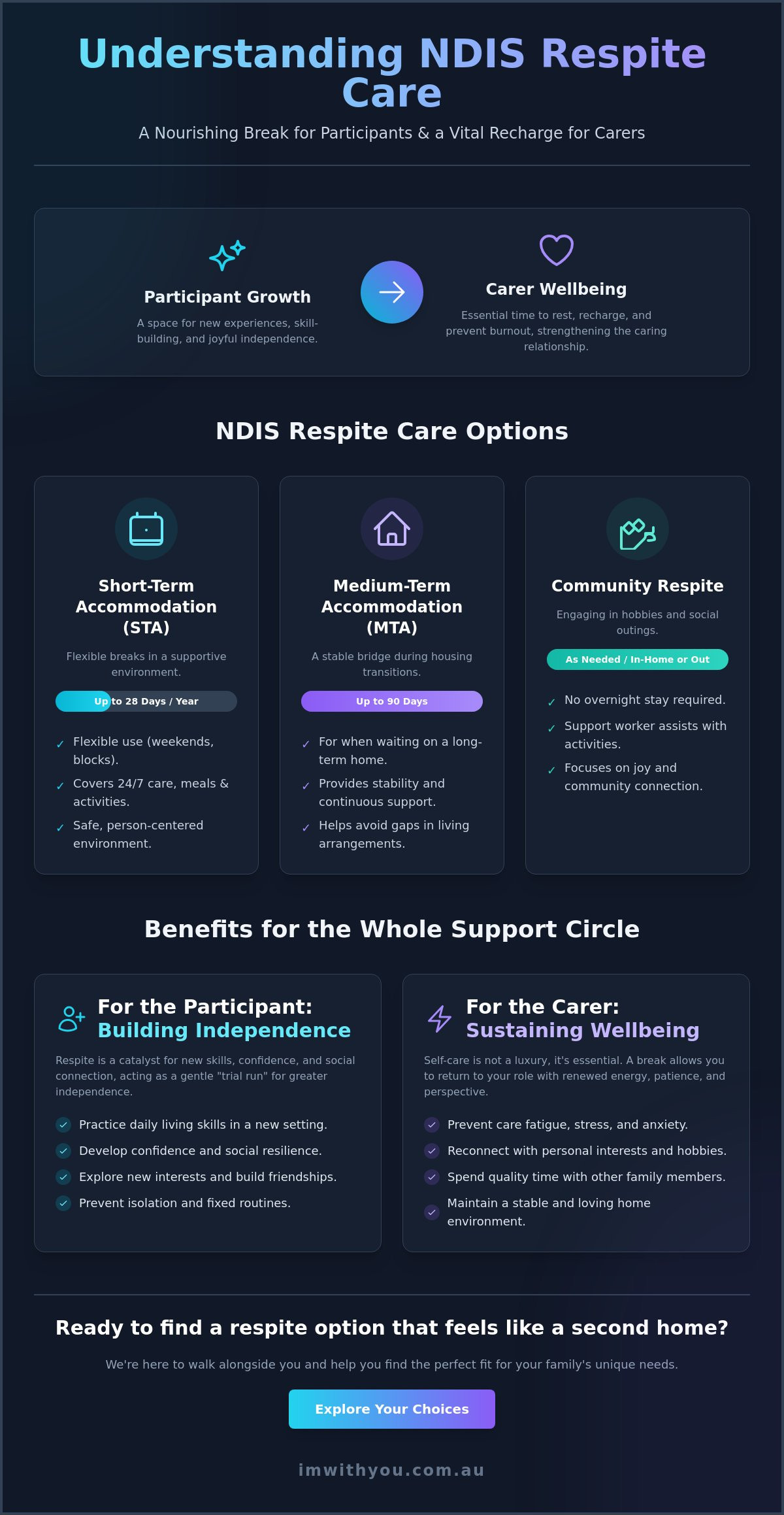
Respite isn’t just about finding a bed for a few nights; it’s about creating a breath of fresh air for your entire support circle. At its heart, this service is a nourishing gift of time that allows both the participant and the carer to recharge. When we explore What is Respite Care?, we see it as a holistic approach to wellbeing. It serves as an umbrella term covering various accommodation and support styles, all designed to keep your caring relationship healthy and sustainable.
We believe in the power of accompaniment. This means we don’t just provide a service; we walk alongside you to ensure every transition feels safe and familiar. Whether support happens in a specialized center or out in the neighborhood, it’s always tailored to your comfort level. Exploring different ndis respite care options helps you find a rhythm that respects your loved one’s agency while giving you the space to rest without the weight of “carer guilt.”
To help you visualize how these supports work in practice, watch this helpful video:
Short-Term Accommodation (STA)
Often referred to as Short-Term Respite (STR) following NDIS updates in October 2025, this is the most common way families access a break. It’s typically funded for up to 28 days per year. You can use this time flexibly, such as a weekend every month or a fortnight block. This funding is comprehensive; it covers 24-hour care, nutritious meals, and tailored activities in a safe environment. Our guide on Short Term Accommodation (STA) offers a deeper look at how this can work for you.
Medium-Term Accommodation (MTA) and Community Respite
Sometimes, life transitions require a longer bridge. Medium-Term Accommodation (MTA) provides a stable place to stay for up to 90 days while you wait for a long-term housing solution. If an overnight stay isn’t what you need, community-based respite is a wonderful alternative. This involves a support worker assisting the participant with social outings or hobbies while the carer takes a break. Understanding what are leisure activities and how they spark joy can help you choose ndis respite care options that focus on growth and community connection.
The Benefits of Respite for the Whole Support Circle
Choosing to explore ndis respite care options is a brave step toward a more sustainable future for your family. We see respite as a proactive investment in personal growth rather than a simple pause in care. For the participant, a change of scenery acts as a catalyst for new interests and social connections. It’s a time where they aren’t just “looked after,” but truly celebrated and encouraged to explore their agency in a safe, supportive environment. This shift in perspective turns a weekend away into a joyful adventure that builds confidence and character.
We also recognize the profound emotional relief this provides for you. Self-care isn’t a luxury; it’s a prerequisite for providing high-quality care over the long term. These breaks are a vital part of the Official NDIS Respite Funding Guidelines because the NDIS recognizes that your health directly impacts the quality of support your loved one receives. Taking this time allows you to breathe, knowing your loved one is surrounded by unwavering support and dedicated companionship.
Building Independence for the Participant
Respite often serves as a gentle “trial run” for supported independent living ndis. It gives participants a chance to practice daily living skills, like preparing a simple meal or managing a morning routine, away from the usual family dynamic. This boost in confidence is a powerful tool for social inclusion. It helps prevent the isolation that can sometimes occur when routines become too fixed. By engaging with new people and places, individuals develop the resilience needed for a more independent life.
Sustaining the Caring Relationship
Preventing care fatigue is vital for the health of your whole support circle. When you have the space to reconnect with your own interests or spend focused time with other family members, you return with a refreshed perspective. This helps reduce the stress and anxiety that often builds up in high-intensity roles. Exploring different ndis respite care options ensures that the home environment remains stable and loving for everyone involved. If you’re feeling overwhelmed, I’m here to help you explore your choices and find the right path forward.
How to Secure Respite Funding in Your NDIS Plan
Securing the right funding starts with a clear, honest conversation about your daily life. While the jargon can feel heavy, understanding your ndis respite care options is mostly about matching your family’s needs to the NDIS goals. Most respite funding, officially known as NDIS short-term respite, sits within your ‘Core Supports’ budget under ‘Assistance with Daily Life’. This flexibility allows you to use your existing budget for short stays when you need them most, provided the need is documented in your plan.
Gathering evidence is a vital step in this journey. You don’t have to do this alone. Carer impact statements and therapist reports are powerful tools that translate your lived experience into the language the NDIS understands. Having a trusted ndis provider by your side can make this process feel much lighter. We can help you identify which reports will best highlight the need for companionship and skill building during a respite stay.
Meeting the ‘Reasonable and Necessary’ Criteria
To access funding, you’ll need to show how respite helps the participant achieve their specific goals, such as increasing social participation or building confidence in the community. It’s about proving that the support is effective and represents good value for money. The NDIS looks for supports that sustain the informal care network to ensure long-term stability for the participant. By focusing on how a break prevents burnout, you demonstrate that respite is a necessary investment in the participant’s ongoing care.
Preparing for Your Plan Review
When your review approaches, take time to document your current level of support and explain why a break is essential for your sustainability as a carer. Identify specific goals that ndis respite care options can help reach, such as trying new hobbies or practicing independent living skills. Use clear, descriptive language to paint a picture of how these supports change your daily life for the better. If you need support gathering your thoughts before your next meeting, contact us for a gentle chat about your planning needs.
Choosing a Respite Partner Who Truly Understands
Finding the right fit for your family is about more than just checking boxes. It’s about finding a team that sees the person, not just the disability. When you evaluate ndis respite care options, you’re looking for a partner who prioritizes dignity and social inclusion as much as safety. A high-quality provider doesn’t just offer a room; they offer a personalized experience where every activity is planned around the participant’s unique goals. This person-centered approach ensures that respite feels like a positive choice rather than a clinical necessity.
What to Ask a Potential Provider
Don’t be afraid to ask the hard questions during your search. You should enquire about staff training, especially their adherence to the six rights of medication administration. It’s also vital to ask how they handle person first language and respectful communication. This shows they value your loved one’s identity and agency. Check for flexibility in scheduling and their ability to cater to specific cultural or dietary needs. A truly supportive partner will welcome these questions as a sign of your commitment to quality care.
The ‘Im with you’ Commitment
At ‘Im with you,’ we approach every respite stay as a partnership of trust and companionship. We’re proud to have received the 2026 award for excellence, a marker of our commitment to premium, high-standard service across our disability support and advocacy offerings. But more than awards, it’s the gentle, human touch that defines our work. We act as a trusted advocate and a steady companion, ensuring every individual feels safe, heard, and celebrated. If you’re ready to explore ndis respite care options that prioritize growth and wellbeing, we invite you to reach out for a chat with one of our compassionate advocates today.
Embracing a Future of Balanced Care and Connection
Taking the time to explore ndis respite care options isn’t just about finding a temporary stay; it’s about investing in the long-term health of your entire family. We’ve seen how these supports can transform from a simple break into a season of growth, where participants build independence and carers find the space to breathe. By understanding the funding pathways and choosing a partner who values dignity, you’re creating a foundation of stability and joy for everyone in your support circle.
At ‘Im with you,’ we’re more than just a service provider; we’re your steady companion in this journey. As winners of the 2026 Excellence in Disability Care Award and specialists in NDIS Support Coordination and Advocacy, we’re committed to walking alongside you. Our national team prioritizes person-centered support to ensure your loved one feels safe and celebrated every step of the way. Connect with a compassionate advocate at ‘Im with you’ today to discuss how we can support your unique goals. You don’t have to navigate this complex system alone, and we’re here to help you find the perfect balance for your home.
Frequently Asked Questions
What is the difference between STA and respite care?
Respite care is the umbrella term for the support you receive, while Short-Term Accommodation (STA) is the specific NDIS funding category used to pay for it. Following updates in October 2025, the NDIS officially renamed STA to Short-Term Respite (STR) to better reflect its purpose. Both terms refer to a service that includes accommodation, meals, and 24-hour care, allowing you and your informal carers to take a nourishing break.
How many days of respite can I get per year under the NDIS?
You can typically access up to 28 days of Short-Term Respite each year through your funding. This allocation is designed to be flexible, so you don’t have to use it all at once. Many families choose to break this down into weekend stays once a month or two separate 14-day blocks. This flexibility helps you find a rhythm that sustains your caring relationship without feeling restricted by a rigid schedule.
Can NDIS respite care be provided in my own home?
Yes, respite can absolutely be provided in your own home if that’s where you feel most comfortable. This is often referred to as in-home respite or community-based support. A dedicated support worker can come to your house to assist with daily tasks and activities while your primary carer takes time away to recharge. It’s one of the many ndis respite care options available to ensure support fits your specific lifestyle and preferences.
Does the NDIS cover the cost of food and activities during respite?
The NDIS covers the cost of your meals, accommodation, and personal care when you’re using Short-Term Respite funding. It also includes the cost of basic activities that are part of the support program during your stay. However, you’ll still need to cover your own personal expenses. This includes things like movie tickets, entry fees to major attractions, or any special treats you’d like to buy while you’re out in the community.
What happens if my NDIS plan doesn’t explicitly mention ‘respite’?
You can often still access support even if the word ‘respite’ isn’t written in your plan. Most ndis respite care options are funded through the ‘Core Supports’ budget, specifically under ‘Assistance with Daily Life’. As long as the support is reasonable and necessary for your goals, you have the flexibility to use your core budget for short-term stays. If you’re unsure, we can help you review your plan and advocate for clearer wording in your next review.