

Imagine sitting at your kitchen table on a Wednesday morning, looking at your new NDIS plan and feeling a heavy knot in your stomach because the funding for your core supports is significantly lower than the quotes you provided. It’s a moment where the anxiety of how you’ll pay for next month’s therapy sessions starts to cloud everything else. You aren’t alone in feeling that the NDIA hasn’t fully heard your story. It’s common to feel overwhelmed when the system uses complex jargon instead of simply listening to your lived experience.
We want to help you understand exactly what to do if ndis plan is not enough so you can advocate for yourself with confidence and clarity. We’ll stand beside you to ensure your plan reflects the actual support you need to live with dignity and independence. This guide walks you through the practical steps of lodging a review, gathering the right evidence, and making sure your voice is finally the loudest one in the room. You have the right to choice and control, and we’re here to help you reclaim it.
Key Takeaways
- Understand why your current funding may fall short and find reassurance that you are not alone in seeking a plan that truly reflects your daily life.
- Learn the clear, step-by-step process of what to do if ndis plan is not enough, from requesting simple plan variations to lodging a formal internal review.
- Master the art of building a strong evidence base with OT reports and impact statements that translate your personal needs into the language the NDIA understands.
- Explore how professional support coordination acts as your advocate, walking beside you to ensure every piece of evidence is submitted correctly and your voice is heard.
Understanding Why Your NDIS Plan Might Fall Short
Opening your NDIS plan to find the funding doesn’t match your actual needs feels like a heavy weight. We want you to know that you’re not alone in this experience. Many participants find that their first or even second plan doesn’t quite capture the full picture of their daily lives. It’s a common hurdle within the National Disability Insurance Scheme (NDIS), but it isn’t the end of your story. We see this as a starting point for your advocacy rather than a final word on your independence.
To better understand this concept, watch this helpful video:
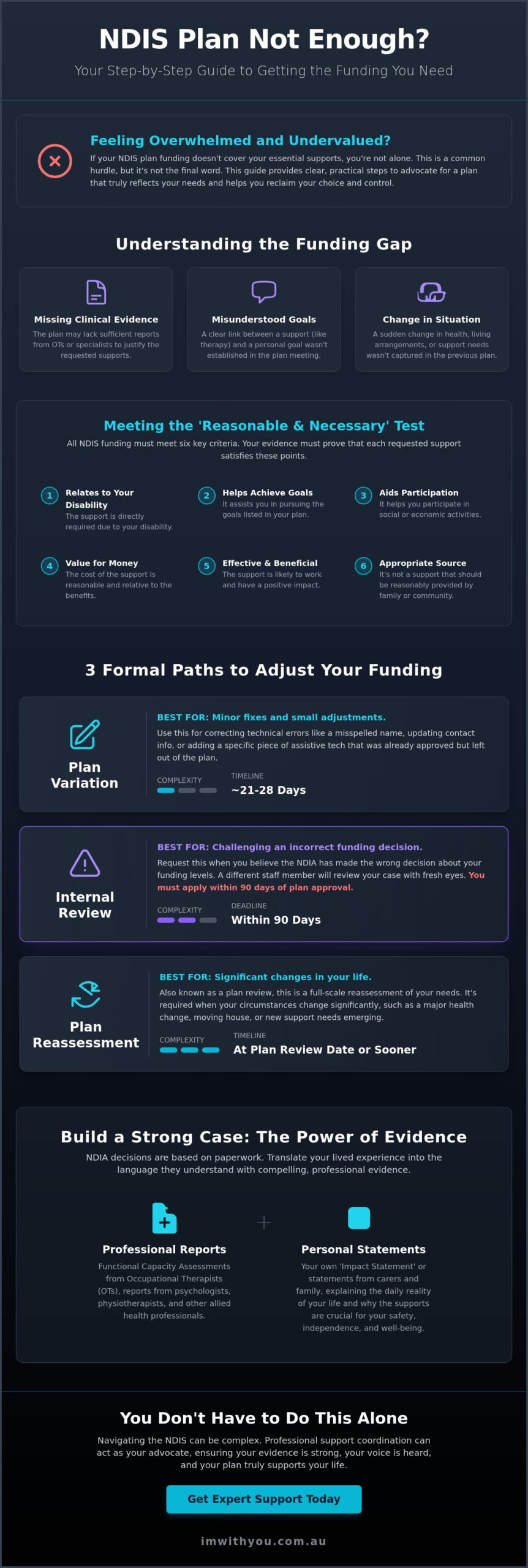
If you’re wondering what to do if ndis plan is not enough, start by looking at why the gap exists. Often, the shortfall stems from missing clinical evidence, misunderstood goals, or a sudden change in your situation that wasn’t captured during the planning meeting. Take a deep breath and remember that we’re here to walk side-by-side with you. This plan is a foundation, and you have the right to seek a version that truly reflects your life.
Common Gaps in Initial NDIS Plans
Shortfalls usually appear in Core Supports, which cover daily living, or Capacity Building, which funds therapy and skill development. It’s essential to check if the NDIA correctly understood your intellectual disability or physical support requirements. According to operational data from early 2024, many plans fall short simply because the link between a specific support and a personal goal wasn’t made clear enough during the assessment phase.
The ‘Reasonable and Necessary’ Test
The NDIA uses six specific criteria to justify every dollar of funding. They assess if a support is disability-related, effective, beneficial, and represents value for money. They also consider what is reasonable for families or the community to provide. Reasonable and Necessary acts as the bridge between your goals and the funding provided. We treat your Choice and Control as a sacred promise, helping you navigate these criteria so the NDIA sees the person behind the paperwork.
The Three Formal Paths to Adjusting Your Funding
Realizing your budget falls short feels heavy; we want you to know there are clear ways forward. If you’re wondering what to do if ndis plan is not enough, the NDIA provides three distinct avenues to seek a correction. While you wait for a decision, you can still access your current funds to maintain your leisure activities and essential care. We’ll walk through these options together to find the one that fits your journey.
- Plan Variation: Best for minor, technical changes or fixing small errors.
- Internal Review: Used when you believe the NDIA made the wrong decision regarding your funding levels.
- Plan Reassessment: Required when your life circumstances or support needs have changed significantly.
When to Choose a Plan Variation
A Plan Variation is the quickest path for making minor adjustments. You might use this to correct a misspelled name, update your contact details, or add a specific piece of assistive technology that was already discussed but left out. By mid-2026, the NDIA streamlined this process to be much faster than a full reassessment. Most simple variations are now processed within 21 to 28 days; this allows you to keep your momentum without a long wait.
Navigating the Internal Review Process
If you feel the funding allocated doesn’t reflect your actual needs, you can request an Internal Review of a Decision. This is a formal process where a different staff member looks at your case with fresh eyes. You must lodge the “Request for a Review of a Decision” form within 90 days of receiving your plan approval. When filling it out, focus on why the current funding doesn’t meet the “reasonable and necessary” criteria. Learning how to prepare for a plan review helps you gather the right evidence to support your claim. If you miss this three-month window, a full Plan Reassessment becomes your primary option.
For those experiencing major shifts, like moving house or a change in health, a Plan Reassessment provides a holistic look at your entire situation. Knowing what to do if ndis plan is not enough is about choosing the path that respects your energy and your needs. We’re here to stand beside you as you navigate these steps. If you feel overwhelmed by the paperwork, reach out to us for a supportive conversation about your options.
Building a Strong Case: The Power of Evidence
While we wish the NDIA could see the daily reality of your life, their decisions are built on paperwork. When you’re figuring out what to do if ndis plan is not enough, your strongest tool is a folder full of clear, clinical evidence. Think of this process as bridge-building; you’re creating a sturdy path of data that leads directly to the funding you deserve. We’re here to help you gather the right pieces so you don’t have to carry the weight alone.
Gathering Professional Support Reports
Your therapists are your greatest allies in this journey. Ask your Occupational Therapist or GP to write reports using NDIS-friendly language that focuses on functional capacity rather than just a diagnosis. If your situation involves complex health needs, it’s vital that reports follow the six rights of medication administration. This level of detail proves that your support needs are specific and necessary for your safety. Every report should explicitly link back to your NDIS goals, showing exactly how a support item helps you achieve independence.
The Lived Experience Statement
The Carer Impact Statement is your chance to share the heart of the matter. We often feel the need to put on a brave face, but this is the time for radical honesty. Describe the “worst-case day” in detail. If you’re exhausted because you’re providing 24-hour care without a break, say so. Being transparent about these challenges is often the key to unlocking the right level of support. It’s not about what you can do on your best day; it’s about what you need to thrive on your hardest ones.
The idea of collecting dozens of pages can feel overwhelming. Don’t try to do it all at once. Set a timer for 15 minutes and focus on just one email or one phone call to a therapist. These small, manageable steps will eventually build the evidence you need to show what to do if ndis plan is not enough to meet your needs. We believe in your agency and your right to be heard.
If the paperwork feels like too much, reach out to us at I’m With You so we can walk this path by your side.
How a Trusted NDIS Provider Stands With You
Facing a funding gap is often exhausting, but you don’t have to navigate the bureaucracy alone. When you are wondering what to do if ndis plan is not enough, a dedicated provider acts as your professional anchor. We understand that your plan is more than a budget; it is the foundation for your independence. Our team focuses on NDIS support coordination to ensure your voice is heard during the review process.
We take the lead in coordinating your team of therapists, including occupational therapists and physiotherapists, to gather the right evidence. It’s not just about having reports; it’s about ensuring those reports use the specific language the NDIS requires to prove a support is “reasonable and necessary.” At I’m With You, we don’t just deliver services. We walk beside you through every complex hurdle. We treat Choice and Control as a sacred promise, ensuring you have a plan that actually works for your life.
Advocacy vs. Support Coordination
It’s helpful to know the difference between these two roles. A Support Coordinator helps you implement your plan and prepare for reviews. An external disability advocate might be needed if you face a formal dispute or an Administrative Appeals Tribunal (AAT) case. Our team helps you prepare for planning meetings by reviewing your current support data. We identify gaps early to prevent future funding shortfalls. This proactive approach ensures your evidence is robust before you even step into a meeting.
Next Steps for Your Journey
If your current funding feels like a barrier rather than a bridge, we invite you to reach out for a gentle plan review consultation. We can sit down together, look at your current goals, and determine what to do if ndis plan is not enough for your specific needs. You deserve a partner who values your dignity as much as your progress. Your journey is unique, and we are here to ensure your plan reflects your true potential.
Taking the Next Step Toward the Support You Deserve
Navigating a plan that falls short feels exhausting, but your NDIS journey should reflect your actual life, not just a set of numbers. You now have the tools to understand why gaps occur and how to use formal review pathways to seek a fairer outcome. Gathering strong, clinical evidence is the most powerful way to advocate for your needs. Knowing exactly what to do if ndis plan is not enough transforms a stressful situation into a clear, manageable path forward.
You don’t have to carry this burden alone. At I’m With You, our expert Support Coordinators specialize in complex advocacy to ensure your voice is never lost in the paperwork. We provide national coverage with a gentle, human touch that earned us the Awarded for Excellence in 2026. We treat your right to choice and control as a sacred promise, standing beside you to secure the resources that empower your independence. Your goals are achievable, and we’re ready to help you reach them.
Let us walk beside you; contact ‘I’m With You’ for expert NDIS support today.
Frequently Asked Questions
Can I still use my current NDIS funding while waiting for a review?
You can continue to use your current NDIS funding while you wait for the NDIA to process your review. Your existing plan remains active and valid until a new decision is made or a new plan is issued. It’s important to manage your remaining budget carefully so you don’t run out of funds before the review finishes. We’ll stand beside you to help monitor your spending and ensure your essential supports continue during this waiting period.
How long does the NDIA take to complete an Internal Review in 2026?
In 2026, the NDIA operates under the Participant Service Guarantee which sets a maximum timeframe of 90 days to complete an internal review. While many participants receive a response much sooner, often within 60 days, this legal limit provides a clear expectation for your wait. We understand that every day counts when you’re wondering what to do if ndis plan is not enough to meet your daily support needs.
What happens if my request for more funding is denied again?
If the NDIA maintains their original decision after an internal review, you can lodge an application with the Administrative Appeals Tribunal (AAT). You must submit this application within 28 days of receiving the internal review outcome letter. The AAT is an independent body that reviews your case with fresh eyes. This step can feel overwhelming, but it’s a vital part of exercising your choice and control to ensure your plan supports your life.
Is there a cost to lodge a Plan Variation or a Review of a Decision?
There is no cost to lodge a Plan Variation or a Request for Review of a Decision with the NDIA. These are free services provided by the Australian Government to ensure every participant receives a fair plan. While there’s no application fee, you might use your current funding to pay for updated therapist reports or functional assessments. We’ll help you navigate these requirements so you can present the strongest possible evidence for your funding needs.
Can my Support Coordinator lodge the review request for me?
Your Support Coordinator can help you prepare and lodge a review request if you provide written consent for them to act on your behalf. They are experts at gathering professional evidence and explaining what to do if ndis plan is not enough to achieve your specific goals. While they handle the administrative steps, the decision always remains yours. We’ll walk side-by-side with you to ensure your voice remains the focus of the process.