

The date for your NDIS plan review is on the horizon, and with it, a familiar wave of anxiety might be washing over you. We understand. The pressure to get everything right, the fear of not being heard, and the uncertainty about your future funding can feel immense. That’s why we’ve created this gentle ndis plan review checklist for 2026-not just as a list of tasks, but as a steady companion to walk with you through the process, ensuring you never feel alone.
This guide is designed to help you gather your thoughts, collect the right evidence, and articulate your goals with clarity and confidence. Our goal is to empower you, ensuring your voice is at the very heart of your review. We want you to walk into your meeting feeling prepared, respected, and in full control, ready to co-design a plan that truly supports your life and aspirations. Let’s take this next step, side-by-side.
Key Takeaways
- Learn to approach your plan review as a collaborative conversation, turning it from a source of stress into an opportunity to shape your support journey.
- Follow our step-by-step ndis plan review checklist 2026 to calmly gather your reports and reflect on your goals, ensuring you build a strong case for the support you need.
- Discover practical tips to feel confident on meeting day, helping you clearly communicate your needs and advocate for yourself with ease.
- Understand the crucial steps that follow your meeting, from when to expect your new plan to how you can review it, so you feel supported through the entire process.
Understanding Your NDIS Plan Review: What to Expect in 2026
We understand that the thought of an NDIS plan review can feel daunting. But we want to gently reframe this moment. Think of it not as a test, but as a heartfelt conversation about your journey, your goals, and your life. It is your dedicated opportunity to ensure your plan truly reflects who you are and where you want to go. As we look towards 2026, the NDIS continues to evolve, and being prepared is the key to empowerment. This is the first step in your ndis plan review checklist 2026, designed to ensure you walk into that conversation feeling confident and heard.
What is a Plan Review and Why is it So Important?
At its core, a plan review is a check-in to make sure your NDIS funding and supports are still the right fit for you. Life is dynamic, and your plan should be too. This process is the most powerful way you can exercise your ‘Choice and Control’-a promise we believe is sacred. The National Disability Insurance Scheme (NDIS) is designed to be flexible, and this review is how that flexibility comes to life. It’s where we can align your funding with new goals, celebrate your achievements, and adjust for any changes in your circumstances, ensuring your plan continues to support your best life.
Scheduled vs. Participant-Requested Reviews
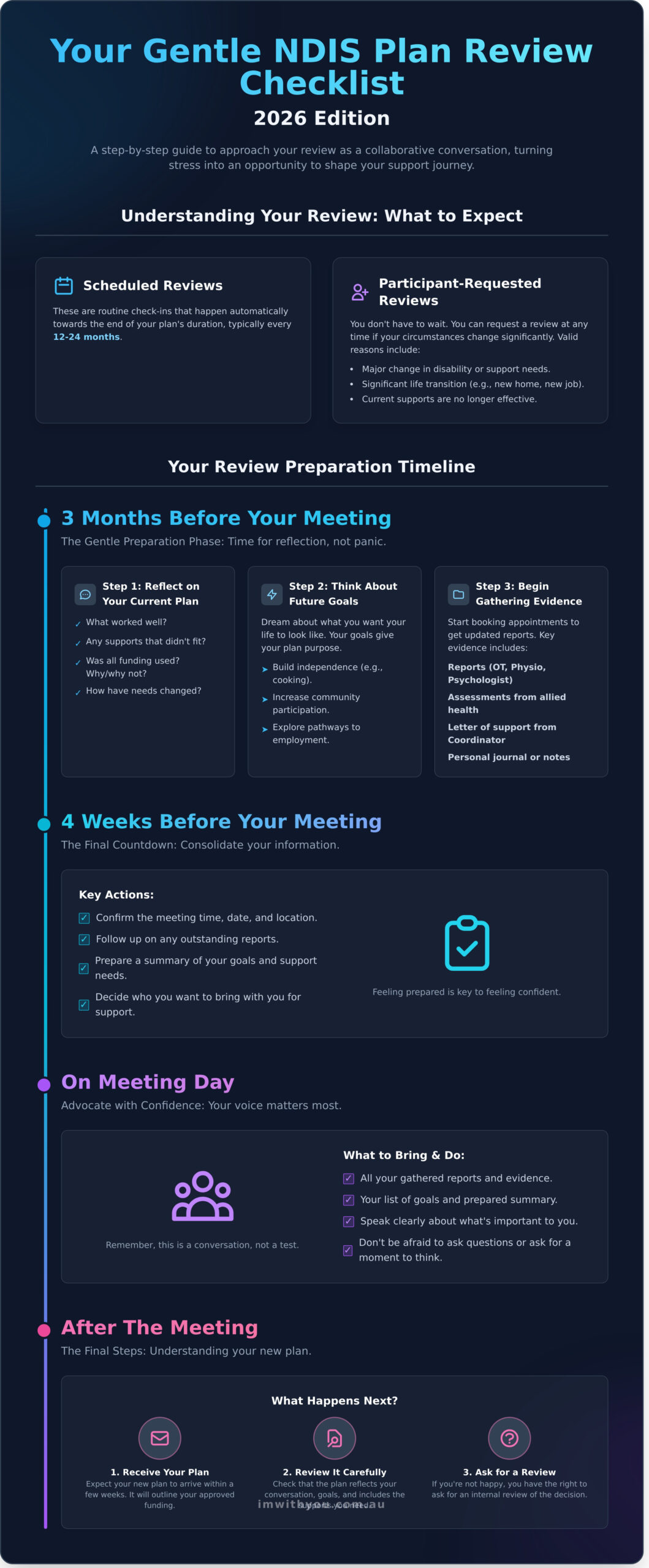
Your NDIS journey will include different types of reviews, and knowing which is which helps you stay in the driver’s seat. Most reviews are scheduled and happen automatically towards the end of your plan’s duration (usually every 12-24 months).
However, you don’t have to wait if your circumstances change significantly. You can ask for a participant-requested review at any time. Valid reasons include:
- A significant change in your disability or support needs.
- A major life transition, like moving into your own home or starting a new job.
- Realising your current supports are no longer helping you achieve your goals.
To request an early review, you can speak with your Support Coordinator or Local Area Coordinator (LAC), or submit a ‘Change of Details or Circumstances’ form directly to the NDIA. In some cases, the NDIA may also initiate a review, but you will always be contacted beforehand.
The Pre-Review Checklist: 3 Months Before Your Meeting
The three months leading up to your plan review meeting are a time for gentle reflection, not last-minute panic. Think of this as a quiet space to gather your thoughts and stories from the past year. Starting this process early is the kindest thing you can do for yourself, ensuring you feel calm, prepared, and in control. We’re with you every step of the way as you work through this part of your ndis plan review checklist 2026, turning preparation into an act of empowerment.
Step 1: Reflect on Your Current Plan
Let’s look back together at your journey over the last 12 months. This isn’t about judgment; it’s about understanding what has truly supported you and where the gaps might be. A great way to start is by asking yourself these gentle questions:
- What parts of my plan worked really well for me?
- Were there any supports that didn’t feel like the right fit?
- Did I use all of my funding? If not, what were the barriers?
- How have my life circumstances or support needs changed?
- In what ways did my supports help me move closer to my goals?
Step 2: Think About Your Future Goals
Your NDIS plan is built around your aspirations. Now is the perfect time to dream about what you want your life to look like in the next one to two years. Your goals give your plan purpose and direction. They could be anything from learning to cook a new meal each week (to build independence), joining a local art class (for community participation), or exploring volunteer work (as a pathway to employment). When you have clear goals, we can help connect them to the reasonable and necessary supports you’ll need to achieve them, putting your Choice and Control right at the heart of your plan.
Step 3: Begin Gathering Your Evidence
The word ‘evidence’ can sound clinical, but it’s simply the professional backing for your story. It’s the collection of reports and letters that show how your supports are helping you and what you need moving forward. It helps to understand the official process for how NDIS plans are monitored and reviewed, as this gives context to the documents you’re gathering. Start booking appointments with your support team now to get updated documents. Key evidence can include:
- Reports from your occupational therapist, physiotherapist, or psychologist.
- Assessments from other allied health professionals.
- A letter of support from your Support Coordinator.
- A simple journal where you’ve noted daily challenges and support needs.
The Final Countdown Checklist: 4 Weeks Before Your Meeting
With about a month to go, this is the time to transform your collection of reports and reflections into a clear, compelling story. You’ve gathered the evidence; now, we’ll help you organise it so the NDIA can truly understand your journey and your goals. As you move through this final phase of your ndis plan review checklist 2026, remember that your voice is the most important part of the process.
Step 4: Complete Key NDIS Forms
The NDIA will provide you with a form, often called the ‘Preparing for your plan review’ booklet (or its 2026 equivalent). This document is your formal opportunity to outline how your last plan went and what you need for the next one. When filling it out, be clear and direct. Use bullet points to list your needs and connect every request back to one of your specific goals. It’s a great idea to write your answers in a separate document first, then copy them over. Always make a photocopy or take a digital scan of the completed forms for your own records.
Step 5: Prepare Your Participant or Carer Statement
This is where your story truly comes to life. A Participant or Carer Statement is a powerful document written in your own words, explaining your life, your aspirations, and the challenges you face. It adds a human element that reports alone cannot convey. We suggest a simple structure:
- A day in my life: Describe a typical day. What parts are easy? What parts are difficult without support? Use real examples to paint a picture.
- My goals and aspirations: Reiterate the goals you’ve set. Explain why they are important to you and how they will increase your independence and well-being.
- My support needs: Clearly state what supports you believe are reasonable and necessary to achieve those goals.
Don’t be afraid to be honest about your struggles. This vulnerability helps build a strong case for the supports you need to live a full and empowered life.
Step 6: Connect With Your Support Network
You are not alone on this journey. This is the perfect time to lean on your support network. A dedicated Support Coordinator is invaluable here; they can review all your documents, check for consistency, and help you practice what you want to say in the meeting. They stand beside you to ensure your voice is heard. Family, friends, and carers also play a vital role, and resources like Carers Australia’s guide on Reviewing Your NDIS Plan can provide an invaluable perspective. Having someone in your corner can make all the difference, transforming anxiety into confidence.
A great Support Coordinator helps ensure you feel prepared, understood, and in control of your plan review. Learn how our Support Coordinators can stand with you.
The Meeting Day Checklist: What to Bring and How to Advocate
The day of your plan review meeting can feel daunting, but we believe that thoughtful preparation is the best way to transform anxiety into confidence. Remember, this conversation is about you. You are the expert on your own life, your goals, and what you need to thrive. We’re here to help you make sure your voice is heard clearly and respectfully.
Feeling prepared is a powerful act of self-advocacy. By having everything you need at your fingertips, you create the space to focus on the conversation, not on searching for a piece of paper. This is a vital part of your ndis plan review checklist 2026.
Your Essential Document Pack
We suggest organising your documents in a labelled folder the night before. This simple step can bring a wonderful sense of calm. Your complete ndis plan review checklist 2026 should include these documents to ensure a smooth and productive meeting:
- Recent assessments and reports: Bring copies of any new reports from your occupational therapist, psychologist, physiotherapist, or other allied health professionals.
- Your prepared goal statement: The summary of your goals and aspirations that you worked on earlier.
- Quotes for supports: Any quotes you have gathered for assistive technology, specific therapies, or other key supports.
- Your current NDIS plan: It’s always helpful to have your existing plan on hand for easy reference.
- Photo identification: Such as your driver’s licence or proof of age card.
- A notepad and pen: Perfect for jotting down important points, names, or actions discussed during the meeting.
Tips for a Confident Conversation
This meeting is your dedicated space to exercise your fundamental right to Choice and Control. Your voice is the most important one in the room. Here are a few gentle reminders to help you advocate for yourself with confidence and clarity.
- Lean on your preparation: Don’t hesitate to refer to your notes. You can say, “I’ve written down a few points here to make sure I cover everything.”
- Ask for clarity: If you hear a term you don’t understand, it’s perfectly okay to ask, “Could you please explain what that means for me?”
- Pause when you need to: You do not need to have an immediate answer. Feel empowered to say, “That’s a good question. Can I have a moment to think about that?”
- Bring a support person: You have the right to have someone with you, whether it’s a family member, a friend, or a professional support coordinator. If you feel you need an advocate to stand beside you, please know we’re with you.
The Post-Review Checklist: Understanding Your New Plan
Once your plan review meeting is complete, it can feel like a weight has been lifted. But your journey isn’t quite over, and we’re here to walk the final steps with you. The post-review phase is just as important for ensuring your new plan truly empowers you. Think of this as the final stage of your ndis plan review checklist 2026, where you confirm the details and put your vision into action.
Receiving and Reviewing Your New Plan
The NDIA will send you your new plan, typically within 21 days of your meeting, though this can sometimes take longer. When it arrives, take a quiet moment to read through it carefully. We recommend checking these key areas to ensure everything aligns with your discussion:
- Funding Amounts: Are the funds in your Core, Capital, and Capacity Building budgets what you expected and discussed? Do they seem reasonable and necessary to achieve your goals?
- Your Goals: Have your short-term and long-term goals been captured accurately, just as you described them? The plan should be a direct reflection of your aspirations.
- Plan Dates: Check the start and end dates to ensure they are correct.
Activating Your Plan and Choosing Providers
With your approved plan in hand, you can begin your search for providers who will walk alongside you to achieve your goals. This is where your Choice and Control truly comes to life. It’s about finding partners in your journey who understand your vision and are committed to supporting you holistically. See if our approach to care feels right for you. We believe in building genuine connections to help you live the life you choose.
What If You Disagree With the Decision?
It is deeply disheartening if your new plan doesn’t reflect what you need. Please know you are not alone, and you have clear options. If you believe the decision is not right, you can request an internal review. You have three months from the date you receive the plan to make this request. The process is straightforward, and staying calm and organised is key:
- Contact the NDIA to formally request an internal review of the decision. You can do this via phone, in writing, or by filling out a form.
- Clearly explain why you disagree with the funding and provide any supporting evidence you have.
- A different NDIA staff member, who was not involved in the original decision, will review your case and make a new one.
Navigating this can feel overwhelming, but remember, we are with you every step of the way.
Navigating Your 2026 NDIS Review, Together
Your NDIS plan review is more than a meeting; it’s a vital opportunity to shape your future. This guide has shown that with thoughtful preparation-from gathering reports months in advance to knowing how to advocate for yourself on the day-you can approach this process with clarity and confidence. Using this ndis plan review checklist 2026 is your first step towards ensuring your voice is heard and your goals are placed at the very centre of your plan.
But remember, you never have to walk this path by yourself. At Im with you, our person-centered support honours your ‘Choice and Control’ as a sacred promise. Our dedicated team, recognised with the 2026 Award for Excellence in Care, stands with you every step of the way, offering gentle guidance and expert advocacy.
Feeling overwhelmed? You don’t have to do this alone. Let’s walk this path together. Your journey matters, and we are here to help you move forward with empowerment and peace of mind.
Frequently Asked Questions
How long does an NDIS plan review meeting usually take?
Your NDIS plan review meeting is a dedicated space for your story, and it typically lasts between 60 and 90 minutes. This can vary depending on the complexity of your needs and goals. The most important thing to remember is that this is your time. We encourage you not to feel rushed, as the goal is to have a thorough and supportive conversation that truly captures your journey and aspirations for the year ahead.
Is it possible for my NDIS funding to be reduced after a plan review?
We understand this can be a source of anxiety, and it is possible for funding to change. A reduction might happen if your support needs have decreased or you have successfully achieved major goals. However, the purpose of a review is to ensure your plan provides the right level of funding for your current needs. Providing strong, clear evidence of how your supports help you pursue your goals is the best way to justify your required funding.
What is the single most important piece of evidence I should provide?
While every piece of your story is important, a comprehensive report from a key allied health professional, like an Occupational Therapist, is often the most impactful. This report should clearly link your disability to your day-to-day functional capacity and recommend specific supports. It acts as a professional cornerstone, providing the NDIA with a clear, evidence-based understanding of why you need the supports you are requesting to live a full and empowered life.
Do I absolutely need a Support Coordinator for my plan review?
While not mandatory, having a Support Coordinator by your side can be incredibly reassuring and beneficial. Think of them as a knowledgeable guide on your journey, helping you gather the right reports, articulate your goals clearly, and navigate the meeting with confidence. They are there to ensure your voice is heard and that you can fully exercise your Choice and Control, reducing the stress that can often come with the review process.
What’s the difference between a plan review and a plan reassessment in 2026?
A plan review is the scheduled check-in that typically happens as your current plan is about to end. It’s a time to look at what worked, what didn’t, and set new goals. A plan reassessment, however, is usually requested when your circumstances change significantly. Using a complete ndis plan review checklist 2026 is helpful for both, but a reassessment focuses specifically on how your new situation impacts your support needs.
Can I bring a family member or advocate with me to my review meeting?
Absolutely. You should never feel you have to go through this process alone. We strongly encourage you to bring a family member, a trusted friend, or a professional advocate with you. They can provide emotional support, help you remember important points, and speak on your behalf if you wish. Having someone with you is a fundamental part of your rights and helps create a safe space for an open and honest conversation.
How do I talk about my mental health needs in a plan review?
Speaking about your mental health is a sign of strength, and it’s a vital part of your holistic wellbeing. We recommend focusing on the functional impact-how your mental health affects your daily life. You can talk about its effect on your capacity to work, socialise, or manage tasks at home. A supporting letter or report from your psychologist, counsellor, or psychosocial recovery coach can provide powerful, professional evidence to support your needs.