

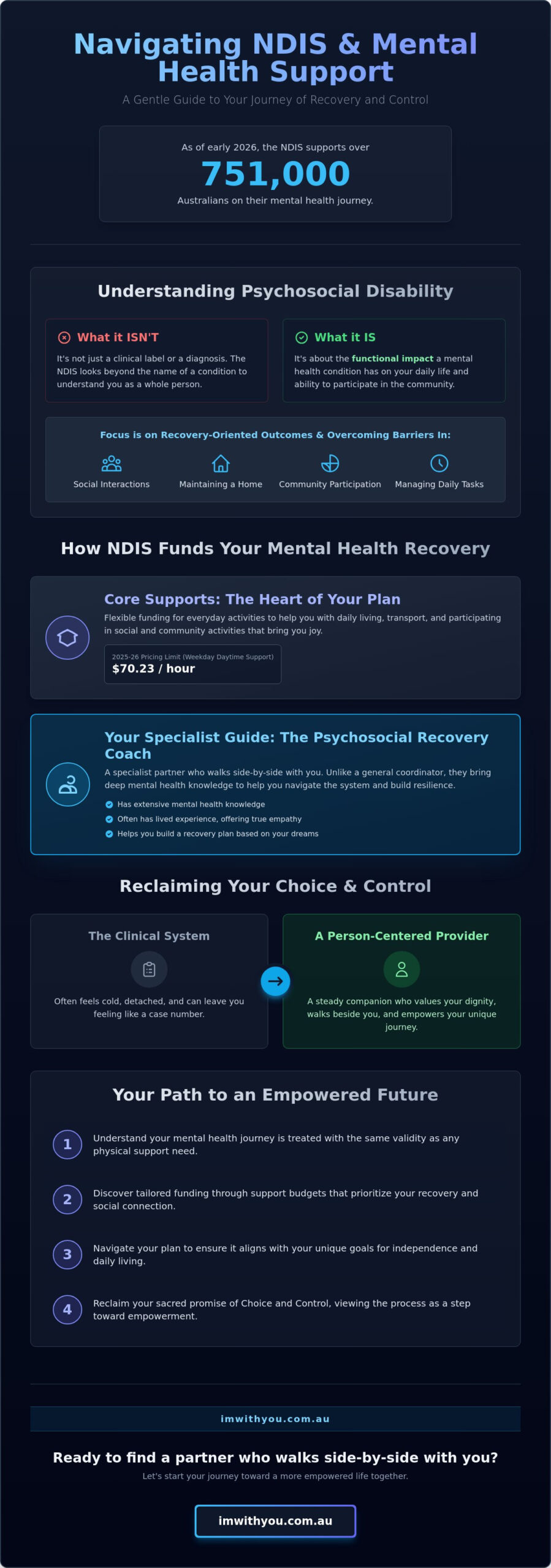
What if the path to managing your mental health didn’t feel like an endless cycle of clinical assessments and cold paperwork? We understand that for many of the 751,000 Australians supported by the scheme as of early 2026, the journey to access ndis and mental health support often feels overwhelming. You’ve likely felt the weight of trying to prove your story to a government body or found yourself lost in the confusing jargon of psychosocial disability. It’s exhausting to feel like a clinical case number when you’re simply looking for a steady hand to help you find your footing again.
You deserve to be heard and valued as a whole person, not just a diagnosis. In this guide, we’ll demystify how the scheme works and show you how to access compassionate care that respects your dignity. We’ll explore the 2025-26 pricing arrangements and explain how specific supports can restore your Choice and Control. From capacity building to community participation, you’ll learn how to find a partner who walks side-by-side with you toward a more empowered life.
Key Takeaways
- Understand how the NDIS defines psychosocial disability and why your mental health journey is treated with the same validity as any physical support need.
- Discover how to access ndis and mental health support through tailored funding that prioritizes your recovery and social connection.
- Learn how to navigate the support budgets within your plan to ensure they align with your unique goals for independence and daily living.
- Reclaim your sacred promise of Choice and Control by viewing the application process as a meaningful step toward an empowered future.
- Identify the value of a person-centered provider that walks beside you as a steady companion rather than directing you from a distance.
What is NDIS Mental Health Support and Psychosocial Disability?
The NDIS uses specific language to describe how mental health affects your life. You’ll often hear the term Psychosocial disability. This isn’t just a clinical label; it’s a way to recognize that mental health conditions can create significant barriers in your daily routine. Whether it’s managing social interactions, maintaining a home, or finding the confidence to step outside, ndis and mental health support is designed to help you overcome these hurdles. We believe your mental health is just as valid as any physical disability, and the scheme is here to provide the functional support you need to thrive.
Accessing this support involves showing that the impact on your life is “permanent or likely to be permanent.” While that phrase sounds heavy, it simply means you have an ongoing need for a steady hand by your side. The focus here is on recovery-oriented outcomes. This doesn’t mean a “cure” in the medical sense. Instead, it’s about building your strengths and helping you live a life of meaning and connection, regardless of your symptoms. We’re here to ensure you never feel like a case number during this process.
To better understand this concept, watch this helpful video:
Common Conditions and Functional Impact
The NDIS supports individuals with various conditions, including schizophrenia, bipolar disorder, and severe anxiety or depression. However, the scheme cares more about the *impact* on your life than the specific name of your diagnosis. It’s vital to distinguish between clinical treatment and functional support. While the Health Department handles doctors and medication, ndis and mental health support focuses on your ability to participate in the community and manage daily tasks. It’s about the practical side of living well.
Why a Gentle Approach Matters
The clinical system often feels cold and detached, which can increase anxiety when you’re already struggling. That’s why choosing an NDIS provider who leads with empathy is so important. At Im with you, we don’t direct you from above; we walk side-by-side with you. Our philosophy is rooted in the belief that you deserve a companion who values your dignity and supports your unique journey toward independence.
How the NDIS Funds Your Mental Health Recovery
Understanding your plan shouldn’t feel like solving a puzzle alone. NDIS funding is designed to be a flexible tool that adapts to the natural ebbs and flows of your recovery journey. Unlike rigid clinical budgets, NDIS mental health support is organized into Support Budgets tailored to your specific life goals. This means if you have a difficult month, your funding can often flex to provide more intensive help when you need it most. It’s about building your capacity to manage daily tasks while ensuring you remain connected to the people and places that matter to you.
The scheme focuses on providing the resources you need to live a more independent and connected life. This funding isn’t just about “managing” a condition; it’s about investing in your future. If you’re feeling unsure about how to allocate your budget, we can help you explore your options to ensure every dollar serves your dignity and personal growth.
Core Supports for Daily Living
Core supports are the functional heart of your plan. This funding helps with everyday activities like self-care, transport, and social participation. For instance, under the 2025-26 pricing arrangements, a standard weekday daytime support worker is billed at a limit of $70.23 per hour. This person can walk side-by-side with you as you run errands or attend appointments. We also believe that recovery involves more than just “getting by.” It includes finding joy in leisure activities, which helps rebuild social confidence and creates a holistic sense of well-being.
The Role of a Psychosocial Recovery Coach
A Psychosocial Recovery Coach is a specialist role specifically designed for ndis and mental health support. Unlike a general support coordinator, these coaches have extensive mental health knowledge and often have lived experience. They work collaboratively with you to build a recovery plan that reflects your dreams rather than just your diagnosis. They help you navigate the complexities of the system and stay by your side during times of increased need. Their goal is to foster your resilience and help you reclaim Choice and Control over your own story.
Accessing NDIS Support: Your Journey to Choice and Control
The process of Accessing NDIS support can often feel like an overwhelming hurdle to clear. We want to help you reframe this application as the very first step toward reclaiming your independence. Instead of viewing it as a test you must pass, see it as a tool to unlock the resources you deserve. At I’m With You, we treat Choice and Control as a sacred promise. This means you hold the power to decide who supports you, how they help, and when that support happens. You’re the expert in your own life, and the scheme is here to back your vision for the future.
You don’t have to walk this path alone. Whether you’re just starting to think about ndis and mental health support or you’re preparing for a review, advocates and compassionate providers are ready to stand with you. If you feel anxious about the paperwork or the meetings, connect with our team to find a steady companion who understands the system and values your voice.
Gathering Evidence with Compassion
When you ask your doctor or therapist for supporting documents, the focus should be on your functional impact rather than just a clinical diagnosis. It’s helpful to provide a clear picture of how your condition affects your ability to manage self-care, social interactions, and daily planning. We encourage you to use person-first language during these discussions. This ensures that the documentation reflects your humanity and dignity, focusing on the support you need to thrive rather than just a list of limitations.
Preparing for Your Planning Meeting
Your planning meeting is the moment to advocate for the life you want to lead. While it’s natural to want to show your strengths, it’s vital to speak honestly about your “worst days.” This ensures your funding is sufficient to support you when things are most difficult. Remember, you have every right to bring a support person, friend, or advocate to this meeting. Having someone stand beside you can lower your anxiety and ensure that every one of your goals is heard and recorded accurately.
Walking Side-by-Side: Why ‘Im with you’ is Different
Finding a partner who truly sees you is the turning point in any path to wellness. As an award-winning provider in 2026, Im with you is dedicated to setting a new standard for excellence in ndis and mental health support. We don’t believe in leading from the front or directing your choices from a distance. Instead, we walk side-by-side with you. Our team acts as a steady, capable friend who happens to have deep expertise in the NDIS system. We focus on your strengths, ensuring that your dignity remains intact while you build the life you want.
Our commitment to advocacy means your voice is the loudest in the room during every decision. We treat Choice and Control as more than just a policy; it’s our sacred promise to you. We’re here to ensure the supports you receive are ones you actually want, delivered in a way that feels safe and respectful. You deserve a guide who understands that your journey is unique and respects your agency at every turn.
A Holistic Approach to Mental Wellbeing
Recovery isn’t a solo task; it involves your whole village. We offer a range of services, including Community Participation Support and Capacity Building Skills, to help you reconnect with the world on your own terms. By integrating these supports, we create a complete picture of wellbeing that extends far beyond daily tasks. We also recognize the vital role of families and carers, providing the reassurance they need to know their loved one is in safe, compassionate hands. This holistic view ensures that every part of your life is supported, not just your symptoms.
Ready to Start Your Journey?
We invite you to reach out for a warm, non-judgmental conversation about your plan. Whether you’re looking for Support Coordination or help with daily activities, we’re here to listen first and act second. Im with you is more than just our name; it’s our daily promise to you. Let’s explore how we can walk this path together, ensuring you feel heard, empowered, and never alone in your ndis and mental health support journey.
Reclaiming Your Future with Confidence
You’ve taken a significant step today by exploring how ndis and mental health support can transform your daily life. We’ve looked at how the scheme validates your experience through the lens of psychosocial disability and how flexible funding empowers your recovery. Remember that your journey is defined by your goals; not a clinical label. With the right companion, navigating these systems becomes a shared path rather than a lonely struggle.
As a provider honored with the 2026 Award for Excellence in NDIS Care, we’re proud to offer person-centered advocacy and support across Australia. Our national coverage ensures that no matter where you are, you have access to a team that values your dignity above all else. We’re ready to stand beside you as you exercise your right to Choice and Control.
Let’s walk this path together; contact I’m With You for compassionate NDIS support today.
Your story is still being written, and we’d be privileged to be part of your next chapter. You’re capable, you’re valued, and you’re never alone on this journey.
Common Questions About Your Mental Health Journey
Can I get NDIS support for depression or anxiety?
You can certainly access ndis and mental health support for depression or anxiety if these conditions have a significant and permanent impact on your daily functioning. The scheme looks at how your mental health affects your ability to communicate, socialize, and manage self-care. While many people manage these conditions through the primary health system, the NDIS steps in when you need ongoing functional support to live an independent life.
What is a Psychosocial Recovery Coach and do I need one?
A Psychosocial Recovery Coach is a specialist with mental health knowledge who walks side-by-side with you to navigate the complexities of your plan. These coaches differ from standard support coordinators because they focus specifically on recovery-oriented practice and often have lived experience. Whether you need one depends on your personal goals; however, many participants find their expert companionship invaluable for building resilience and maintaining Choice and Control over their journey.
What happens if my NDIS application for mental health is rejected?
You have the right to request an internal review of the decision within 90 days of receiving your outcome letter. If the internal review doesn’t change the result, you can then apply to the Administrative Appeals Tribunal (AAT) for an independent assessment. This process feels stressful, but remember that many successful participants had to provide additional evidence or clarification before their plan was eventually approved by the NDIA.
How do I use my NDIS funding for community mental health programs?
You can use your Core Supports budget to access community-based programs that help you build social skills and reduce isolation. This funding allows you to pay for a support worker to accompany you to groups or activities that align with your recovery goals. It’s a practical way to move away from clinical settings and toward a life filled with meaningful connection and community participation on your own terms.
Is NDIS mental health support different from seeing a psychologist?
NDIS support focuses on functional help for daily living while a psychologist provides clinical treatment for your condition. Your NDIS funding might pay for therapeutic supports to build skills, but it doesn’t replace the medical services provided by the Medicare-funded health system. Think of ndis and mental health support as the help that enables you to manage your life, while clinical health services focus on treating your symptoms.