

What if a new diagnosis isn’t just a barrier to overcome, but an invitation to join a vibrant, expressive community? Learning about auslan australia opens up a world where hands and faces tell stories that words sometimes can’t reach. I know it feels overwhelming when you’re suddenly facing a communication gap or trying to decode complex NDIS categories. You might worry about your loved one feeling isolated or left behind in social settings. Im with you, and I understand that weight.
This guide will show you how Auslan fosters deep, heart-to-heart connections while giving you the practical tools to manage NDIS support with confidence. We’ll explore Auslan’s unique culture, look at strategies for home life, and clarify how to use your funding for the specialized support you deserve. Together, we’ll turn uncertainty into a clear path forward for your family.
Key Takeaways
- Discover how auslan australia serves as a complete, natural language that fosters deep cultural connection and identity within the Australian Deaf community.
- Learn practical strategies for creating a visual-friendly home environment that reduces daily frustration and strengthens your family’s communication.
- Gain clarity on navigating NDIS budget categories to access the essential funding you need for professional Auslan training and interpreting.
- Explore how dedicated support coordination and advocacy ensure your NDIS plan is fully tailored to support your unique communication journey.
Understanding Auslan: Australia’s Unique Visual Language
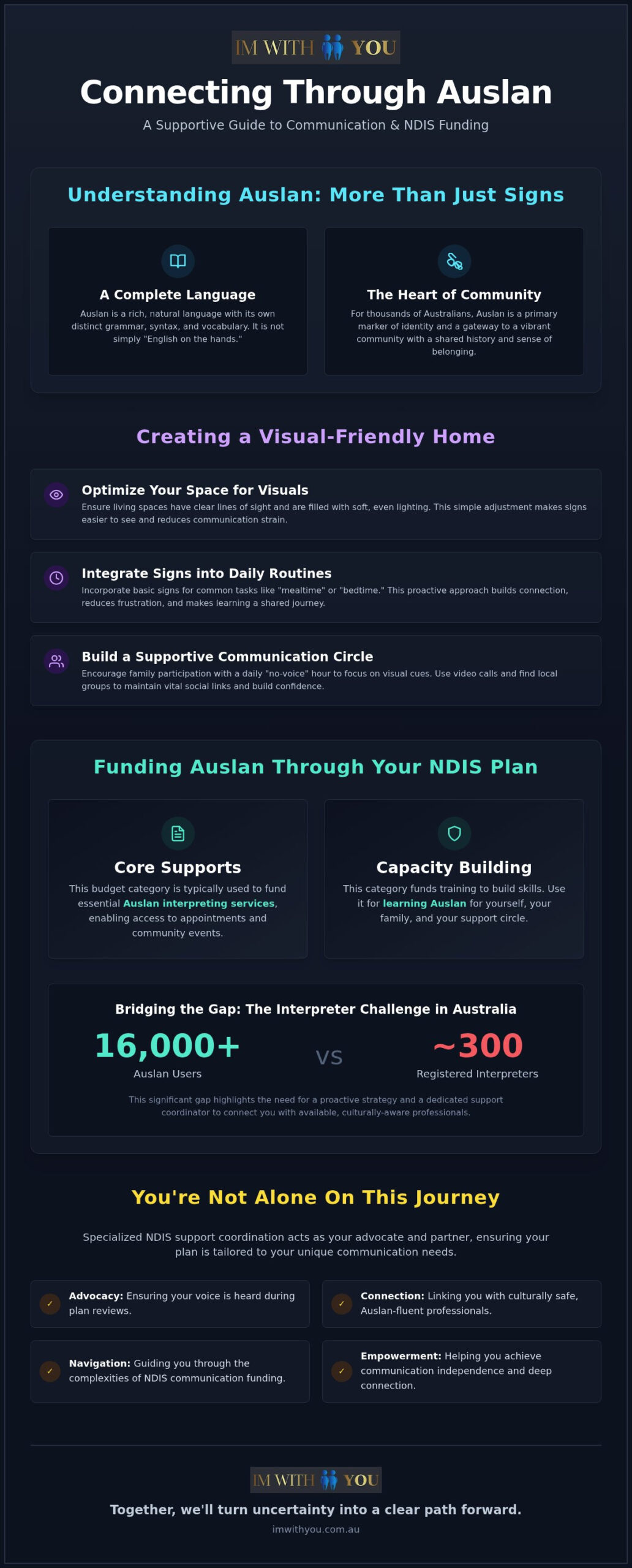
When you first encounter Auslan (Australian Sign Language), you might view it as a way to translate English words into hand signals. It’s actually much more beautiful and complex. Auslan is a rich, natural language with its own distinct grammar, syntax, and vocabulary. For anyone beginning their journey with auslan australia, the first step toward building a genuine bridge of connection is recognizing this linguistic independence. It doesn’t follow the word order or rules of English. Instead, it uses a sophisticated visual structure where handshapes, body movements, and subtle facial expressions carry the weight of every sentence. Understanding that it isn’t “English on the hands” allows us to communicate with the respect and depth that every individual deserves.
The Heart of Deaf Culture and Identity
For thousands of Australians in 2026, Auslan serves as the primary marker of their identity and a gateway to a vibrant community. It’s a vehicle for a shared history, storytelling, and a profound sense of belonging that spans generations. We’re here to walk this path with you, ensuring the focus remains on the person, not just the diagnosis. By embracing person-first language, we honor each individual’s unique strengths and their place within this rich cultural landscape.
This shift in perspective turns a communication barrier into an opportunity for growth and inclusion. It’s about seeing the person behind the signs and valuing the rich perspective they bring to our national community. When we approach auslan australia as a cultural gift rather than a clinical need, we create space for genuine partnership. You aren’t just learning to communicate; you’re learning to connect in a way that respects the dignity and agency of your loved ones.
Practical Strategies for Managing Communication with Auslan
Integrating Auslan (Australian sign language) into your daily life doesn’t have to be a daunting task. It’s about making small, intentional changes that create a profound sense of safety and inclusion. I suggest starting by looking at your home through a visual lens. Ensure your living spaces have clear lines of sight and plenty of soft, even lighting so that every sign is easy to see. These physical adjustments lay the vital foundation for successful communication in auslan australia.
You can also manage daily routines by incorporating basic signs for common tasks like mealtime or getting ready for bed. This proactive approach reduces frustration and builds an immediate, heart-to-heart connection. When your whole support circle learns together, it prevents the social isolation that often worries families. It turns learning into a shared journey of discovery rather than a clinical requirement.
Building a Supportive Communication Circle
I’ve seen how powerful it is when families implement a “no-voice” hour each day. This practice encourages everyone to focus on visual attention and non-verbal cues in a safe, non-judgmental space. You can also use video calling platforms to maintain vital social links with the wider community. Encouraging community participation by finding local groups where signing is the primary mode of interaction helps build confidence and identity in the context of auslan australia. If you’re feeling unsure about how to start these routines, our team is here to help you explore capacity building skills so you never have to navigate these changes alone.
Accessing Auslan Support Through Your NDIS Plan
Securing the right funding for auslan australia can feel like a complex puzzle. I’m here to help you piece it together. Typically, you’ll find funding for interpreting services within your ‘Core Supports’ budget. If you’re looking to learn the language yourself or want training for your family, these costs usually sit under ‘Capacity Building.’ Understanding these categories ensures you’re looking in the right place for the support that matters most.
Advocacy plays a vital role in this process. It’s important that your NDIS plan reflects the true cost of communication access, including the varied rates for after-hours or weekend interpreting. We focus on ensuring your plan isn’t just a document, but a practical tool that allows you to engage with the world on your terms. I’ll stand with you to ensure every line of your plan honors your right to be heard and understood.
Having a plan is the first step, but finding the right Auslan-fluent supports is where the real connection happens. With only about 300 Auslan interpreters working across the country for over 16,000 users, finding availability requires a proactive strategy. A dedicated coordinator bridges this gap, connecting you with professionals who respect the linguistic and cultural depth of the Deaf community. This ensures your support circle isn’t just technically capable, but culturally safe and welcoming.
How We Walk Alongside You in Your Journey
Our team provides specialized NDIS support coordination to help you navigate the complexities of communication funding. We act as your advocate, ensuring your voice is heard during plan reviews so you can access the Auslan resources you deserve. This might include using tools like the Auslan Signbank dictionary to support your learning journey at home. Im with you as a steady partner in your journey toward communication independence and a life of deep connection.
Your Path to Communication Independence
Embracing a new way of communicating is a profound act of love and commitment. We’ve moved from understanding the unique grammar of auslan australia to creating a home environment that celebrates visual connection. You now have the strategies to manage NDIS budgets and the confidence to advocate for the resources your family deserves. Im with you to ensure these plans translate into real-world independence and joy. As the recipient of the 2026 Award for Excellence in care, our specialist NDIS support coordinators and advocates are ready to walk this path beside you. We believe that every individual has the right to be understood and to belong. We’re here to help you navigate your Auslan journey; let’s talk about your NDIS plan today. You are never alone in this transition toward a more connected life.
Frequently Asked Questions
Is Auslan the same as sign language used in other countries?
No, Auslan is a unique language that evolved specifically within the Australian Deaf community. While it shares historical roots with British Sign Language, it’s completely different from American Sign Language. Recognizing that Auslan Australia has its own distinct grammar and cultural nuances is vital. It’s a beautiful, independent language that reflects the rich history and identity of the people who use it.
Can I get NDIS funding to learn Auslan as a family member?
Yes, you can often access funding for family training if it directly supports the participant’s communication goals. This is typically managed through the Capacity Building budget. I’ll walk alongside you to ensure your NDIS plan reflects this need during your next review. Our advocacy services focus on making sure your whole support circle has the tools needed to foster deep, lasting connections at home.
What is the difference between an Auslan interpreter and a support worker?
An interpreter is a qualified professional who facilitates communication between Auslan and English; a support worker provides practical assistance with daily tasks or community participation. Both roles are vital but serve different purposes. Interpreters focus on linguistic access. Support workers focus on companionship and social support. We can help you coordinate both types of specialists to ensure your loved one feels fully supported and understood.
How do I find a qualified Auslan interpreter in Australia?
You should look for interpreters who are NAATI-certified to ensure they meet professional standards for Auslan Australia. Many families find it helpful to work through established agencies or use our specialized NDIS support coordination to manage these bookings. I’m here to help you navigate these options so you can find a qualified professional who feels like a good fit for your family’s unique needs.