

What if the biggest barrier to getting the support you deserve isn’t your disability at all, but simply not knowing you have the right to ask for more? If you’ve ever sat in an NDIS planning meeting feeling overwhelmed, unheard, or unsure whether your plan truly reflects your needs, you’re not alone in that feeling. It’s one of the most common experiences shared by participants across the country.
The truth is, the NDIS system is genuinely complex, and feeling like just a number in it is completely understandable. That anxiety before a planning meeting, that quiet uncertainty about whether you’re asking for the right things, those feelings are real and valid. NDIS advocacy services exist precisely because navigating this system shouldn’t be something you have to figure out on your own.
This guide is here to walk alongside you through exactly that. You’ll discover how disability advocacy works in practice, what a skilled advocate can do to help you secure funding that genuinely fits your life, and how to step into your own NDIS journey with confidence. I’m with you on this. Let’s explore what’s possible together.
Key Takeaways
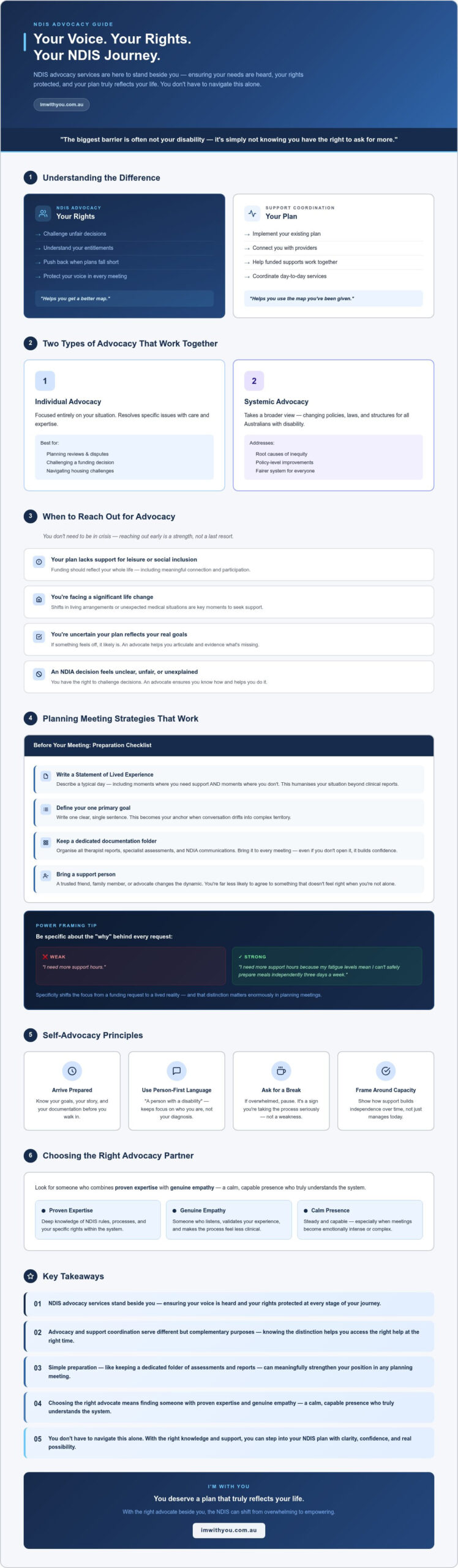
- NDIS advocacy services are designed to stand beside you, ensuring your voice is heard and your rights are protected throughout every stage of your NDIS journey.
- Advocacy and support coordination serve different but complementary purposes — understanding the distinction helps you access exactly the right kind of help at the right time.
- Simple preparation strategies, like keeping a dedicated folder of assessments and therapist reports, can meaningfully strengthen your position in any planning meeting.
- Choosing the right advocacy partner means looking for someone who combines proven expertise with genuine empathy — a calm, capable presence who truly understands the system.
- You don’t have to navigate this alone. With the right knowledge and support, you can step into your NDIS plan with clarity, confidence, and a real sense of possibility.
Understanding NDIS Advocacy Services: Your Voice, Your Rights
At its heart, disability advocacy is about one simple principle: you deserve to be heard. An advocate stands beside you, not in front of you, ensuring your voice carries weight in every conversation with the NDIA, every planning meeting, and every decision that shapes your daily life. It’s not about someone else speaking for you. It’s about making sure you’re never left speaking alone.
One of the most common points of confusion in the NDIS world is the difference between advocacy and support coordination. They’re both valuable, but they serve genuinely different purposes. Support coordination focuses on implementing your existing plan, connecting you with providers, and helping your funded supports work smoothly together. NDIS advocacy services, by contrast, focus on your rights. An advocate helps you challenge decisions, understand your entitlements, and push back when your plan doesn’t reflect what you actually need to live a full and connected life.
Think of it this way: a support coordinator helps you use the map you’ve been given. An advocate helps you get a better map.
Types of Advocacy: Individual vs. Systemic
Individual advocacy is focused entirely on your situation. Whether you’re preparing for a planning review, disputing a funding decision, or navigating a housing challenge, an individual advocate works alongside you to resolve that specific issue with care and expertise.
Systemic advocacy takes a broader view. It works to change the policies, laws, and structures that affect all Australians with disability, addressing the root causes rather than just the symptoms. Both forms matter, and both contribute to a fairer system for everyone.
When to Reach Out for Support
You don’t need to be in crisis to benefit from advocacy. Consider reaching out if:
- Your current plan doesn’t include enough support for leisure activities or meaningful social inclusion
- You’re facing a significant life change, such as a shift in living arrangements or an unexpected medical situation
- You feel uncertain about whether your plan genuinely reflects your goals and daily needs
- A decision from the NDIA feels unclear, unfair, or unexplained
I’m with you in saying this clearly: reaching out early is a strength, not a last resort. The right advocacy support can shift your entire NDIS experience from overwhelming to empowering.
Practical Strategies for Effective Self-Advocacy
Knowing your rights is powerful. Knowing how to communicate them clearly is transformative. Self-advocacy isn’t about being confrontational or having all the answers before you walk into a room. It’s about arriving prepared, feeling grounded in your own story, and trusting that your experience is valid evidence in itself.
Start by identifying the ‘why’ behind each request you plan to make. Not just “I need more support hours,” but “I need more support hours because my fatigue levels mean I can’t safely prepare meals independently three days a week.” That specificity changes the conversation. It shifts the focus from a funding request to a lived reality, and that distinction matters enormously in planning meetings.
Using person-first language is another quiet but meaningful tool. Framing yourself as a person with a disability rather than a disabled person keeps the conversation centred on who you are, not what your diagnosis says about you. It sets a respectful tone from the outset and gently signals to planners that you expect to be treated as a whole individual.
Don’t underestimate the power of having a support person beside you. A trusted friend, family member, or advocate in the room changes the dynamic in ways that are hard to quantify but easy to feel. The meeting becomes less clinical, less isolating, and you’re far less likely to agree to something that doesn’t feel right simply because you’re overwhelmed in the moment. I’m with you in saying this clearly: you never have to walk into that room alone.
Managing Your NDIS Planning Meetings
Preparation is your greatest asset. Before your meeting, write a short ‘Statement of Lived Experience’ that describes what a typical day looks like for you, including the moments where you need support and the moments where you don’t. This document humanises your situation in a way that clinical reports alone often can’t. Pair it with one clear, single sentence defining your primary goal for the year. That sentence becomes your anchor when the conversation drifts into complex territory.
- Keep a dedicated folder containing all therapist reports, specialist assessments, and written communications with the NDIA. Organised documentation strengthens your position and saves valuable time.
- Ask for a break if the meeting becomes overwhelming. This is not a sign of weakness. It’s a sign that you’re taking the process seriously enough to engage with it clearly.
- Bring your folder to every meeting, even if you don’t open it. Knowing it’s there builds confidence before you’ve said a single word.
Communicating with Clarity and Dignity
When explaining why you need a particular support, frame it around capacity building wherever possible. Describe how that support will help you do more independently over time, not just manage today. This framing aligns with how the NDIS evaluates reasonable and necessary supports, and it positions you as someone invested in your own growth.
After every planning meeting or significant phone call, send a brief summary email to your planner recapping what was discussed and agreed. It keeps everyone accountable and creates a paper trail that protects you if questions arise later. It’s a small habit with a significant impact.
Effective ndis advocacy services can teach you these strategies in depth, but you can start practising them right now. If you’d like a steady, knowledgeable companion to help you prepare for your next planning meeting, explore how I’m With You supports participants every step of the way.
Choosing the Right Advocacy Partner: How We Walk Beside You
Not all advocacy support feels the same. There’s a meaningful difference between a provider who processes your case and one who genuinely walks beside you through it. In 2026, with the NDIS landscape more complex than ever, choosing a partner with a proven track record of quality care isn’t just sensible; it’s essential to getting outcomes that actually reflect your life.
The right advocate feels less like a case manager and more like a calm, capable friend who happens to know the system inside out. They listen before they advise. They ask what matters to you before they speak on your behalf. And critically, they keep your interests at the centre of every conversation, independent of any other agenda. That independence is non-negotiable. A quality ndis advocacy services provider has no conflict of interest pulling them in another direction. Their only loyalty is to you.
Collaboration is the foundation. A great advocacy partner doesn’t hand you a script or make decisions for you. They help you find your own voice, build your confidence, and step forward with clarity. The goal is always your growing independence, not your ongoing reliance on them.
The ‘I’m With You’ Approach to Advocacy
At I’m With You, we believe every person deserves a life full of genuine joy, connection, and social inclusion. Our advocates bring deep expertise across complex support areas, including the technical landscape of the rights of medication administration and other nuanced NDIS requirements. That expertise means you’re never navigating the hard questions alone. We’re an award-winning provider recognised for excellence in 2026, and that recognition reflects a genuine commitment to quality, not just compliance.
Next Steps: Starting Your Collaborative Journey
Beginning is simpler than it might feel right now. Here’s how we move forward together:
- Step 1: Identify your focus area. Pinpoint whether you need support with a plan review, a service dispute, or something else entirely. Clarity here shapes everything that follows.
- Step 2: Start a conversation. Reach out for a gentle, non-judgmental discussion about your options. There’s no pressure, no agenda, just an honest exploration of what’s possible for you.
- Step 3: Build your strategy together. We’ll develop a management approach that puts you in the lead, with us steadily beside you every step of the way.
Effective ndis advocacy services should leave you feeling stronger, not more dependent. I’m with you in believing that the right support changes everything. When you’re ready to take that first step, I’m With You is here to walk alongside you.
Your Next Step Toward an NDIS Plan That Truly Fits Your Life
Navigating the NDIS doesn’t have to feel like something you face alone. Throughout this guide, you’ve seen how ndis advocacy services can protect your rights, how purposeful preparation transforms planning meetings, and how the right advocacy partner keeps your voice at the centre of every decision.
What ties all of that together is one simple truth: you deserve support that genuinely reflects who you are and what you need to live fully. I’m With You is an award-winning disability support provider recognised for excellence in 2026, and every service we offer is built around dignity, independence, and a person-centred approach that never loses sight of you as an individual.
You don’t need to have everything figured out before you reach out. You just need to take one small step forward, and I’m with you for every step that follows.
Let’s walk this path together, contact I’m With You for supportive NDIS advocacy services today. A clearer, more confident NDIS journey is closer than you think.
Frequently Asked Questions About NDIS Advocacy Services
What exactly does an NDIS advocate do in a planning meeting?
An advocate sits beside you during your planning meeting to ensure your voice is heard, your rights are respected, and the conversation stays focused on your actual needs. They can help you articulate complex support requirements clearly, flag when a planner’s questions feel off-track, and gently challenge assumptions that don’t reflect your lived experience. They’re not there to take over the conversation; they’re there to make sure you never feel alone in it.
In practical terms, an advocate might prompt you to share specific examples when your answers feel too general, remind you of a support need you’d planned to raise, or ask the planner to clarify a decision that feels unclear. Think of them as a steady, knowledgeable presence who helps the real you come through in a setting that can otherwise feel clinical and pressured.
Is NDIS advocacy a free service for participants?
Many disability advocacy organisations across Australia receive government funding through the National Disability Advocacy Program, which means their services are often available to participants at no direct cost. However, availability varies depending on your location, the type of advocacy you need, and current demand on those organisations. It’s always worth contacting an advocacy provider directly to ask about their funding model and whether any costs apply to your situation.
Some participants also access ndis advocacy services through their NDIS plan under capacity building supports, depending on how their plan is structured. If you’re unsure what applies to you, reaching out to a trusted provider for an honest conversation about your options is a sensible first step. There’s no pressure in asking the question.
Can I have an advocate even if I already have a Support Coordinator?
Absolutely, and in many situations, having both is genuinely beneficial. A support coordinator focuses on implementing your existing plan and connecting you with the right providers. An advocate focuses on your rights, particularly when you’re challenging a decision, preparing for a plan review, or navigating a dispute. These roles complement each other rather than overlap, and having both means you’re supported across every dimension of your NDIS journey.
If your support coordinator is helping you make the most of your current plan but you feel your upcoming review needs a stronger voice behind it, that’s exactly when ndis advocacy services add real value. You don’t have to choose between them. Both can be part of the same collaborative team working in your corner.
What happens if I am unhappy with the advocacy support I receive?
You have every right to raise concerns, and doing so is a sign of healthy self-advocacy in itself. Start by speaking directly with your advocate or their organisation’s management, as many issues can be resolved through an honest conversation. If that doesn’t resolve the situation, you can lodge a complaint with the Australian Human Rights Commission or the relevant state-based complaints body, depending on the type of service involved.
Choosing an advocacy partner carefully from the outset reduces the likelihood of this situation arising. Look for providers with a transparent complaints process, a genuine person-centred approach, and a clear track record of quality care. I’m with you in saying this plainly: you deserve support that feels right, and if it doesn’t, you’re entitled to seek something better without guilt or hesitation.