

What if the most powerful tool in your support toolkit wasn’t a piece of equipment or a complex plan, but the very way you structure a sentence? Using person first language isn’t about following a rigid list of rules or worrying about “saying the wrong thing” in a clinical way. It’s a choice to see the individual before any diagnosis or disability. Words are the foundation of how we respect the people we walk alongside every day.
I know it can feel overwhelming when terminology seems to change so quickly. You want to be respectful, but the fear of accidentally causing offense or getting lost in complex jargon is real. Im with you, and I understand that your goal is simply to build a genuine, lasting connection. This guide will show you how shifting your words can foster dignity and empower the people you support to lead their own lives. We’ll explore the heart behind these choices, the difference between person-first and identity-first preferences, and practical ways to stay confident in every conversation.
Key Takeaways
- Understand why leading with an individual’s humanity creates a safer, more inclusive environment for everyone involved in support services.
- Learn how to naturally integrate person first language into your daily routines to emphasize strengths and foster a deep sense of belonging.
- Discover simple management strategies to audit your communication and move away from clinical terminology toward life-focused support.
- Gain the confidence to navigate different language preferences by learning how to ask the right questions with care and sincerity.
- Explore how your choice of words can directly empower the agency and independence of the people you walk alongside every day.
What is Person-First Language and Why Does it Matter?
Person first language is a communication style that prioritizes the person’s humanity and individuality over any diagnosis or disability they may live with. Choosing these words is a conscious act of solidarity and respect that honors the person’s right to be seen as a whole human being first. It moves us away from seeing someone through the lens of their limitations and instead focuses on their unique character and potential. For organizations operating in the early childhood education sector, Canavan Byrne offers specialist support and software to ensure these person-centered values are integrated into every aspect of the business.
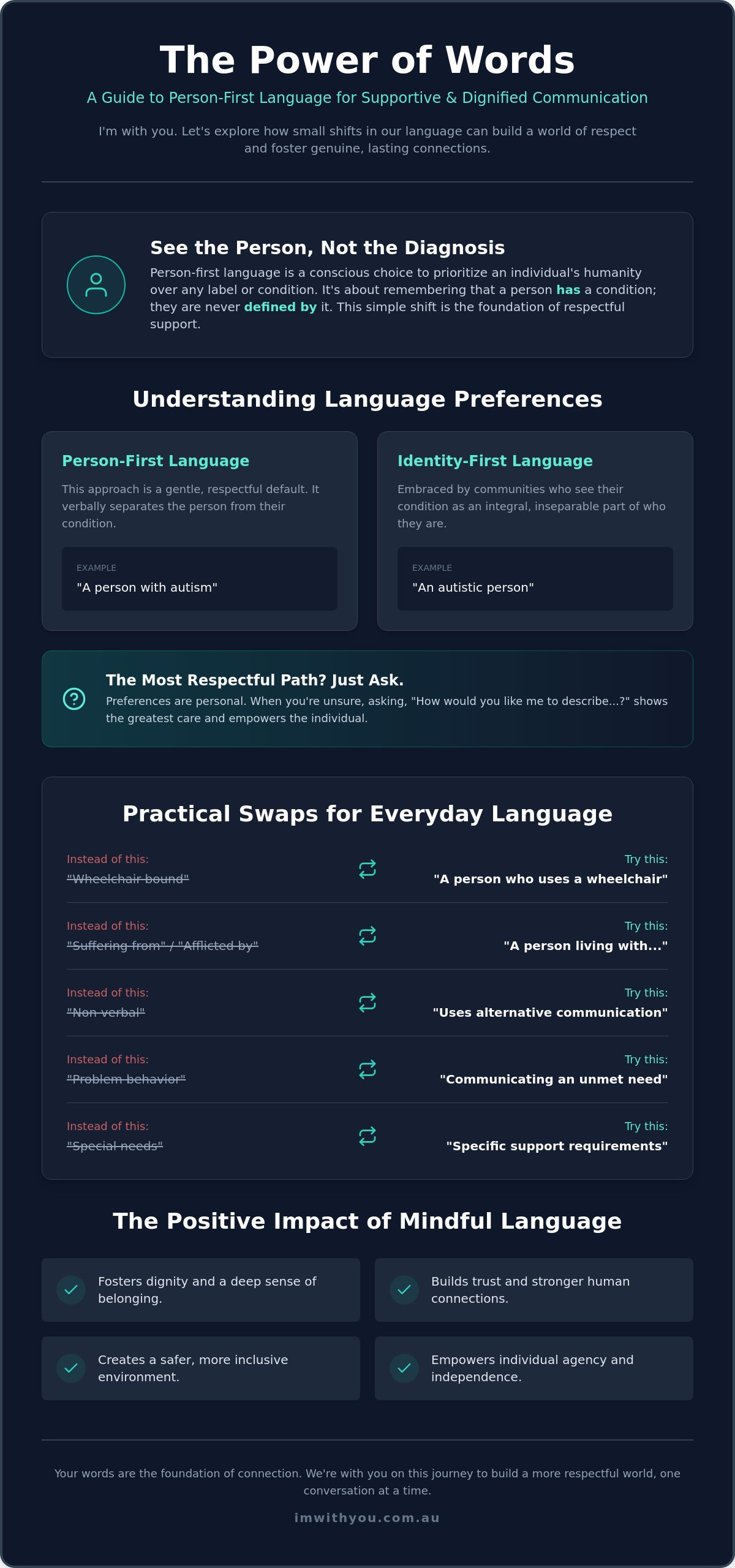
This philosophy rests on the belief that a person ‘has’ a condition, but they are never ‘the’ condition itself. For example, we might say ‘a person with autism’ instead of ‘an autistic person’ to ensure the diagnosis doesn’t define their entire existence. Using person first language is vital when you’re finding your perfect match with a provider, as it reflects a deep commitment to individual agency and dignity. Many advocacy groups encourage People-first language because it aligns so closely with the NDIS goal of putting the participant in the driver’s seat of their own life.
To better understand this concept, watch this helpful video:
The Shift from Clinical Labels to Human Connection
Language has a way of either building walls or opening doors. When we move away from clinical labels like ‘the handicapped’, we strip away the cold detachment that can make people feel like a number in a system. Im with you in wanting to create an environment where everyone feels they truly belong. Using human-centered words restores a sense of partnership and ensures that our support feels like a conversation between friends rather than an administrative task.
Person-First vs. Identity-First Language
While person-first language is our standard for respectful support, it’s helpful to know that some communities prefer ‘identity-first’ language. For instance, a 2023 study showed that 87% of autistic adults actually prefer being called an ‘autistic person’ because they see it as a core part of their identity. Choosing person-first terms works as a gentle default, but the individual’s personal preference is always our north star. The most respectful path is simply to ask how they wish to be described.
Practical Management Strategies for Respectful Communication
Auditing the way we speak can feel daunting, but Im with you in this process. It isn’t about perfection or judgment. It’s about refining our approach to ensure every interaction builds dignity and trust. High-quality disability support services rely on this verbal foundation. When we focus on strength-based language, we highlight what a person can do rather than focusing on their deficits. This shift empowers the individual and changes the energy of the entire support relationship.
A simple way to start is by looking at the common phrases we use out of habit. Using person first language helps us stay mindful of the individual’s agency in every moment. You might find Vanderbilt’s guide to language preferences helpful as a supportive framework to begin noticing these patterns in your own daily conversations. Here are a few quick shifts to consider:
- Instead of “Non-verbal,” try “Uses alternative communication.”
- Instead of “Problem behavior,” try “Communication of an unmet need.”
- Instead of “Special needs,” try “Support requirements.”
Everyday Phrases: A Guide to Positive Shifts
Communicating with Empathy in the NDIS World
This shift is particularly powerful when managing supported independent living (SIL) arrangements. During plan reviews or support coordination meetings, using respectful language keeps the focus firmly on the participant’s personal goals. It reminds everyone in the room that we are supporting a unique life rather than just managing a file. If you ever feel overwhelmed by these systems, our team is ready to walk alongside you as a steady companion.
Navigating Preference: What to Do When You’re Not Sure
I know the biggest worry for many families and carers is accidentally causing offense by using the wrong term. That anxiety can sometimes make us feel hesitant to speak up at all. I’m with you in this journey, and I want to reassure you that your desire to be respectful is what matters most. While person first language provides a wonderful foundation for dignity, it isn’t a rigid law that replaces an individual’s own voice. Language is a living, breathing part of our connection, and it’s okay to treat it as a shared discovery rather than a test you have to pass.
Think of language as a bridge you’re building together. Sometimes, you might place a stone that doesn’t quite fit, and that’s perfectly fine. Making a mistake isn’t a failure; it’s a valuable opportunity for a gentle correction and a deeper understanding of the person you support. As your partner in advocacy, we walk alongside you to help navigate these nuances, ensuring the focus remains on the individual’s agency and comfort.
Asking with Grace and Sincerity
The most powerful form of respect is simply asking the person how they wish to be described. You don’t need a complex script to do this well. A simple, honest approach works best. You might say: “I want to make sure I’m being as respectful as possible. Do you prefer me to say ‘person with a disability’ or ‘disabled person’?” Admitting that you’re learning shows that you care deeply about getting it right. It transforms a potentially awkward moment into a beautiful act of partnership.
Advocating for the Person’s Choice
Once you know someone’s “north star” preference, you can become their verbal guardian in the wider world. If a doctor, a stranger, or another provider uses a term that doesn’t align with that preference, you can gently step in. A kind correction like, “Actually, Sarah prefers to be called an autistic person,” ensures her identity is honored by everyone in the room. This clarity helps create a safe space in all areas of life, from formal plan reviews to finding joy and connection through leisure activities. When we get the language right, we open the door to a more inclusive, supportive world.
Embracing a Future of Respectful Connection
Choosing our words with care is more than just a communication style; it’s a way to ensure the people we support feel seen, valued, and heard. By embracing person first language, you’ve taken a significant step toward fostering dignity in every interaction. We’ve explored how small shifts in our everyday phrases can transform clinical labels into human connections. We’ve also seen how simply asking for a person’s preference remains the highest form of respect and partnership.
These nuances are the heartbeat of high-quality care. At “I’m with you,” our award-winning excellence in NDIS support throughout 2026 is built on this foundation of compassionate, person-centered advocacy. Whether you need dedicated Support Coordination for your family or a steady companion to help navigate complex systems, we’re here to walk alongside you. I’m with you: let’s walk this path of respectful care together. Explore our advocacy and support services.
You don’t have to navigate these changes alone. Every conversation is a new chance to strengthen your partnership with the person you support. Keep leading with your heart, and the right words will follow.
Frequently Asked Questions
Is person-first language always the ‘correct’ way to speak?
The “correct” way to speak is always the way the individual prefers to be described. While person first language is a respectful standard for many, individual agency is our ultimate guide. I’m with you in prioritizing the person’s voice over any specific grammar rule. If someone tells you they prefer a different term, honoring that choice is the most respectful action you can take.
What is the difference between person-first and identity-first language?
Person-first language puts the individual before the condition, like saying “a person with a disability,” whereas identity-first language leads with the disability, such as “a disabled person.” Many feel that person-first language highlights their humanity first. However, some communities use identity-first terms to express pride in their disability as an inseparable part of who they are. It’s about how the person sees themselves.
Why is ‘handicapped’ or ‘disabled’ considered outdated in person-first language?
Terms like “handicapped” are considered outdated because they often carry historical baggage of pity or limitation rather than focusing on a person’s strengths. In a person-first framework, we avoid using “disabled” as a collective noun because it can reduce a whole human being to a single characteristic. Shifting our vocabulary helps us move away from clinical management and toward life-focused support that honors every individual’s unique journey.
How can I gently correct a family member who uses outdated terminology?
The best approach is to model the language you want them to use and explain the “why” behind it with kindness. You might say, “I’ve started saying ‘person with a disability’ because it reminds me to see the person first.” I’m with you in knowing these conversations can feel sensitive. Keeping the focus on the dignity of your loved one helps lower defenses and invites others into a more respectful way of speaking.
Does the NDIS require the use of person-first language in plan documents?
While the NDIS doesn’t have a rigid legal requirement for specific phrasing, it strongly promotes a person-centered approach that aligns with person first language. Using these terms in plan documents and reviews helps ensure that support coordination focuses on the participant’s agency and goals. It sets a positive tone for all providers involved, ensuring they see the individual’s possibilities rather than just their support needs.
What should I do if someone gets offended by the term I used?
If you realize you’ve used a term that caused offense, the most supportive response is to offer a sincere, brief apology and ask for their preference. You might say, “I’m sorry, I’m still learning the best way to be respectful. How would you prefer I describe this?” This shows that you value their feelings more than being “right,” which builds immediate trust and strengthens your partnership with them.