

What if the simple act of taking a daily tablet wasn’t just a clinical task, but a moment of shared trust that actually builds your confidence? For many Australians, managing health needs feels like a constant balancing act between safety and autonomy. It’s easy to feel overwhelmed by the complexities of NDIS regulations or anxious about the risk of a mistake. If you’ve ever worried that receiving help might mean losing your voice, please know that Im with you. Understanding disability support worker duties and responsibilities is the first step toward feeling secure and empowered in your own home.
You deserve care that respects your choices while adhering to the highest safety standards, including the 2026 NDIS Practice Standards. This guide explores how disability support workers safely and compassionately assist with medication while protecting your dignity and independence. We’ll look at the clear boundaries of clinical support and how transparent communication keeps you and your family feeling certain. You’ll discover how professional assistance isn’t about taking over; it’s about walking alongside you to ensure you live your life with total peace of mind.
Key Takeaways
- Understand the clear boundaries of disability support worker duties and responsibilities, ensuring you receive safe, non-clinical help that follows your doctor’s precise instructions.
- Discover how a collaborative approach to medication can actually increase your independence by providing the steady, reliable support you need to manage your daily routine.
- Learn about the safety frameworks we use to provide immediate reassurance for families, ensuring every dose is handled with care and accuracy.
- Explore how NDIS Support Coordination helps you access the right level of specialized care, so you can feel confident that your plan truly supports your wellbeing.
- Gain practical management strategies to foster a partnership of trust with your support team, remembering that I’m with you every step of the way.
Defining the Role: Disability Support Worker Duties and Responsibilities in Medication Assistance
Medication assistance is a vital part of your daily rhythm, ensuring you take your prescribed treatments safely and on time. It’s much more than just a task; it’s a core component of disability support services designed to keep you feeling your best. When we look at disability support worker duties and responsibilities, we see a role rooted in partnership. I want you to know that I’m with you in every step of this journey, making sure your health is supported with a gentle, human touch rather than a cold, clinical process.
While this support is essential, it’s strictly non-clinical. This means your support worker follows your doctor’s exact instructions rather than making medical decisions on their own. Understanding Caregiver duties and responsibilities helps clarify that the focus is on accompaniment and safety. To better understand how these roles work in a real-world setting, watch this helpful video:
Assistance vs. Administration: Understanding the Boundary
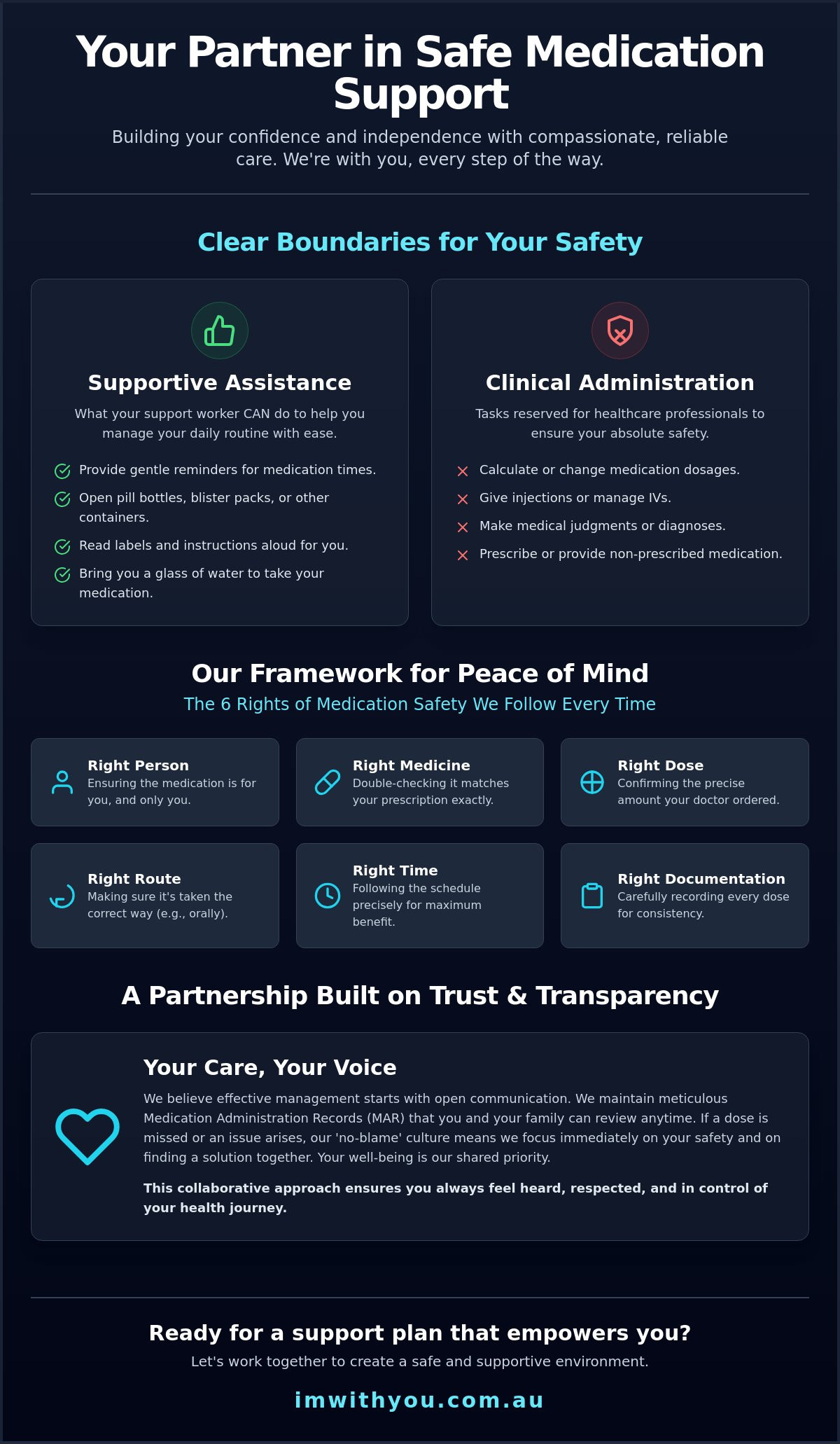
There’s a helpful distinction between assisting and administering. Assistance involves simple, practical tasks like opening a pill bottle or providing a gentle reminder. Administration requires specific NDIS training and must follow a documented Medication Management Plan. Our workers won’t calculate dosages or change your schedule; that remains the expert role of your GP or pharmacist. This clarity ensures everyone stays safe and focused on your wellbeing.
Promoting Dignity Through Person-Centred Care
We believe medication support should always respect your choice and privacy. By using person first language, we keep your identity and preferences at the heart of everything we do. This approach encourages you to do as much as you can for yourself. Our goal is to empower your independence, ensuring that disability support worker duties and responsibilities serve as a bridge to your autonomy, not a barrier to it.
Collaborative Management Strategies for Safe Medication Assistance
Effective medication management is built on a foundation of open communication and a shared commitment to your safety. Within the scope of disability support worker duties and responsibilities, we view every dose as an opportunity to reinforce our partnership. Safety isn’t just a clinical checklist for us; it’s a way of showing that we care deeply about your comfort and health. By working closely with your doctors and pharmacists, we ensure your support evolves alongside your needs. Research into Collaborative medication management shows that this team-based approach significantly reduces risks and improves outcomes.
The Six Rights: Our Framework for Safety
To keep every interaction safe, our team follows the six rights of medication administration. These include confirming the Right Person, Right Medicine, Right Dose, Right Route, Right Time, and Right Documentation. Our support workers use these rights as a steady mental checklist every single time. This rhythm provides a reliable structure that helps prevent errors while keeping the focus on your individual needs. It’s a simple yet powerful way to provide peace of mind for you and your family.
Documentation and Incident Management
We use Medication Administration Records (MAR) to track consistency and notice any subtle changes or side effects. I’m with you in creating a space where transparency is the priority. We maintain a no-blame reporting culture. This means if a dose is ever missed, the focus is on immediate safety and solution-finding rather than punishment. You always have the right to view and discuss these records with us at any time. If you’re feeling unsure about how your current support is managed, exploring our Disability Support Services can help you find a strategy that feels truly supportive and safe.
Why High-Quality Support Coordination and Specialized Expertise Make a Difference
Navigating the complexities of medication needs within an NDIS plan can often feel like a heavy burden. It’s perfectly natural to feel overwhelmed by the administrative requirements and the high stakes involved. I want you to know that you don’t have to carry this weight alone. A skilled coordinator acts as your advocate, ensuring your funding specifically covers the level of care you need for safe medication management. When you’re looking for an ndis provider, prioritize those who lead with empathy. Our primary goal is to handle the technical hurdles so you can focus on the moments that bring you joy.
Integrating Medication into Daily Life
Within supported independent living ndis environments, medication assistance isn’t a separate, clinical event that interrupts your day. Instead, it fits naturally into your daily routine, much like having a morning coffee or preparing a meal. A key part of disability support worker duties and responsibilities is the quiet, attentive observation of your health. Because they spend significant time with you, support workers are often the first to notice subtle changes in your wellbeing. They act as a vital link, reporting these observations back to your family and medical team to ensure your care remains proactive and responsive.
Building Trust Through Specialized Expertise
Trust is earned through consistent, specialized care and a genuine commitment to your safety. At Im with you, our dedication to this partnership was recognized when we received an award for excellence in 2026. This honor reflects our deep commitment to superior care standards and person-centred support. As you explore your options, don’t hesitate to ask potential providers about their specific medication training. You should feel empowered to ask about their emergency protocols and how they handle unexpected changes. Knowing that your team is prepared for any situation allows you to relax. It reinforces the promise that I’m with you, providing a steady hand and a knowledgeable heart as we navigate your health journey together.
Empowering Your Journey with Safe and Compassionate Care
Choosing to receive help with medication is a courageous step toward maintaining your health and your freedom. We’ve seen how the Six Rights framework and clear communication build a safety net that protects you every day. When you understand disability support worker duties and responsibilities, you see that this role is about more than just a schedule; it’s about a partnership that respects your voice. Our team brings a person-centred and empathetic approach to every interaction, ensuring your daily routine feels steady and supportive. I want you to feel the confidence that comes from having a knowledgeable guide by your side.
With our specialized NDIS Support Coordination and our 2026 Award for Excellence in Care, we’re dedicated to managing the complexities so you don’t have to. You deserve a life focused on your strengths and possibilities rather than clinical requirements. Let’s walk this journey together. Contact Im with you for compassionate NDIS support today. You aren’t alone in this; I’m with you to ensure you feel heard, safe, and truly empowered every single day. Your well-being is our shared priority, and we’re ready to support you with the warmth and expertise you deserve.
Frequently Asked Questions
Can a support worker give me an injection or crushed medication?
Generally, a support worker cannot give you an injection or crush your medication because these are considered clinical tasks. Injections usually require a registered nurse, and crushing tablets can change how the medicine works, so it needs specific approval from your doctor or pharmacist. I’m with you in ensuring your safety comes first, so we always stick to the clear boundaries of non-clinical care to protect your health.
What should I do if my support worker makes a medication error?
If a medication error occurs, your first step is to seek medical advice immediately from your GP or the Poisons Information Centre on 13 11 26. After ensuring your immediate safety, please notify your support provider so they can document the incident and follow their no-blame reporting protocol. This transparency is a key part of disability support worker duties and responsibilities, helping us learn and improve your care together.
Do support workers need special training to help with medication under the NDIS?
Yes, support workers must complete specific training, such as the HLTHPS006 ‘Assist clients with medication’ unit, to help you safely and legally. This ensures they understand the safety frameworks and the 2026 NDIS Practice Standards required by the NDIS Commission. By staying up to date with these certifications, our team provides the specialized expertise you need to feel secure and well-cared for in your daily routine.
Can a support worker help me buy my medication from the pharmacy?
A support worker can certainly help you collect your prescriptions from the pharmacy as part of your community participation or daily living support. They can drive you to the chemist or pick up the medication on your behalf if that’s what you prefer. This practical help is one of the many disability support worker duties and responsibilities that help you maintain your independence and keep your health management completely stress-free.