

On 14 October, a support worker in Brisbane hesitated to report a minor disagreement, fearing that the paperwork might damage the deep bond they had spent months building. It’s a valid concern; many people worry that a formal incident management procedure is a cold, clinical tool designed to find fault rather than offer help. We believe that reporting should never feel like an interrogation, but rather a way to wrap a blanket of safety around the people we support.
You already know that the heart of your work is about human connection, and it’s natural to feel anxious when technical NDIS Commission jargon starts to crowd out that personal touch. We promise to help you see these steps as a path toward empowerment and continuous improvement. By the end of this guide, you’ll have a clear understanding of the 4-step management process and the confidence to identify reportable incidents with ease. We’re here to walk with you, ensuring you feel supported and capable during every challenge while keeping dignity and choice and control at the centre of every decision.
Key Takeaways
- Understand how a compassionate incident management procedure balances NDIS regulatory requirements with a deep, personal commitment to your safety and dignity.
- Discover the four essential pillars of response that prioritise your immediate health and emotional reassurance above all else during challenging moments.
- Learn to distinguish between reportable and non-reportable events, including why ‘near misses’ are vital data points for your proactive protection.
- Explore the vital role of post-incident debriefing in supporting your psychological wellbeing and ensuring you always feel heard, safe, and respected.
- Gain insight into our award-winning systems that treat every incident as a meaningful opportunity for growth and continuous improvement in your NDIS journey.
What is an Incident Management Procedure in the NDIS Context?
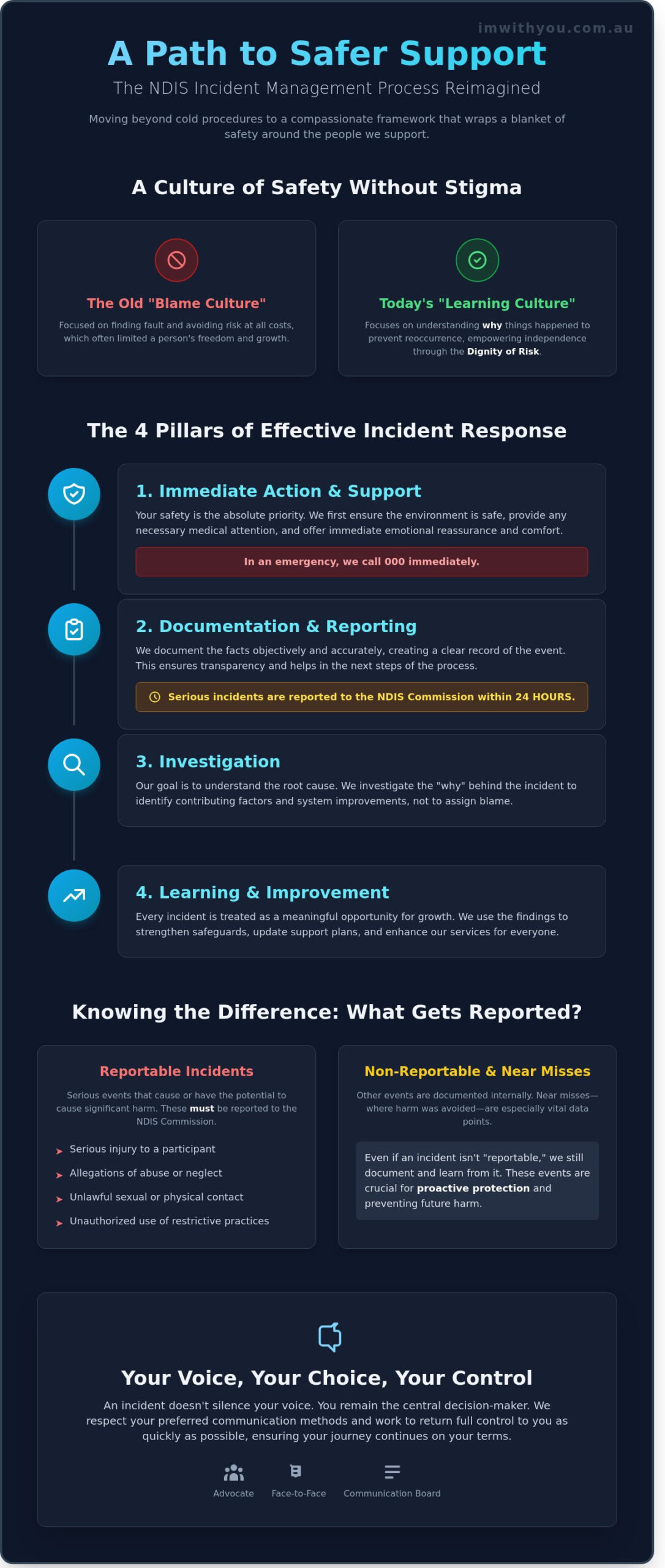
At Im with you, we believe safety is about much more than just paperwork. An incident management procedure is a structured framework we use to identify, respond to, and learn from events that cause harm or create a risk of harm to the people we support. It’s a roadmap that ensures we act quickly when things go wrong, but it also serves as a compass to guide us toward better care in the future. By following a clear Incident Management process, we ensure that every event is documented with care and every lesson is used to strengthen your support journey.
This process serves a dual purpose that balances regulatory needs with human connection. We strictly adhere to the requirements set by the NDIS Quality and Safeguards Commission, which oversees the safety of over 610,000 participants across Australia as of late 2023. While these rules provide a necessary safety net, our primary focus is always your personal wellbeing. We don’t just report an incident to tick a box; we do it to ensure you feel safe, heard, and supported in your own home and community.
Adopting a person-centred approach changes how we view safety. In the past, many services focused on avoiding risk at all costs, which often limited a person’s freedom. Today, we balance our Duty of Care with your right to Dignity of Risk. If you want to learn to cook on a gas stove or travel to a new suburb alone, we support those goals. We recognise that growth involves taking chances. Our procedure isn’t there to stop you from living your life, but to provide a safety framework that catches you if you stumble.
- Identification: Recognising when an event has occurred that impacts a participant’s safety or wellbeing.
- Immediate Action: Ensuring the person is safe and providing any necessary medical or emotional support.
- Reporting: Notifying the NDIS Commission within 24 hours for serious “reportable incidents.”
- Investigation: Looking at the “why” behind the event to prevent it from happening again.
The Core Philosophy: Safety Without Stigma
We’ve moved away from the old blame culture that once dominated disability services. Instead, we embrace a learning culture that focuses on why things happened rather than who is at fault. Transparent reporting builds a bridge of trust between you and our team because it shows we’re committed to honesty. An incident management procedure is a tool for empowerment that transforms a moment of crisis into a pathway for greater independence and safety.
Choice and Control During a Crisis
Your voice doesn’t disappear when a crisis occurs. We ensure you remain the central decision-maker in the aftermath of any event. This means respecting your preferred communication methods, whether that’s through an advocate, a communication board, or a quiet face-to-face chat. We balance your immediate physical safety with your long-term autonomy. Every step we take after an incident is designed to return control to you as quickly as possible, ensuring your journey continues on your own terms.
The 4 Pillars of an Effective Incident Management Process
When something goes wrong, our first instinct is to protect and care. An effective incident management procedure isn’t just about ticking boxes for the NDIS Commission. It’s about creating a safety net that catches you when you fall and helps you stand up stronger. We view this process through four essential pillars that ensure every person involved feels heard, safe, and valued. By focusing on empathy rather than just compliance, we turn a stressful event into a shared journey toward better support.
Step 1 & 2: Immediate Action and Accurate Documentation
Your safety is the absolute priority. If there’s an immediate threat to life or health, we call 000 straight away. Once the environment is safe, we focus on emotional reassurance. This means staying by your side and providing the comfort you need. Following this, we document the facts. We use objective language to describe exactly what happened without making assumptions. For major events like serious injuries or allegations of abuse, the NDIS Commission requires notification within a strict 24-hour window. This timeframe ensures that oversight starts immediately, keeping the focus on your protection.
To ensure your organisation meets these high standards, following best-practice procedures helps maintain consistency and trust. We believe that clear documentation acts as a voice for the participant; it ensures their experience is recorded with dignity and precision. This step is vital for transparency and helps us understand the full context of the event. While most incidents require reporting within 24 hours, some less urgent reportable incidents, like certain uses of restrictive practices, allow for a 5-business-day notification period. We stay on top of these dates so you don’t have to worry about the paperwork while you’re recovering.
Step 3 & 4: Analysis and Meaningful Change
After the initial stress has settled, we look deeper. We conduct a “no-blame” investigation. This isn’t about finding someone to fault; it’s about finding systemic gaps that let the incident happen. We ask “why” until we reach the root cause. For example, if a medication error occurred, we don’t just look at the person holding the tablet. We look at the storage system, the lighting, or the shift handover process. Data from the NDIS Commission’s 2022-23 annual report suggests that proactive root cause analysis can significantly reduce the recurrence of similar events by addressing the environment rather than just the individual.
Meaningful change happens when we turn these findings into action. We update support plans and risk assessments to reflect what we’ve learned. This might mean introducing new equipment or changing how we communicate. Refining your incident management procedure ensures that a difficult moment becomes a catalyst for a safer future. Closing the loop is the final, most important part of our journey together. We sit down with you and your family to explain what we found and how we’re making things safer. This open dialogue reinforces your Choice and Control, ensuring you remain the pilot of your own life. If you’re looking for a partner who prioritises your safety through every step, we are here to walk with you during the challenging times.
Reportable vs. Non-Reportable Incidents: Knowing the Difference
Navigating the NDIS space can feel like learning a whole new language. We understand that your priority is the safety and well-being of the people you support. Knowing exactly what happens when something goes wrong is a big part of that peace of mind. Under the NDIS Act 2013, specifically Section 73Z, we categorise incidents to ensure everyone stays protected. This isn’t about clinical checklists; it’s about making sure your incident management procedure reflects the respect and care you deserve every day.
The ‘Big 6’ Reportable Incidents
The NDIS Quality and Safeguards Commission identifies six specific types of events that we must report to them directly. We call these ‘Reportable Incidents’ because they trigger a formal oversight process to ensure your rights are protected. These include the death of a participant, serious injury, and any form of abuse or neglect. They also cover unlawful sexual contact and the unauthorised use of restrictive practices.
Timing is critical for these disclosures. We must notify the Commission within 24 hours of becoming aware of a death, serious injury, or abuse allegation. For the unauthorised use of a restrictive practice, the window is 5 business days. We take these deadlines seriously because they’re a safeguard for your dignity. We stand side-by-side with you during these times, ensuring your voice is heard throughout the investigation.
The Value of Tracking ‘Minor’ Events
A common myth suggests that only physical injuries or major crises require a formal response. We believe every moment of your journey deserves attention. Even if no one was hurt, a ‘near miss’ is a gift of information. It tells us where a system might be weak before a real injury happens. We don’t wait for a crisis to act; we look for patterns in the small things to keep you safe.
- Trend Spotting: If a participant trips on the same hallway rug three times in a month, that’s 100% a signal to change the environment.
- Capacity Building: Recurring frustration during a specific task might show we need to adjust our support approach or offer more training to staff.
- Internal Reporting: Every voice matters. When staff or participants report small concerns, it strengthens our incident management procedure and prevents future risks.
Managing ‘low-impact’ incidents with high-impact care is how we honour your Choice and Control. A minor disagreement or a small scratch might not need a report to the Commission, but it still requires an empathetic conversation. We document these events internally to ensure we’re always learning. This proactive approach turns data into empowerment, moving us away from simply managing a case toward truly supporting a life.
We treat the reporting process as a sacred promise of transparency. Whether it’s a major event or a small hiccup in your day, we’re with you. Our team focuses on your psychosocial recovery and long-term stability, ensuring that every incident leads to a meaningful improvement in your care. By being thorough with the small details, we create a foundation of trust that allows you to focus on your goals and independence.
Post-Incident Care: Supporting the Person Behind the Procedure
When an unexpected event occurs, the paperwork represents only one small part of the story. The emotional ripple effect often lasts much longer than the time it takes to fill out a formal report. We understand that a truly effective incident management procedure prioritizes the human heart just as much as the regulatory requirements. According to the NDIS Quality and Safeguards Commission 2022-23 Annual Report, there were over 1.5 million reportable incidents recorded across Australia. Each of those statistics represents a person whose sense of security was temporarily shaken. Recovery starts with acknowledging this impact immediately and with deep, genuine compassion.
Restoring a sense of safety involves more than just fixing a physical hazard or updating a risk register. It requires emotional rebuilding through consistent, predictable care and a commitment to walking alongside those affected. We focus on stabilizing the environment first, ensuring that you feel heard and protected before we dive into the technicalities of the event. This human-centered approach transforms a clinical process into a healing one.
The Debriefing Process for Participants
We create a quiet, familiar space where you can share what happened in your own words, without feeling rushed or judged. Our team uses trauma-informed communication techniques to ensure we don’t cause further distress while we gather information. We listen more than we talk, focusing on your feelings of safety and your “Choice and Control” over what happens next. This helps us understand not just what occurred, but how it impacted your confidence. It’s vital to remember that recovery is a journey, not a single conversation. We’ll check in with you 24 hours later, then again after a week, to ensure you feel steady and supported. This rhythmic follow-up ensures no one feels abandoned after the initial crisis passes.
Supporting Our Support Workers
Our carers are the backbone of the support we provide, but they aren’t immune to the stress of difficult situations. We recognize the reality of vicarious trauma, which studies show can affect up to 25% of frontline workers in high-pressure care environments. By providing professional counseling resources and structured peer support, we help our team process their experiences in a healthy way. We believe that a supported carer is a safer carer for the participant. When a worker feels emotionally resilient and backed by their organization, they can provide the calm, regulated presence you need. We build this resilience through open dialogue and a culture that treats every incident as a shared learning opportunity rather than a moment for blame.
I’m With You acts as a steady hand during this recovery journey. We don’t just file a report and walk away; we stay by your side to adjust your support plan and introduce new tools for independence. Whether it’s modifying a home environment or refining a daily routine, we take these steps together. We treat the incident management procedure as a sacred promise to improve your quality of life and protect your dignity. By focusing on holistic healing, we ensure that every challenge becomes a stepping stone toward a more secure and empowered future.
If you are looking for a partner who values your safety and emotional wellbeing above all else, reach out to I’m With You today for compassionate, person-centered NDIS support.
How I’m With You Implements Best-Practice Procedures
We view every challenge as a path toward better care. At I’m With You, we don’t just follow a checklist; we embrace a culture of continuous improvement. When an unexpected event occurs, our team treats it as a vital opportunity to refine our support and ensure your safety remains absolute. This mindset helped us secure the 2026 Excellence Award for Disability Support Services. Our systems prioritize human dignity over administrative ease, making us a trusted partner for hundreds of Australian families.
Transparency is the heartbeat of our partnership. When you choose us, you’re choosing a team that keeps you informed every step of the way. Families can expect a personal phone call within 2 hours of any reportable incident, followed by a detailed written summary within 24 hours. We believe that clarity reduces anxiety. You’ll never have to guess what’s happening or what the next steps are. Our incident management procedure is designed to be proactive, focusing on root cause analysis rather than just surface-level fixes. We’re committed to learning why something happened so we can prevent it from happening again.
Our Technology and People
By integrating modern reporting tools, we ensure no detail is missed. Our digital platform allows support workers to document observations in real-time, which has reduced reporting delays by 40% across our service areas. We don’t stop at technology. Our team undergoes specialized training every 90 days. These sessions focus on psychosocial recovery and trauma-informed safety protocols. This ensures our staff have the emotional intelligence to support you through difficult moments. If an incident occurs, our Support Coordination team steps in immediately. They help you navigate the NDIS Commission requirements while ensuring your plan continues to meet your evolving needs.
Walking Side-by-Side with You
The I’m With You promise means we’re a steady companion during your most vulnerable times. We don’t just manage cases; we support lives with a gentle, non-judgmental touch. We’ve simplified the process of understanding your rights. You can access our incident management policy in plain English at any time. We believe complex legal jargon shouldn’t stand between you and your sense of security. Our 2026 excellence award reflects our commitment to this human-centered approach. We’re here to walk this journey with you, providing the steadfast support you need to maintain choice and control over your life.
Your safety and peace of mind are our highest priorities. We’re ready to provide the professional expertise and warm companionship you deserve. Connect with our compassionate team today to learn more about how we can support your unique journey.
Choosing a Future Rooted in Safety and Trust
Navigating the complexities of NDIS safety doesn’t have to feel overwhelming or cold. You’ve learned that a robust incident management procedure is more than just a regulatory requirement; it’s a vital tool for ensuring your voice is heard and your dignity is preserved. By distinguishing between reportable and non-reportable events and focusing on trauma-informed post-incident care, we ensure that every step of your journey remains focused on your personal agency. At I’m With You, we don’t just manage cases; we support lives. As a Registered NDIS Provider and the recipient of the 2026 Award for Excellence in Care, our trauma-informed support team is dedicated to standing beside you. We’ve refined our processes to ensure that when challenges arise, you’re never navigating them alone. Your safety is our sacred promise, and your choice and control remain at the heart of everything we do together. We’re here to provide the steady, expert guidance you deserve so you can focus on what matters most. You’ve got a partner in us, and we’re ready to walk this path together.
Discover how we prioritise your safety and dignity
Frequently Asked Questions
What is considered a ‘reportable incident’ under the NDIS?
A reportable incident includes serious events such as the death of a participant, serious injury, abuse, neglect, or unlawful sexual or physical contact. According to the NDIS Commission, it also covers the unauthorized use of a restrictive practice. We treat these reports as a vital way to keep you safe and ensure your rights are always respected during your journey with us.
How long does a provider have to report an incident to the NDIS Commission?
Registered providers must report most serious incidents, such as allegations of abuse or serious injury, within 24 hours of becoming aware of the event. For the unauthorized use of a restrictive practice, the reporting timeframe is 5 business days. We act quickly because standing beside you means taking immediate action to ensure your environment remains safe and supportive.
Do I have to report an incident if the participant asked me not to?
Yes, you’re legally required to report a reportable incident even if a participant asks you to keep it private. While we view Choice and Control as a sacred promise to every individual, the NDIS Practice Standards 2018 mandate these reports to prevent future harm. We’ll walk with you through the process; we’ll explain every step so you feel heard and supported while we fulfill our safety obligations.
What happens after an incident report is submitted to the NDIS Commission?
The NDIS Commission reviews the report to decide if they need to take further action, such as requesting an internal investigation or conducting their own inquiry. They also check that the provider’s incident management procedure was followed correctly to protect everyone involved. We stay right with you during this time, providing a sense of security and clear communication as the Commission completes its review.
Can a participant make their own incident report?
You can absolutely make your own report or lodge a complaint directly with the NDIS Commission at any time. You can call them on 1800 035 544 or use the complaint form available on their official website. We encourage you to use your voice; it’s a powerful way to maintain your independence and ensure your supports are delivered with the dignity you deserve.
How does an incident management procedure improve the quality of care?
A clear incident management procedure improves care by identifying risks and preventing the same problems from happening twice. By analyzing 100% of recorded incidents, we can update our training and support plans to better meet your needs. This process isn’t just about paperwork; it’s about constantly evolving so we can provide a safer, more holistic experience for every person we support.
What is a ‘near miss’ and why is it important to record it?
A near miss is an event that didn’t result in harm but had the potential to cause an injury or accident. Recording these close calls is essential because they act as early warning signs for our team. When we track these moments, we can fix underlying issues before a real injury occurs, keeping your daily life as smooth and worry-free as possible.
Who is responsible for managing incidents in a disability support setting?
Every staff member is responsible for identifying and reporting incidents, but the registered NDIS provider holds the ultimate legal accountability for the management process. Managers must ensure the organization complies with the NDIS (Incident Management and Reportable Incidents) Rules 2018. We take this responsibility to heart, acting as your knowledgeable guide to ensure your safety is never compromised.