

Stepping into the world of the NDIS can feel overwhelming, like you’ve been handed a map to a new country with a language you don’t yet speak. If you’re feeling lost in a sea of acronyms and unsure of the difference between a Support Coordinator, a Plan Manager, or an LAC, please take a deep breath. You are not on this journey alone. We believe that true Choice and Control begins with clarity and confidence, which is why we’ve created this gentle guide.
Here, we’ll get ndis support coordination explained in simple, human terms. We will walk you through what a Support Coordinator truly does-acting as your partner and advocate-and how they can empower you to bring your NDIS plan to life. Our goal is for you to leave this page feeling more in control, less anxious, and ready to find the right person to stand with you, every step of the way.
Key Takeaways
- With ndis support coordination explained in gentle terms, you’ll see how a coordinator acts as your personal guide to turn your NDIS plan into action.
- Discover the different levels of support available, helping you find the right fit to build your confidence and independence on your own terms.
- Understand how to successfully request Support Coordination funding in your NDIS plan by linking it to your ‘Capacity Building’ goals.
- Learn what to look for when choosing a coordinator, ensuring you find a trusted partner who respects your choices and walks alongside you on your journey.
What is NDIS Support Coordination? Your Navigator for the NDIS World
Think of a Support Coordinator as your personal guide on your NDIS journey. The world of the National Disability Insurance Scheme (NDIS) is full of incredible opportunities, but we know it can also feel complex and overwhelming at times. We’re here to walk beside you, making sure you feel understood, heard, and in control every step of the way.
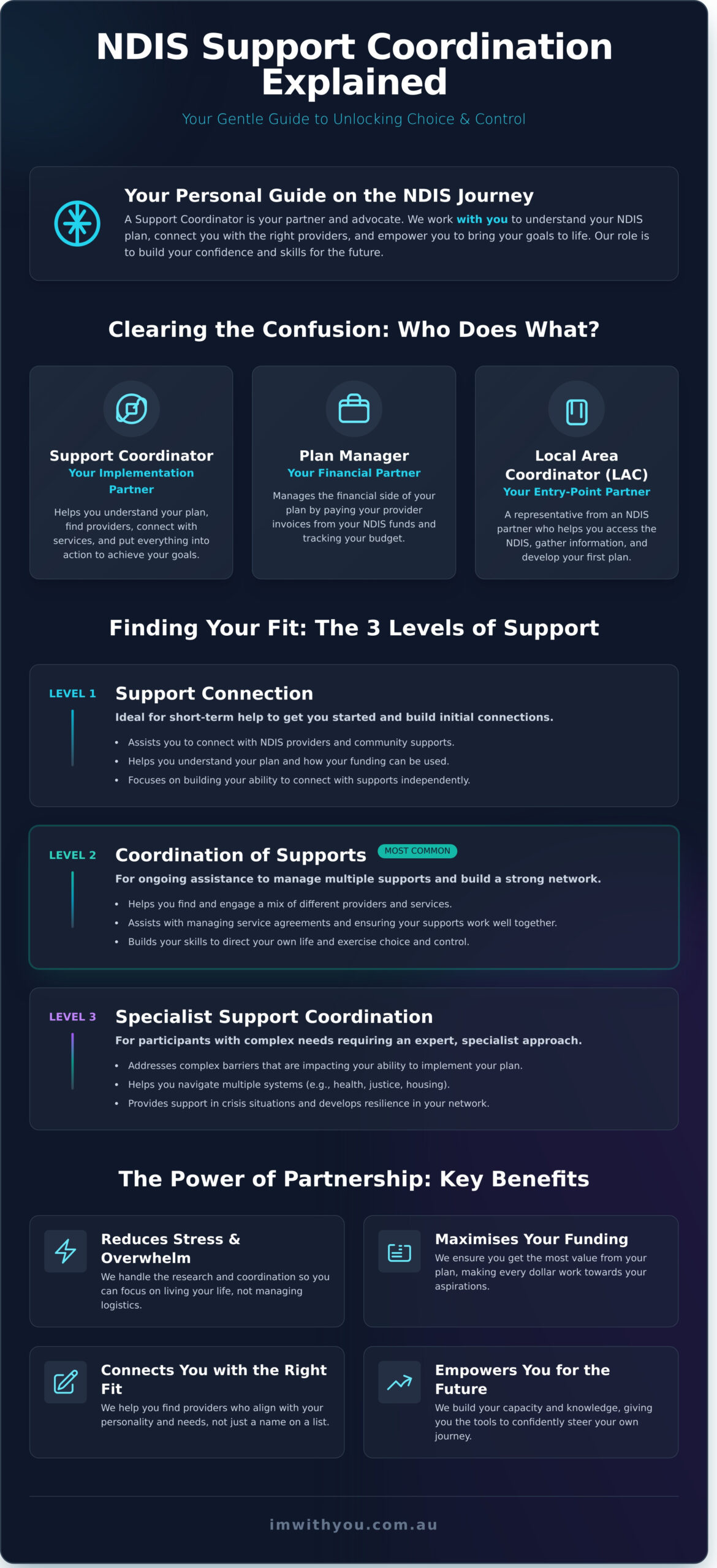
A Support Coordinator’s main purpose is to help you understand your plan and connect you with the right supports and services to bring your goals to life. We work with you, not for you. This is your plan and your life, and our role is to honour your choices. We listen to what you want to achieve, and then we help you put your plan into action. Ultimately, our goal is to build your confidence and skills, empowering you to manage your own supports with ease.
Support Coordinator vs. Plan Manager vs. LAC: Clearing the Confusion
With different roles in the NDIS, it’s easy to get confused. Having ndis support coordination explained clearly alongside its counterparts helps you know who to turn to. Here is a simple comparison:
| Role | Main Responsibility |
|---|---|
| Support Coordinator | Helps you understand your plan, find providers, and put it into action. Your implementation partner. |
| Plan Manager | Manages the financial side of your plan, paying invoices from your NDIS funds. Your financial partner. |
| Local Area Coordinator (LAC) | Helps you access the NDIS and can assist with developing your first plan. Your entry-point partner. |
Why This Role is So Important for Your Journey
Having a Support Coordinator on your team isn’t just a convenience; it’s a powerful way to enhance your entire NDIS experience. It’s about feeling truly supported as you move towards your goals.
- It reduces stress and overwhelm: We handle the research and coordination, so you can focus on what matters most-living your life.
- It connects you with the right fit: We help you find providers who align with your personality and needs, not just the first name on a list.
- It ensures you get the most value: We make sure you are using your NDIS funding effectively, making every dollar work towards your aspirations.
- It empowers you for the future: We are with you to build your own capacity and knowledge, giving you the tools to confidently steer your own journey.
The 3 Levels of Support Coordination: Finding the Right Fit for You
The NDIS understands that everyone’s journey is wonderfully unique. That’s why Support Coordination isn’t a one-size-fits-all service. Instead, your plan may include funding for one of three different levels, each designed to provide just the right amount of help-not too much, and never too little. Our goal is to walk beside you as we explore these options, helping you feel confident about the support you receive. In this part of our guide on ndis support coordination explained, we’ll look at each level to help you find the perfect fit for your life and your goals.
Level 1: Support Connection
This level is perfect if you feel mostly confident managing your plan but need some short-term help to get the ball rolling or overcome a specific hurdle. We find it’s a great fit for people who are new to the NDIS or simply want to explore what’s possible in their community. A Support Connector can help you research and engage with local providers, like finding a great physiotherapist or joining a social group that shares your passions. The goal is to help you build those initial bridges, empowering you to take the lead on your journey.
Level 2: Coordination of Supports
This is the most common level of support coordination, and for good reason. It’s designed for people who have several different supports in their plan and need ongoing assistance to make sure everything works together in harmony. Your Support Coordinator becomes your trusted partner, standing with you to navigate the system. We can help you organise multiple therapies, manage service agreements with different providers, and ensure your funding is being used effectively. It’s a collaborative process where we explore How Support Coordinators Help you build your skills and truly exercise your right to choice and control. The ultimate goal is to create a strong, reliable network that makes your life easier.
Level 3: Specialist Support Coordination
This higher-intensity level is for participants with very complex needs or those facing significant barriers. We are here for you if you are managing a crisis, navigating complex systems like health or justice, or trying to secure stable housing. A Specialist Support Coordinator has advanced skills and a clinical background to address these challenges. They work intensively with you and your entire support network-including doctors, government agencies, or housing services-to find holistic and lasting solutions. The goal is to overcome difficult obstacles and create a safe, consistent support system that protects your wellbeing.
What Does a Support Coordinator Actually Do? A Look into Your Partnership
Moving beyond the official definitions, let’s explore what this partnership looks like day-to-day. A great Support Coordinator does more than just make calls on your behalf; they walk alongside you, building a relationship based on trust and a deep understanding of your goals. They are your cheerleader, your problem-solver, and your advocate, dedicated to helping you live the life you choose.
Think of them as the person who helps connect the dots, transforming the funding in your plan into real-world experiences and supports that make a meaningful difference. Their role is to champion your potential and ensure your journey is as smooth and empowering as possible.
Bringing Your NDIS Plan to Life
Your NDIS plan is a powerful tool, and your coordinator helps you unlock its full potential. We stand with you to demystify the jargon and make your plan work for you. Together, we will:
- Understand Your Funding: We’ll sit down with you and gently explain each funding category, ensuring you feel clear and confident about how your funds can be used.
- Connect You with Providers: We research and present you with a range of quality NDIS providers that align with your goals, so you can make an informed decision. Your Choice and Control is always the priority.
- Set Up Service Agreements: We help you navigate service agreements, making sure they are fair, clear, and reflect the support you’ve agreed upon.
Advocating For You and Building Your Voice
One of the most vital roles of a Support Coordinator is to be your advocate, ensuring your voice is always heard. When you have NDIS support coordination explained in this way, you see it’s about empowerment. We are here to help you articulate your needs, resolve challenges, and prepare for important milestones like plan reviews by gathering reports and tracking your progress toward your goals.
Growing Your Confidence and Community
Our ultimate goal is to build your capacity to navigate the NDIS independently. We’ll teach you practical skills, like using the myplace participant portal, so you feel more in control. We also believe in a holistic approach, helping you connect with local community groups, hobbies, or activities-not just formal disability services. And along the way, we’ll be there to celebrate every success with you.
How to Get Support Coordination Funded in Your NDIS Plan
Getting Support Coordination included in your plan isn’t automatic, but with the right preparation, it is absolutely achievable. We understand this can feel like another hurdle, but we’re here to walk beside you through the process. Support Coordination is a specific line item funded under your ‘Capacity Building’ budget, designed to help you build the skills to navigate the NDIS and connect with your community.
The key is to clearly explain to the NDIA why you need this support and how it will empower you on your journey. Feeling prepared for your planning meeting is the first and most important step to advocating for your needs with confidence.
Preparing for Your Planning Meeting
Walking into your meeting feeling calm and self-assured comes from thoughtful preparation. Before you go, take some time to reflect on your needs and goals. This isn’t about focusing on limitations; it’s about identifying the tools you need to build the life you want, with true choice and control.
- Think about your barriers: What makes it difficult for you to understand your plan, find the right providers, or use your funding? Be honest about challenges like complex communication needs, feeling overwhelmed by the system, or having a limited informal support network.
- Gather supporting letters: If possible, ask your doctor, occupational therapist, or psychologist for a brief report that recommends Support Coordination. This professional backing adds significant weight to your request.
- Connect it to your goals: Write down practical examples. For instance, “My goal is to join a local sports club. A Support Coordinator would help me find an inclusive club, understand their service agreements, and arrange the right supports to participate.”
What to Say in Your Meeting
In the meeting, your voice is the most important one in the room. This is your opportunity to share your story and advocate for the support that will unlock your plan’s full potential. The goal is to clearly and simply connect your request to your journey towards greater independence.
- Start with a direct statement: “I would like to request funding for Support Coordination in my plan.”
- Explain how it builds your capacity: Use phrases like, “I need help to understand the NDIS and connect with providers so I can learn to manage my plan on my own in the future.”
- Link it back to your NDIS goals: For example, “To achieve my goal of living more independently, I need a Support Coordinator to help me research and secure suitable housing options.”
By clearly explaining how this support empowers you, you are putting the NDIS principle of ‘Choice and Control’ into action. Having NDIS support coordination explained in terms of your personal goals shows the NDIA you are focused on building a more independent future. And if you need a hand preparing for that conversation, remember, we’re with you. You can learn more about our gentle approach at imwithyou.com.au.
Choosing a Support Coordinator Who is Right for You
Now that we have had ndis support coordination explained, we arrive at the most personal and important step: choosing your partner for this journey. This decision is about more than a service; it’s about finding a trusted ally who makes you feel comfortable, respected, and truly heard. A great Support Coordinator listens more than they talk. They are genuinely curious about your goals and what matters most to you. Their role is to empower you, ensuring you feel in control of your life, not managed. They walk beside you, helping you navigate the system with confidence and clarity.
Questions to Ask a Potential Support Coordinator
Finding the right fit starts with a conversation where you are in the driver’s seat. Asking thoughtful questions helps you understand if a coordinator’s approach aligns with your vision. Consider asking:
- What is your experience working with people who have goals similar to mine?
- How will you communicate with me, and how often can I expect to hear from you?
- How will you help me understand and exercise my right to choice and control over my supports?
- What makes you passionate about being a Support Coordinator?
Their answers should give you a sense of connection and reassurance, showing they are committed to your independence.
The ‘I’m With You’ Difference
At I’m With You, our entire approach is built on a foundation of empathy, trust, and genuine partnership. We believe that having NDIS support coordination explained is only the beginning; the real, meaningful work happens when we stand with you, side-by-side. We walk alongside you, at your pace, ensuring you are always in control. Your voice is the most important one in the room, and our unwavering commitment is to amplify it, honour it, and act on it.
Our award-winning team isn’t here to simply implement a plan; we are here to listen, understand, and support you in building the life you want. We see our role as your steady companion and your trusted advocate, every step of the way. If you are looking for a team that puts you at the heart of everything we do, we would be honoured to connect.
Let’s start the conversation about your journey.
Your Journey Forward, With Confidence and Support
Navigating the NDIS doesn’t have to feel overwhelming. At its heart, Support Coordination is about having a dedicated partner by your side, helping you connect with the right services and empowering you to bring your plan to life. Now that we’ve had ndis support coordination explained, you can see it as a vital tool for building your independence and truly exercising your choice and control. The most important step is finding a partner who listens and understands your unique goals.
At I’m With You, our experienced team is dedicated to your empowerment. We combine our award-winning excellence in care with a deeply compassionate, person-centered approach because we believe you deserve to feel heard. You are not just a plan to be managed; you are a person with a life to live. Feel understood and supported. Discover how our compassionate Support Coordinators can be with you on your journey. You don’t have to walk this path alone.
Frequently Asked Questions About NDIS Support Coordination
What is the difference between a Support Coordinator and a Plan Manager?
A Support Coordinator and a Plan Manager are two distinct but equally valuable members of your support team. Think of your Support Coordinator as the person who walks beside you, helping you understand and use your NDIS plan to connect with the right services and build your skills. A Plan Manager, on the other hand, looks after the financial side of your plan. They handle invoices and manage your budget, giving you peace of mind and more time to focus on your goals.
Can I choose my own Support Coordinator?
Absolutely. The NDIS is built on the promise of ‘Choice and Control,’ and this is your right in action. You are in the driver’s seat when it comes to selecting a Support Coordinator who truly understands you and your goals. Finding someone you connect with and trust is so important for your journey. We believe this relationship is a partnership, and you deserve to choose the person who will walk alongside you with empathy and understanding.
What should I do if I’m not happy with my Support Coordinator?
It’s so important that you feel safe, heard, and supported. If your current Support Coordinator isn’t the right fit, please know you have every right to make a change. You can speak with them directly if you feel comfortable, or you can simply find a new provider who aligns better with your needs. Your wellbeing is the priority, and exercising your choice and control to build a team that truly supports you is a powerful step in your NDIS journey.
How many hours of Support Coordination will I get in my NDIS plan?
The number of Support Coordination hours in your plan is tailored to your unique situation and goals. The NDIA considers what is ‘reasonable and necessary’ for you, looking at things like the complexity of your support needs and whether you are navigating a significant life change. There isn’t a standard amount; it’s a personal allocation designed to give you the right level of support to build your confidence and bring your plan to life on your own terms.
Do I have to use a registered provider for Support Coordination?
Your ability to choose between registered and unregistered providers depends on how your NDIS plan is managed. If your funding is NDIA-managed, you will need to choose a registered provider. However, if you are plan-managed or self-managed, you have the wonderful flexibility to select either a registered or an unregistered Support Coordinator. This freedom is another way the NDIS empowers you to build a support network that you feel completely comfortable and confident with.
Will a Support Coordinator help me get more funding in my NDIS plan?
While a Support Coordinator cannot guarantee more funding, they are a vital advocate in your corner. They will stand beside you to help you gather the right reports and evidence to show how your needs are being met and where there might be gaps. When we have NDIS support coordination explained to participants, we describe it as having someone to help you clearly articulate your needs to the NDIA during your plan review, ensuring your story is heard and understood.
Is Support Coordination available for all NDIS participants?
Support Coordination is not automatically included in every NDIS plan. It is funded by the NDIA when it is considered ‘reasonable and necessary’ to help you on your journey. This support is often provided if you have complex needs, are navigating a major life transition, or need help building your skills and confidence to implement your plan effectively. It’s an extra layer of dedicated support to ensure you feel empowered, not overwhelmed, by the possibilities within your plan.