

You’ve spent weeks in a busy hospital ward surrounded by monitors and white coats, but now that you’re home, the silence feels heavy and the stack of forms for ndis support for stroke survivors on your kitchen table looks like an impossible mountain. It’s natural to feel a sense of abandonment after discharge, especially when cognitive fatigue makes even the simplest task feel overwhelming. I understand the deep worry that your funding won’t stretch far enough to cover the intensive neuro-rehab you need. I’m here to tell you that you don’t have to face these hurdles alone.
In this guide, I’ll show you how to effectively manage your plan to secure tailored therapies and professional support coordination. You’ll discover a clear roadmap to regain your daily independence and reconnect with your community. Together, we’ll explore how to turn complex requirements into a practical recovery strategy that respects your pace and priorities.
Key Takeaways
- Learn how to navigate the NDIS eligibility process by gathering essential evidence from neurologists and occupational therapists to document the functional impact of your stroke.
- Discover how to balance your funding between Capacity Building for neuroplasticity and Core Supports to effectively manage daily fatigue with ndis support for stroke survivors.
- Understand the vital role of support coordination in connecting you with specialized neuro-rehabilitation experts who truly understand your recovery journey.
- Build a clear roadmap for regaining your independence through a management strategy that prioritizes your personal dignity and social connection.
Understanding NDIS Eligibility and Access for Stroke Survivors
The path to securing ndis support for stroke survivors begins with understanding how the scheme views your recovery journey. If you’re under 65, the NDIS recognizes stroke as a primary disability when it results in a permanent and significant impact on your life. This shift from acute hospital care to community support can feel abrupt, but it’s where your long term journey toward independence truly takes shape. I’m here to help you translate your medical needs into the functional language the NDIS requires.
The “Permanent and Significant” Requirement
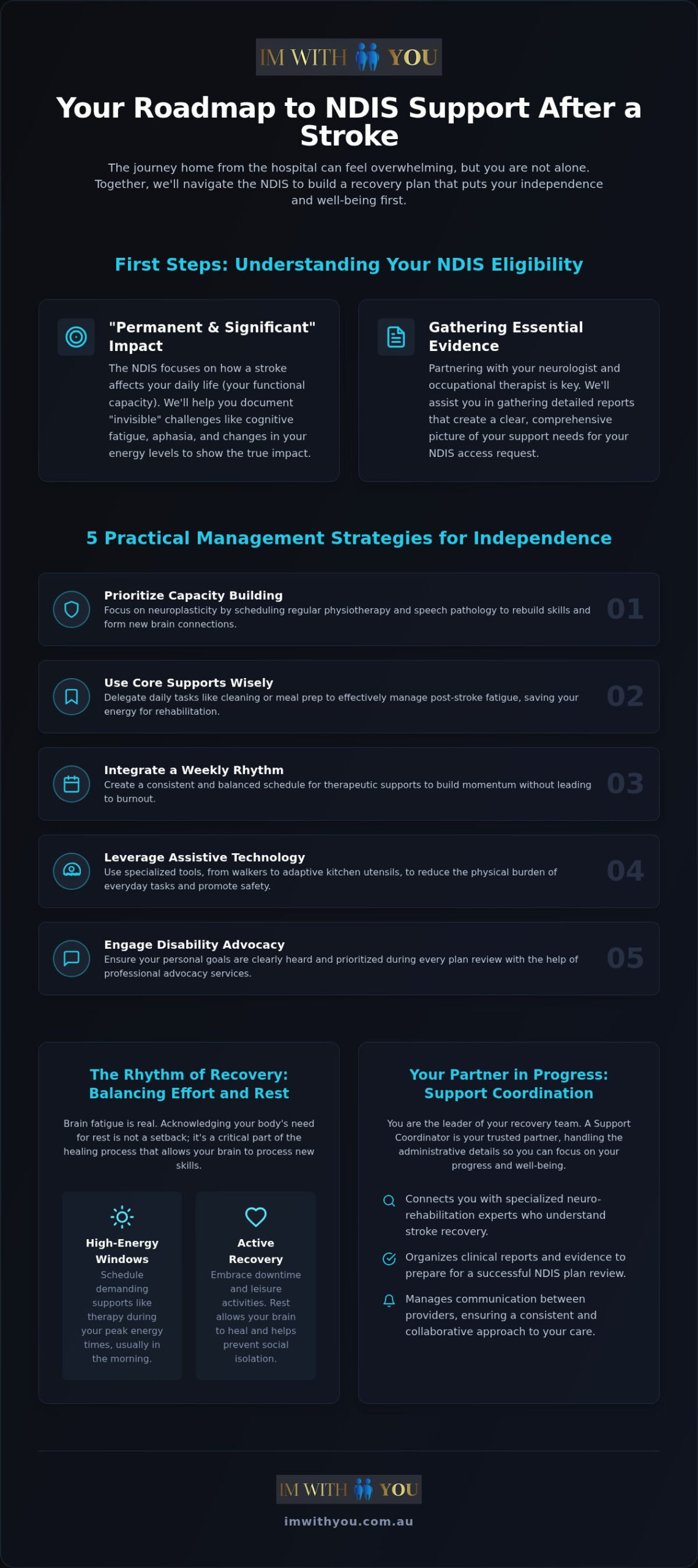
To access funding, you’ll need to demonstrate how the stroke affects your functional capacity. Functional capacity refers to your practical ability to participate in daily activities and social roles, regardless of the clinical severity of the stroke itself. I recommend partnering with your neurologist and occupational therapist to gather detailed reports that highlight “invisible” challenges such as aphasia or cognitive fatigue. Using person-first language helps the NDIA see you as an individual with goals, rather than just a medical diagnosis. We want to ensure your plan reflects the reality of your daily energy levels and communication needs.
Navigating the Transition from Hospital to Home
Leaving the clinical safety of a hospital ward is a major milestone, but it often brings new anxieties about managing at home. Accessing ndis support for stroke survivors helps bridge this gap by identifying immediate needs for safety and comfort. This might include:
- Assistive technology like walkers or specialized kitchen utensils to help you prepare meals.
- Home modifications to ensure your bathroom and entrances are accessible and safe.
- Therapeutic supports to continue the progress you started during your initial rehabilitation.
I’ll walk alongside you during this transition to ensure your access request captures these essential requirements for a safe, dignified return to your own space. You don’t have to figure out the paperwork while you’re still healing.
5 Practical Management Strategies for Post-Stroke Independence
Effective ndis support for stroke survivors balances high-intensity rehabilitation with the practicalities of daily life. I’ve seen how a well-structured plan allows you to focus on healing rather than just surviving. Here are five ways to manage your supports effectively:
- Prioritize Capacity Building: Focus on neuroplasticity by scheduling regular physiotherapy and speech pathology.
- Use Core Supports: Delegate daily tasks like cleaning or meal prep to manage post-stroke fatigue.
- Integrate a Weekly Rhythm: Create a consistent schedule for Therapeutic Supports to avoid burnout.
- Leverage Assistive Technology: Use specialized tools to reduce the physical burden of everyday movements.
- Engage Disability Advocacy Services: Ensure your goals are clearly heard during every plan review.
Balancing Therapy and Rest
Brain fatigue is a very real, invisible hurdle that can stall your progress if ignored. I recommend scheduling your most demanding supports during your high-energy windows, which are usually in the morning. Balancing hard work with finding joy in leisure activities helps prevent social isolation. It’s okay to rest; your brain needs downtime to process new skills and rebuild connections.
Effective Plan Management and Advocacy
Choosing how to manage your funds is a big decision. While self-management offers control, many find that plan management provides the perfect middle ground by removing the accounting burden. Whatever you choose, remember that your voice is the most powerful tool in your recovery toolkit. When looking for ndis support for stroke survivors, accessing Disability Advocacy Services can provide the steady support you need to ensure your stroke-specific needs stay front and center.
Partnering for Progress: The Role of Support Coordination
Managing the moving parts of your recovery can feel like a full-time job when you’re already dealing with cognitive fatigue. Support Coordination simplifies this by connecting you with specialized neuro-rehab providers who truly understand the nuances of stroke. I’ll walk alongside you to build a circle of support that includes your family, carers, and therapists, ensuring everyone’s working toward the same goals. You’re the leader of your team, and I’m here to ensure the administrative side doesn’t slow you down.
A dedicated coordinator helps you:
- Source therapists with specific stroke expertise and availability.
- Organize clinical reports and evidence for your plan review.
- Manage the communication between your different providers to ensure a consistent approach.
When it’s time for your NDIS plan review, we’ll prepare together. We’ll use clear evidence of your progress to secure the ndis support for stroke survivors you deserve, so you can move forward with confidence and clarity.
Choosing the Right Partner for Your Journey
Your recovery deserves a team that offers more than just clinical expertise. You need a partner who brings empathy and reliability to every conversation. I’ve put together a guide on how to choose an NDIS provider to help you find your perfect match. It’s about finding someone who values your dignity and understands that person-centered care is a core promise. This relationship is built on trust and a shared commitment to your long-term social inclusion.
Advocacy as a Tool for Empowerment
Life doesn’t always go as planned. New health challenges or secondary issues can arise unexpectedly, requiring quick adjustments to your funding. Advocacy ensures you have the ndis support for stroke survivors needed to adapt your plan when things change. The Im with you approach means you’re never alone in navigating the system. We’ll face every challenge as a team, keeping your independence and personal agency at the heart of every decision we make together.
Your Path to a Brighter Future
You’ve explored how to document your functional capacity and balance intensive therapy with essential rest. Recovery is a marathon, but with the right ndis support for stroke survivors, every small victory brings you closer to your goals. Our specialized NDIS Support Coordinators are here to simplify the complex paperwork and advocate for your unique needs. As recipients of the 2026 Excellence in Care Award, we take our promise of national advocacy and person-centered care seriously. We’ll walk with you through every plan review and every milestone. Let us walk alongside you; explore our NDIS support services today. You have the inner strength to reclaim your story, and you don’t have to do it alone.
Frequently Asked Questions
Can I get NDIS support if I had a stroke but am over 65?
You generally can’t access the NDIS if you’re over 65 when you first apply. Instead, you’ll find support through the aged care system, such as Home Care Packages or the Commonwealth Home Support Programme. Providers like Elleson Care offer person-centred aged care and NDIS services that ensure you continue to receive high-quality support. If you were already an NDIS participant before turning 65, you can choose to stay with the scheme. I’ll help you explore the best pathway for your specific age and situation.
The NDIS commonly funds a variety of ndis support for stroke survivors to help rebuild functional skills. This includes occupational therapy for daily living, physiotherapy for mobility, and speech pathology for communication or swallowing challenges. You might also access exercise physiology or psychology to support your emotional wellbeing. We focus on ensuring these therapies align with your personal goals for independence and community connection.
How do I change my NDIS plan if my recovery needs increase?
You can request a plan reassessment if your support needs change significantly during your recovery. This process, often called a change of circumstances, requires updated evidence from your treating therapists to explain why more funding is necessary. I’ll walk alongside you to gather the right reports and advocate for the adjustments you need. It’s about making sure your plan grows with you as you reach new milestones.
Does the NDIS cover the cost of home modifications after a stroke?
Yes, the NDIS can fund home modifications if they’re considered reasonable and necessary for your safety and independence. This is a vital part of ndis support for stroke survivors, covering items like grab rails or bathroom structural changes. An occupational therapist will assess your needs and recommend specific modifications, which often involves detailed property documentation; you can discover PHOTO iD to see how professionals efficiently organize and label such photo evidence. We’ll help you navigate this process so your home remains a safe, supportive space for your recovery.