
Does the world of the NDIS sometimes feel like a confusing mix of acronyms? If terms like SIL, SDA, and ILO leave you feeling more overwhelmed than empowered, please know you are not alone. It’s a common feeling, and we’re here to walk beside you, gently clearing the path. This guide is our way of taking your hand and exploring the journey of supported independent living ndis, showing you how it can be a powerful step toward the independence you deserve, built entirely around your personal goals and aspirations.
Together, we will unpack what SIL truly means, who it is for, and how it can honour your fundamental right to choice and control. By the end of this guide, our hope is that you will feel a sense of clarity and confidence, equipped with the understanding you need to decide if this is the right next step for you. You are in the driver’s seat of your life; we are simply here with you, holding the map.
Key Takeaways
- Understand that Supported Independent Living (SIL) is about having someone by your side to help with daily tasks, empowering you to live more independently at home.
- We gently clear up the confusion between SIL, SDA, and ILO, helping you feel confident in understanding which NDIS housing support aligns with your personal goals.
- Walk through our gentle, step-by-step guide to applying for supported independent living ndis funding, designed to make the process feel manageable and less overwhelming.
- Explore real-life examples of how SIL support works day-to-day, helping you picture how it could support your own unique journey towards greater independence.
What is Supported Independent Living (SIL)? A Simple, Gentle Explanation
When you first hear the term Supported Independent Living, it’s easy to picture a specific type of building or housing complex. But the heart of SIL is about people, not a place. It’s a gentle way of describing the support you can receive to help you with daily tasks so you can build your independence at home. Think of it like having a supportive coach or a helpful flatmate who is there to assist you on your terms, helping you navigate daily life with more confidence.
This is where supported independent living ndis funding comes into your journey. It is a specific type of support funded through the National Disability Insurance Scheme (NDIS) to help you achieve your personal housing and independence goals. At its core, SIL is built on the promise of your choice and control, empowering you to live the life you want, as independently as possible, with the right people standing beside you.
The Heart of SIL: It’s About Support, Not a Building
It’s important to understand that SIL funding is for the support services you receive from people, not for the physical building you live in. This funding pays for the support workers who assist you with your daily life. This is wonderful news because it means you have a real say in where you live. You can receive SIL support whether you’re in your own home, a private rental, or specialised housing.
What are the Goals of SIL?
The journey with SIL is a partnership, and the goal is always to build your capacity and confidence for greater independence. We are with you to help you:
- Build skills for daily life: This could include learning to cook new meals, creating a personal budget, or learning how to manage your household tasks.
- Increase your confidence: We focus on empowering you to live more independently, helping you feel capable and comfortable in your own home.
- Manage your home and responsibilities: We can assist you with daily routines and responsibilities, making them feel calm and achievable.
- Feel safe and supported: Above all, SIL ensures you have the right support to be safe, healthy, and happy in your own space.
Who is SIL Designed For? Exploring Your Personal Goals
Thinking about your next step towards independence? Supported Independent Living (SIL) isn’t just about a set of services-it’s about building a life that feels right for you. It’s designed for adults (18 and over) with an NDIS plan who have higher support needs and want to live as independently as possible.
This often means you require some level of help at home throughout the day, including overnight support, to feel safe and confident. For many, SIL is the key that unlocks the dream of moving out of the family home and creating a space to call their own, with the right support standing right beside them.
Could SIL Be Right for You?
To help you see if SIL aligns with your personal vision, let’s explore a few gentle questions together. This isn’t a test, but a way to reflect on your own journey:
- Do you need significant, regular help with daily activities like personal care, cooking, or managing your home?
- Is having someone available overnight important for your safety, well-being, or peace of mind?
- Are you excited by the idea of learning new skills for independence, like budgeting or navigating your community?
- Do you dream of having your own space, whether that’s by yourself or with housemates who share similar goals?
It’s a Partnership in Your Journey
If you found yourself nodding along, it’s a wonderful sign that SIL could be a great fit. The most successful supported independent living NDIS plans are built around your unique aspirations. Your support team is there to walk side-by-side with you, helping you turn those goals into reality. This person-centred approach is a core part of the program, as outlined in the official NDIS guidelines on Supported Independent Living. It’s a collaborative process we do with you, never to you, ensuring your choice and control are always at the centre.
Every person’s path is unique, and it’s completely okay to feel unsure. That’s what we’re here for. Feeling unsure? Let’s talk about your goals together.
What Does SIL Support Look Like? A Day in the Life
Moving from the idea of support to what it actually feels like day-to-day can make all the difference. The beauty of Supported Independent Living (SIL) is that it’s not a one-size-fits-all service; it’s a gentle framework built entirely around you and your goals. To help paint a clearer picture of how SIL works in practice, let’s walk through what a day supported by Im with you might look like. Remember, the level of support is always guided by your choice and control.
Morning and Daytime Support
Your day begins on your terms. Im with you support workers can be there with you to help with personal care routines, like showering and getting dressed, in a way that feels comfortable and respects your dignity. Im with you can assist with preparing a healthy breakfast, managing household chores like laundry, or planning your weekly shopping. If you have appointments, community activities, or just want to learn how to use public transport with more confidence, Im with you is right by your side to help you get there and build your skills.
Evening and Overnight Support
As the day winds down, Im with you support continues. Im with you can help you prepare a delicious dinner, tidy up, and settle in for the evening. If you need assistance with medication, Im with you can provide gentle reminders to ensure it’s taken correctly. Having someone you trust available overnight—whether for active assistance or simply for peace of mind—means you can rest easy, feeling safe and secure in your own home. This continuous presence is a core part of how supported independent living ndis funding creates a truly supportive environment.
What SIL Typically Does Not Include
It’s also helpful to understand what SIL funding is not intended to cover, so you can plan your budget and other NDIS supports. Generally, SIL does not include:
- Rent, board, or mortgage payments for your home.
- Everyday living expenses like groceries, utility bills, or phone plans.
- The cost of the physical home (bricks and mortar).
- Other NDIS supports that are funded separately, such as therapies (e.g., occupational therapy) or transport costs for community activities.
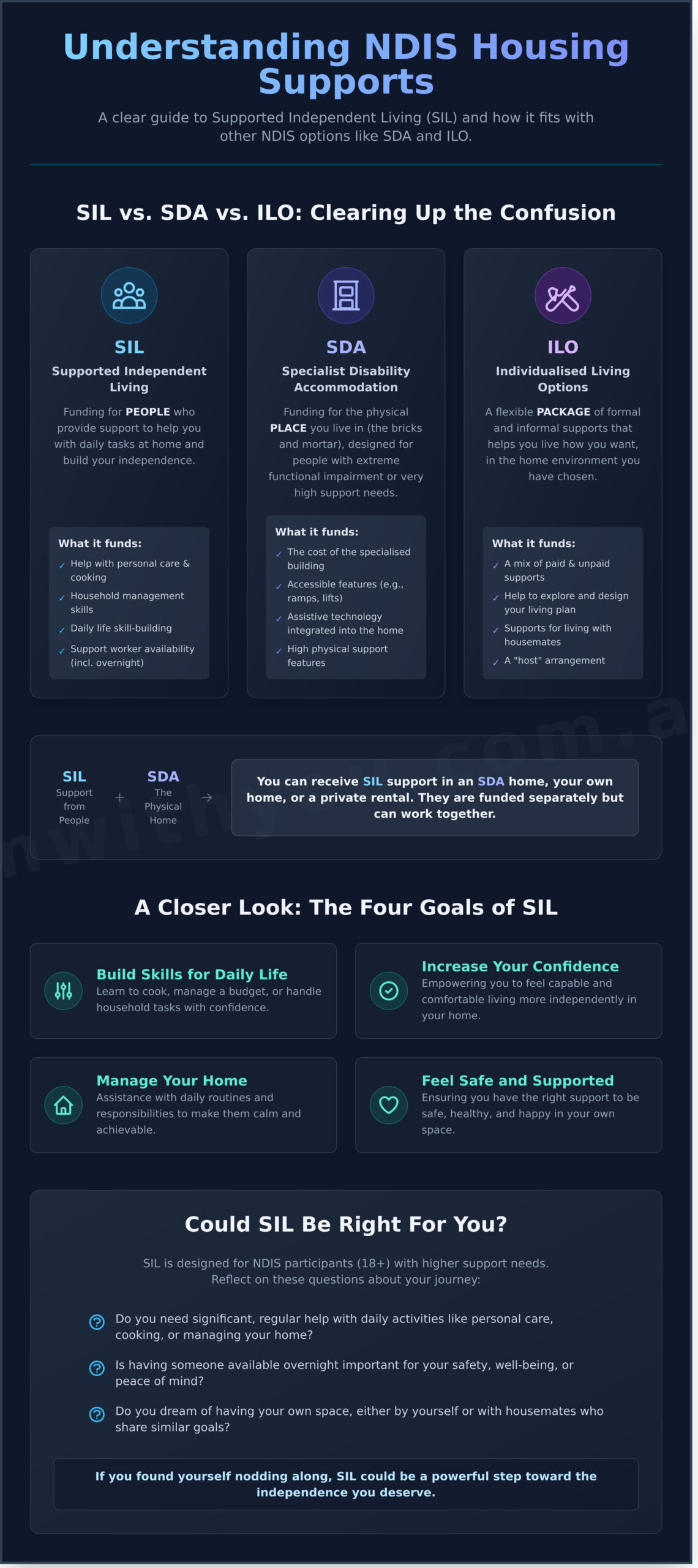
SIL vs. SDA vs. ILO: Clearing Up the NDIS Housing Confusion
Navigating the world of NDIS housing can feel like you’re trying to decode a secret language. SIL, SDA, ILO… these acronyms can be overwhelming when you’re already managing so much. We are right here with you to make it simple. Think of this as your clear, calm guide to understanding the main NDIS living options, so you can make choices that feel right for you and your journey.
Understanding the difference is a critical step in exercising your choice and control. Let’s gently break them down, side-by-side.
Supported Independent Living (SIL)
SIL is all about the support people who help you live as independently as possible in your home. This NDIS funding covers the ‘who’ and the ‘how’ of your daily support-from help with personal care and cooking to building skills and accessing the community. As a dedicated SIL provider, our focus at Im with you is on providing this human support. You can have SIL funding in your own home, a private rental, or a shared arrangement; it’s not tied to a special type of building.
Specialist Disability Accommodation (SDA)
SDA, on the other hand, is funding for the physical building itself. This is specifically for participants with extreme functional impairment or very high support needs who require a specially designed home to live safely. Think of houses with features like ceiling hoists, automated doors, or reinforced walls. It’s important to know that you can have both SDA funding for your home and SIL funding for your supports at the same time-they are designed to work together.
Individualised Living Options (ILO)
ILO is a creative and flexible approach to your living arrangements. It’s a package of supports designed entirely around you, often blending formal (paid) supports with informal help from your network of family and friends. The focus is on finding unique solutions that truly honour your independence. ILO is about co-designing a home life that works perfectly for you, moving beyond traditional models.
So, to put it simply: SIL is the support, SDA is the building, and ILO is the flexible package. When you are exploring your supported independent living NDIS options, remember that the most important part is finding the right people to walk alongside you. If you have questions about how SIL could empower you, we’re here to talk it through, with no pressure at all.
How to Get SIL in Your NDIS Plan: Your Journey Step-by-Step
Navigating the path to securing Supported Independent Living in your NDIS plan can feel like a big undertaking, but it’s a journey you don’t have to walk alone. Think of it as a series of manageable steps, each one bringing you closer to your housing goals. We’re here to gently guide you through the process, side-by-side.
Step 1: Explore Your Goals and Gather Evidence
Everything starts with you and your vision for the future. Before any forms are filled out, take some time to think about what living more independently looks like for you. What skills do you want to build? What does your ideal home life feel like? Once you have a clear picture, the next step is to gather the right evidence. This often involves working with allied health professionals, like an Occupational Therapist (OT), who can complete assessments. These professional reports are vital, as they show the NDIA why supported independent living ndis funding is ‘reasonable and necessary’ to help you achieve your goals.
Step 2: The Home and Living Supports Request
With your goals defined and your evidence ready, it’s time to make the formal request. You, your family, or your Support Coordinator will complete a Home and Living Supports Request form. This document is your opportunity to tell your story to the NDIA. It’s where you’ll outline the specific supports you need to live in your chosen home, connecting them back to your NDIS goals. The more detail and clarity you can provide, the easier it is for the NDIA to understand your needs and aspirations.
Step 3: The Planning Meeting and Decision
Your NDIS planning meeting is a key moment to discuss your housing goals and present your request in person. This is your chance to share your vision and explain how SIL will empower you to build your capacity and live with more choice and control. After the meeting, the NDIA will review all your evidence and the request form to make a funding decision. If your request is approved, the funding for your supports will be included in the Core Supports budget of your NDIS plan.
This can feel like a lot to manage, and it’s okay to feel overwhelmed. We understand. We’re with you every step of the way.
We’re With You on Your Path to Independence
Embarking on your NDIS journey can feel like navigating a complex map, but we hope this gentle guide has served as a trusted compass. We’ve explored how Supported Independent Living is about the person-centered help you receive to build skills and live on your terms, and how it differs from other housing options. Most importantly, we’ve seen that the entire process is designed to honour your personal goals, putting your choice and control at the very heart of your future.
You never have to walk this path alone. As an award-winning provider of high-quality care, our dedicated team at I’m With You is here to walk alongside you. We are committed to providing supported independent living ndis services that truly respect your choices and empower you to live the life you envision. If you’re ready to explore what’s possible, we’re ready to listen.
Ready to explore your options? Let’s have a gentle, no-obligation chat.
Frequently Asked Questions
Can I choose who I live with in a SIL arrangement?
Absolutely. Your right to Choice and Control is at the very heart of your journey, and that includes choosing your housemates. We believe your home should be a place of comfort and safety. We are with you every step of the way to help find a shared living arrangement with people you feel compatible and comfortable with. It’s about creating a supportive household that truly feels like home, built on shared respect and understanding.
What happens if I don’t get along with my support workers?
It is so important that you feel safe and comfortable with the people supporting you. If a support worker isn’t the right fit, you have every right to ask for a change. Your voice is the most important one in this conversation. We encourage you to speak with your SIL provider, and we will stand beside you to ensure a new support worker is found-someone who understands your needs and supports your goals with warmth and respect.
Is Supported Independent Living the same as a group home?
This is a great question, as the terms are often used together. Think of it this way: a ‘group home’ is the physical house you might live in with others. Supported Independent Living (SIL) is the NDIS funding for the support services you receive within that home. SIL is focused on the people who help you with daily tasks and skill-building, empowering you to live as independently as possible in your chosen accommodation.
How much does SIL cost and how is it funded in my NDIS plan?
The cost of SIL is fully covered by your NDIS plan if it’s deemed reasonable and necessary to meet your goals. This funding is allocated under your Core Supports budget. The amount is based on a detailed assessment of your individual needs, including the ratio of support you require. Our goal is to help you get the right level of supported independent living ndis funding to empower your daily life and build your capacity for independence.
Can I use my SIL funding if I live with my family?
SIL funding is specifically designed to support you when you are living in a home away from your family, usually with other NDIS participants. It generally doesn’t apply if you live in the family home. However, the NDIS offers other wonderful supports for this situation, such as In-Home Support or Individualised Living Options (ILO). We can help you explore these pathways to find the right support for your unique living arrangement and personal journey.
What is the difference between active and inactive overnight support in SIL?
Overnight support is tailored to your specific needs. ‘Active’ overnight support means a support worker is awake and on duty for the entire night, ready to provide immediate assistance whenever you need it. ‘Inactive’ overnight support is when a support worker sleeps at your home but is available to be woken for support if required. This option provides peace of mind and security for those who don’t typically need help during the night.