
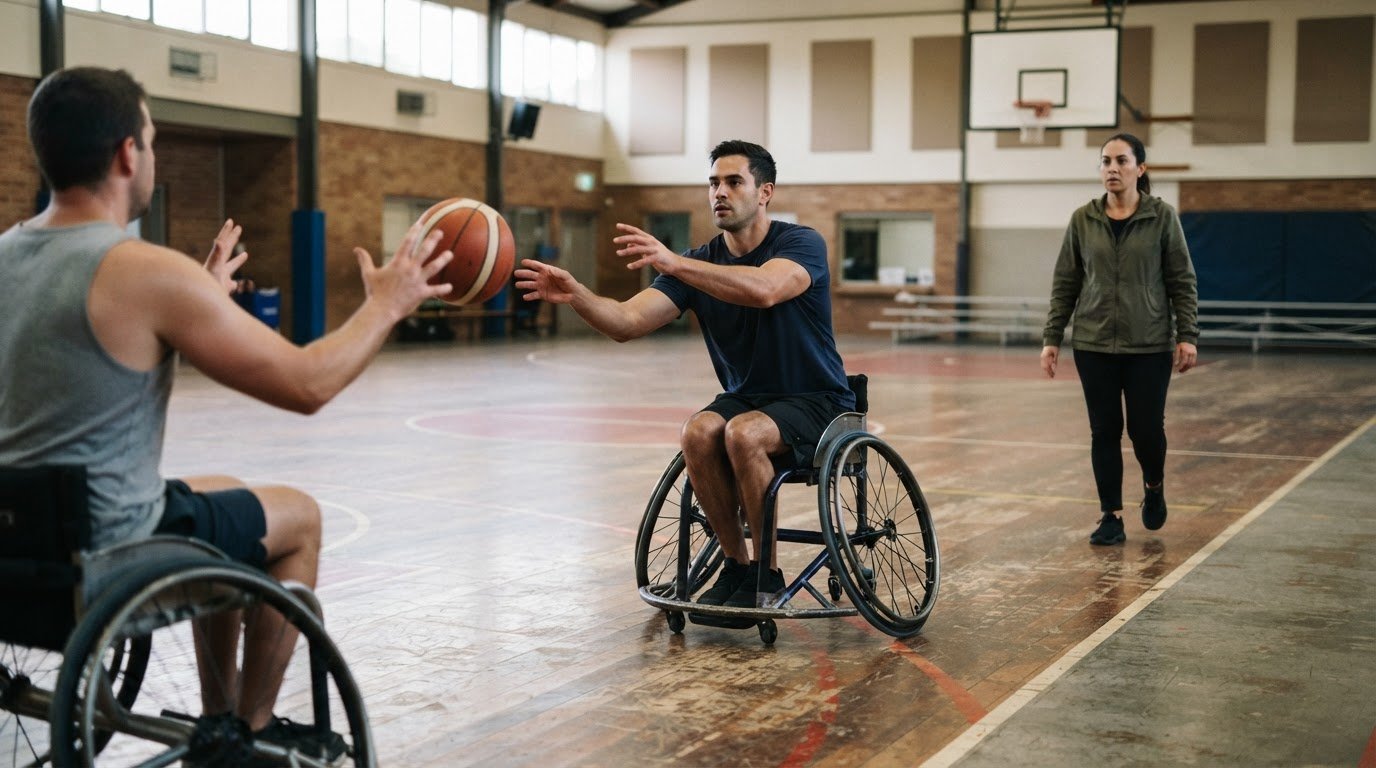
In Australia, 21.4% of people, about 5.5 million, have disability, according to the Australian Bureau of Statistics. Adaptive sports in Australia include activities and programs that make sport more accessible, with adaptations shaped around participants’ needs. There isn’t one single activity or way to take part.
Finding a welcoming place to play takes more than a list of sports. You may be looking for an accessible program or wondering how a local club can include people with disability. These questions matter, and community sport has an important role to play.
This article explains what an adaptive sports program can involve, how disability inclusion works in Australian sport, and practical ways community clubs can welcome people with disability. We’ll look at different ways to participate and what supportive access can look like.
Key Takeaways
- Learn how clubs can make participation more welcoming by listening to people with disability and adapting activities around access needs.
- Understand how adaptive sports programs can involve more than playing, including volunteering and spectating.
- See why community sport matters: according to the Australian Bureau of Statistics, 21.4% of people in Australia, about 5.5 million, have disability.
- Explore how Im with you’s Community Participation Support and NDIS Support Coordination can help you work towards taking part in community life.
1. Disability inclusion in Australian sport
Disability inclusion means adapting sport to people’s access needs, rather than expecting everyone to participate in the same way. Clubs can ask participants and parents or guardians what support would help, then adjust activities. An accessibility question on registration and event RSVP forms gives people a clear way to share their needs.
An inclusion coach with lived experience can offer practical insight into barriers that might otherwise be missed. Inclusive sports training and resources can help coaches adapt communication, equipment, rules and session formats. For example, a coach might explain an activity verbally and demonstrate it, giving participants more than one way to understand the instructions.
Organisations can also build inclusion into their systems through advocacy, accessible policies and regular feedback. A disability inclusion survey can ask about venue access, communication, equipment and whether participants feel welcome. Disability Sports Australia, a founding member of Paralympics Australia recognised by the Australian Sports Commission, is one national example of disability sport advocacy.
Before registering, read the club or event’s safety, accessibility and insurance information. Ask how its safety plan accounts for access needs and equipment, what support is available, and which insurance conditions apply. To find local options, start with the sport’s national organisation or state or territory association, then contact clubs with details about the access arrangements you need.
Australian competitions include the social wheelchair softball competition launched by Softball Australia in 2019. At the Pan Pacific Masters Games 2026, 330 people signed up for Team Veteran across all sports, illustrating another pathway into organised competition.
2. WHAT IS THE ADAPTIVE SPORTS PROGRAM?
Adaptive sports in Australia are activities and organised programs designed to make sport accessible to people with disability. Depending on their interests and the program, participants may play, volunteer or spectate. Options include swimming and running or other athletics activities.
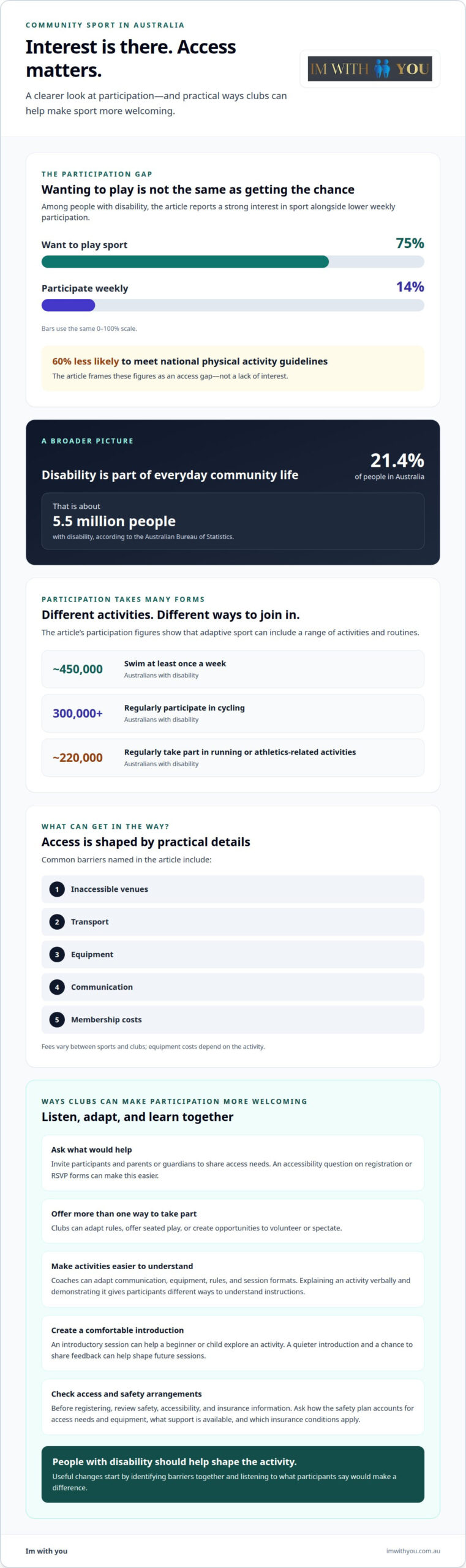
Common barriers include inaccessible venues, transport, equipment, communication and membership costs. Fees vary between sports and clubs, and equipment costs depend on the activity. For a beginner or child, an introductory session can be a welcoming way to learn about an activity before deciding how to take part.
Disability Sports Australia and sport-specific organisations such as Softball Australia are examples of organisations connected with adaptive sport. National sporting bodies and state or territory associations can help identify local clubs, facilities and participation opportunities. Funding options depend on each grant or scheme’s eligibility criteria and coverage; sporting organisations can explain relevant pathways.
To get started, choose an activity and ask a local club about introductory participation and access arrangements. Recreational participation may not require competition classification. Competitive rules vary by sport: wheelchair tennis has Open and Quad divisions, while adaptive standing tennis has four classifications. Programs and facilities vary across states and territories, so local sporting associations can help identify options. For anyone exploring adaptive sports in Australia, a practical starting point is an activity and participation format that fits their goals.
Around 220,000 Australians with a disability regularly participate in running or athletics-related activities. Around 450,000 Australians with a disability swim at least once a week. Together these participation figures show how adaptive sport can encompass different activities and routines, allowing people to explore options that suit their interests and preferred ways of taking part.
3. Community sport for people with disability
According to the Australian Bureau of Statistics, 21.4% of people in Australia, about 5.5 million Australians, have disability. Yet 75% of people with disability want to play sport, while only 14% participate weekly. People with disability are also 60% less likely to meet national physical activity guidelines. These figures point to an access gap, not a lack of interest. Community clubs can help make adaptive sports in Australia more connected to everyday local life.
Local sport can offer flexible ways to participate. A club might adapt rules, offer seated play or create roles for people who prefer to help or spectate. These options recognise different abilities and can help people connect with their communities through shared activity.
Representation matters, too. The Northern Territory Dragonflies became the first representative netball team for women with intellectual disability. Their example shows how community pathways can support participation at representative level and encourage organisations to recognise athletes’ contributions.
Communities can take a practical approach: identify barriers such as transport, venue access, equipment or communication, then work with participants on useful changes. For example, a club could offer a quieter introduction session and invite feedback afterwards. That feedback can shape future sessions and make adaptive sports in Australia more responsive to participants.
Community sport works best when people with disability help shape the activity. If you’d like support to explore participation in community life, talk through your community goals.
With its supporters and partners, Disability Sports Australia enables thousands of people with disability to take part in sport each year, showing the reach that coordinated support can have. More than 300,000 Australians with a disability regularly participate in cycling, illustrating that participation can happen across different sporting settings.
Australia’s social wheelchair softball competition brings together participants of all ages, genders and abilities to play seated in a wheelchair. This is one example of how sport can unite people through formats designed for different participants and interests.
Im with you
Im with you can help you explore support and advocacy as you consider community sport. If you’re working out how participation could fit your goals or support needs, Community Participation Support and NDIS Support Coordination can help you consider practical next steps. Disability Support Services and Disability Advocacy Services may also be useful when you need support to express your preferences and pursue inclusion.
Support is person-centred, so the conversation starts with what matters to you: the activity you’re interested in, how you want to participate and any barriers you’re facing. You don’t need to have every detail worked out before seeking support. Im with you can work alongside you as you explore your options and clarify what support may fit.
To discuss support for taking part in community life, contact Im with you.
Take your next step towards participation
Your next step doesn’t have to be a competition or a fully formed plan. Start with the movement, connection or community role you want, then consider what would make that experience workable. You might focus on feeling more comfortable attending a session, joining in with others or clarifying what support could help you participate. This personal starting point can turn interest in adaptive sports in Australia into a practical direction, without comparing your progress with someone else’s.
I’m With You offers Disability Support Services, Community Participation Support and NDIS Support Coordination. These supports can help you explore your goals, participation options and practical support that may suit your needs.
When you’re ready to talk through your next step, contact Im with you. You can begin with what matters to you and take it from there.
Frequently Asked Questions
What is the Adaptive Sports Program?
In Australia, an adaptive sports program is an organised way to make sport or physical activity accessible to people with disability. It can support someone who wants to try an activity, develop skills or work towards a personal sporting goal. The format depends on the sport and participants’ needs, so programs can look different from one club to another.
What adaptive sports are available for children and beginners in Australia?
Swimming and running or other athletics activities are among the options. Beginners and children can ask local clubs about an introductory session to try an activity and learn how to participate.