

Does the thought of your next NDIS plan meeting fill you with more anxiety than hope? It’s a feeling we understand completely-the confusion over complex terms, the fear of having your funding cut, and the deep frustration of feeling like a case number instead of a person. We believe your journey deserves to be guided by compassion and clarity, not by stress and uncertainty. That’s why we are walking beside you with this complete ndis therapeutic supports guide for 2026.
This is more than just information; it’s a warm, step-by-step roadmap designed to empower you. Together, we’ll explore the full range of available therapies, help you build unshakeable confidence for your plan conversations, and ensure your voice is heard and respected. Consider this your first step toward accessing the supports that will help you build the life you choose, with the unwavering promise that we are with you, every step of the way.
Key Takeaways
- Use this compassionate ndis therapeutic supports guide to understand your options and feel empowered to ask for the therapies that will help you thrive.
- Discover why therapeutic supports are a core part of your ‘Capacity Building’ budget and how they help you build long-term skills for independence.
- Learn the essential ‘reasonable and necessary’ criteria the NDIA uses, so you can build a stronger case for the therapies you need in your plan.
- Follow a clear, step-by-step process for gathering the right Allied Health evidence to confidently request and secure funding for your therapeutic goals.
Understanding NDIS Therapeutic Supports: More Than Just a Line Item
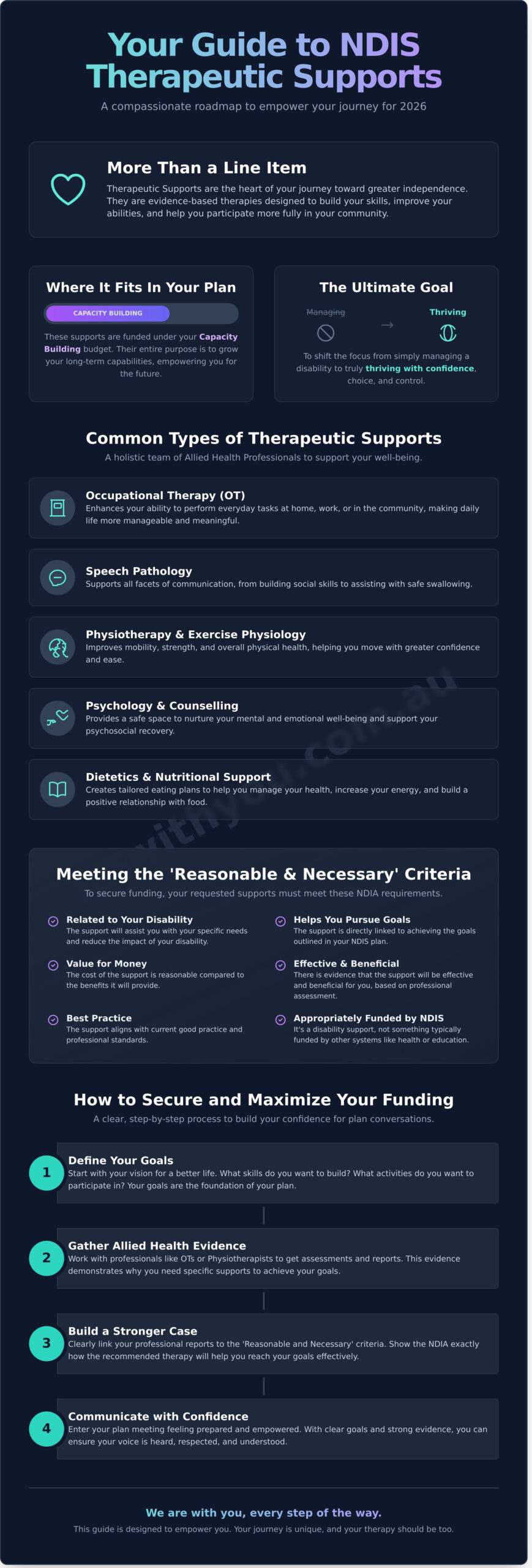
When you look at your NDIS plan, ‘Therapeutic Supports’ might seem like just another category. But we are here to show you it’s so much more-it’s the heart of your journey toward greater independence. These are evidence-based treatments and therapies designed to help you build your skills, improve your functional abilities, and participate more fully in the community. They sit within your ‘Capacity Building’ budget for a powerful reason: their entire purpose is to grow your long-term capabilities, empowering you for the future. This ndis therapeutic supports guide is designed to walk with you through it all.
To help you get started, this video offers a practical overview of accessing NDIS support:
The ultimate goal here is to shift the focus from simply ‘managing’ a disability to truly ‘thriving’ with confidence. Therapeutic supports are the very foundation of ‘Choice and Control’ in your daily life. By developing new skills and strategies, you gain more say over how you live, work, and connect with your world. It’s a core principle of the National Disability Insurance Scheme (NDIS), and one we hold as a sacred promise to you.
What falls under the ‘Therapeutic Supports’ umbrella?
This category is wonderfully broad, covering services like Occupational Therapy, Psychology, and Physiotherapy, all aimed at improving your quality of life. It’s vital to distinguish this from medical care; while a doctor treats an illness (funded by the health system), NDIS therapy helps you build skills for daily living. This is why these supports must always be delivered by qualified professionals who provide safe, effective, and evidence-based care tailored to you.
The ‘With You’ approach to therapy
We believe therapy is most powerful when it’s a partnership. It’s not about a clinician telling you what to do; it’s about us working side-by-side to discover what’s possible for you. This is person-centered care in action. We move beyond a clinical diagnosis to focus on your individual goals and dreams. Your journey is unique, and your therapy should be too. At every step, we are truly with you.
A Holistic View: Common Types of Therapeutic Supports Funded by the NDIS
Navigating your NDIS plan can feel overwhelming, but you are never alone on this journey. Therapeutic supports are all about building your skills and independence, and finding the right team to stand beside you is a crucial step. Think of these supports not as treatments, but as partnerships designed to empower you. As part of this comprehensive ndis therapeutic supports guide, we want to introduce you to the dedicated professionals who can help you achieve your goals.
Your plan can fund a wide range of therapies, each one focused on a different aspect of your well-being. Here are some of the most common supports we see helping people live with more choice and control:
- Occupational Therapy (OT): An OT works with you to enhance your ability to perform everyday tasks at home, work, or in the community, making daily life feel more manageable and meaningful.
- Speech Pathology: This is about more than just speech. A speech pathologist can support you with all facets of communication, building social skills, and even assisting with safe swallowing.
- Physiotherapy and Exercise Physiology: These professionals focus on improving your mobility, strength, and overall physical health, helping you move your body with greater confidence and ease.
- Psychology and Counselling: Your mental and emotional health is vital. Psychologists and counsellors provide a safe space to nurture your well-being and support your psychosocial recovery.
- Dietetics and Nutritional Support: A dietitian can create tailored eating plans to help you manage your health, increase your energy, and build a positive relationship with food.
Allied Health Professionals: Your support team
Allied Health is the collaborative network of university-trained professionals who work with you to support your independence and well-being. For example, an Occupational Therapist is often the key professional who can assess your needs and prescribe vital Assistive Technology (AT) to make your home safer. Similarly, a Physiotherapist can design a program that builds your physical capacity, empowering you to achieve community participation goals like joining a local walking group or sports team.
Specialized and emerging therapies
Your NDIS plan can be flexible enough to include other powerful supports. Art and Music therapy may be funded if they are proven to be a reasonable and necessary way to help you work towards a specific NDIS goal. To make your budget go further, a Therapy Assistant can help you practice the skills your primary therapist recommends, at a lower hourly rate. You might also see the ‘Other Professional’ line item in your plan, which offers the flexibility to access other qualified experts relevant to your journey.
Navigating the ‘Reasonable and Necessary’ Framework for Therapy
Understanding the term ‘reasonable and necessary’ can feel like one of the biggest hurdles on your NDIS journey, but we’re right here with you to make it clear. This framework is simply the NDIS’s way of ensuring that the therapeutic supports you receive are fair, effective, and directly contribute to a better life. It’s a core concept in any complete ndis therapeutic supports guide, and mastering it empowers you to request the right funding with confidence.
For a therapy to be funded, the NDIA will check that it meets all six of the following criteria:
- It’s related to your disability: The support must directly address the functional impact of your disability.
- It helps you achieve your goals: There must be a clear and direct link between the therapy and the goals in your NDIS plan.
- It improves social or economic participation: The therapy should help you connect with your community, engage in work, or pursue education.
- It represents value for money: This isn’t about choosing the cheapest option. It means the long-term benefits of the therapy (like increased independence) justify the cost.
- It’s evidence-based: The therapy is backed by evidence and is likely to be effective and beneficial for you.
- It’s not funded by other systems: The support is a disability-specific need that isn’t covered by systems like Medicare or education.
Proving the Need for Your Support
Your strongest evidence comes from progress reports and assessments from your therapists. These documents should clearly show how a support is essential because of your disability, not just a ‘day-to-day living cost’. For example, funding for an Exercise Physiologist to improve your mobility is disability-related, whereas a standard gym membership is not. Funding is often questioned when this link isn’t clearly demonstrated.
Avoiding the ‘Clinical’ Trap
The language used in your reports matters immensely. It’s vital to focus on functional improvement rather than just clinical treatment. The NDIS prioritises funding for ‘capacity building’-therapies that teach you new skills and increase your independence-over ‘maintenance’ supports that simply keep things as they are. We can help you and your therapist frame requests in a way that highlights empowerment and aligns with NDIS requirements.
How to Secure and Maximize Therapeutic Funding in Your NDIS Plan
Walking into a plan meeting can feel overwhelming, but we want you to feel prepared and empowered. Securing the right funding for therapeutic supports is about clearly communicating your vision for a more independent and fulfilling life. We are with you on this journey, and this part of our ndis therapeutic supports guide is designed to give you the confidence to advocate for your needs.
Here are five clear steps to help you build a strong case for the funding you deserve:
- Step 1: Audit your goals. Before your meeting, take a quiet moment to reflect. Where are you making progress, and where do you feel ‘stuck’? Identifying these barriers helps pinpoint exactly where therapeutic intervention can build your capacity and unlock new possibilities.
- Step 2: Gather supporting evidence early. The NDIS operates on evidence. Well before your meeting, ask your Allied Health professionals for reports, assessments, and quotes that clearly link their proposed therapies to your specific goals.
- Step 3: Frame your request around ‘Choice and Control’. This is more than just NDIS language; it’s your sacred promise of dignity. Explain how specific therapies will increase your independence, reduce your reliance on other supports, and give you more control over your daily life.
- Step 4: Review your draft plan carefully. When you receive your draft plan, check that funding is allocated under the correct support category-‘Capacity Building – Improved Daily Living’-and that the amount aligns with the quotes you provided.
- Step 5: Engage a Support Coordinator. A dedicated Support Coordinator can be your greatest ally in implementing your therapy budget, connecting you with trusted providers and ensuring your plan is activated smoothly. Our Support Coordinators are here to walk beside you every step of the way.
Preparing for your NDIS plan meeting
Your plan meeting is your opportunity to share your story and aspirations. We suggest creating a strong ‘Goal Statement’ that explicitly mentions how therapies will help you achieve your aims. Arrive with a folder containing all your reports and quotes. Most importantly, remember to advocate for yourself with warmth and confidence. You are the expert on your life, and your voice matters most.
Maximizing your budget throughout the year
Once your plan is approved, making the funds last is key. Consider a strategic mix of services, using a qualified therapist for assessments and program design, and a therapy assistant for ongoing practice to make your budget go further. Regularly track your ‘Capacity Building’ spending to ensure it’s being used effectively. If your needs change significantly, don’t hesitate to request a plan variation-your NDIS plan should always evolve with you.
Walking Beside You: How Im with you Supports Your Therapeutic Goals
Understanding your options is the first step, but putting them into action can feel overwhelming. At Im with you, we believe you should never have to walk this path alone. We are more than just a provider; we are your steady companion on your NDIS journey, committed to transforming the complexities of the system into a clear and supportive experience. Our role is to stand beside you, ensuring your path to well-being is filled with dignity, joy, and genuine choice and control.
As you use this ndis therapeutic supports guide to build your future, know that our team is here to help you translate your goals into a tangible, life-enriching reality. We do this by championing your needs, coordinating your services, and connecting you with compassionate professionals who align with your vision for a better life.
A partnership built on trust
Our commitment to your quality of life is at the heart of everything we do, a dedication reflected in our recognition with the NDIS Service Excellence Award in 2026. We focus on your holistic well-being, especially in the area of psychosocial recovery, by creating support systems that nurture your mind, body, and spirit. From preparing for plan reviews to implementing your supports, we are right there with you, ensuring your voice is heard and your choices are honoured.
Taking the next step together
Beginning your journey with us starts with a simple, warm conversation. We invite you to a personalised consultation where we can listen to your story, understand your goals, and explore how we can best support you. Our promise is simple and unwavering: with us, you are never alone in navigating the NDIS. We are here to lift the burden, so you can focus on what truly matters-your health, happiness, and empowerment.
Let’s explore your therapeutic options together-reach out to our friendly team today.
Your Path Forward: A Partner for Your Therapeutic Journey
Navigating the world of NDIS therapeutic supports is a journey of empowerment, not a task to be tackled alone. We hope this ndis therapeutic supports guide has illuminated how these vital services build your capacity and how understanding the ‘reasonable and necessary’ framework is the key to unlocking your plan’s full potential. Your goals, your independence, and your well-being are what matter most.
At Im with you, we don’t just offer services; we offer a partnership. As recognised specialists in Support Coordination and Advocacy and recipients of the 2026 Award for Excellence in Disability Care, our commitment is to you. Our person-centered, empathetic approach means we walk beside you, ensuring your voice is heard and your right to choice and control is at the heart of every decision.
You have the vision for your life. Let us help you build the path to get there. Start your journey with a partner who cares-contact Im with you for NDIS support today.
Frequently Asked Questions About NDIS Therapeutic Supports
What are therapeutic supports in the NDIS?
Therapeutic supports are specialist services designed to help you build your independence and well-being. Funded under your NDIS plan’s Capacity Building budget, they focus on improving your skills and functional capacity. This can include supports like Occupational Therapy to help with daily living, Physiotherapy to improve mobility, or Psychology to support your mental health. It’s all about empowering you on your journey toward your personal goals.
Can the NDIS fund massage therapy or alternative treatments?
This can be a tricky area to navigate. The NDIS generally funds supports that are considered ‘reasonable and necessary’ and are backed by evidence to help with your disability-related goals. While therapeutic massage may be funded if prescribed by a professional like a physiotherapist for a specific outcome, general relaxation massage or many alternative therapies are often not covered as they are viewed as day-to-day living expenses.
How do I get more therapy funding in my NDIS plan?
To get more therapy funding, the key is providing strong evidence to the NDIA. This means working with your current therapists to create detailed progress reports. These reports should clearly outline the successes you’ve had, what goals you are still working towards, and exactly how many hours of therapy are needed to help you achieve them. We can stand beside you to help gather this information for your plan reassessment.
Do I need a GP referral for NDIS therapeutic supports?
No, you don’t need a referral from a GP to access therapeutic supports with your NDIS funding. This is a wonderful part of the ‘Choice and Control’ promise, which puts you in the driver’s seat. You have the freedom to research and connect directly with the NDIS-registered or non-registered therapists who you feel are the best fit for you and your journey, ensuring your support team truly understands your needs.
What is the difference between a Physiotherapist and an Exercise Physiologist under NDIS?
While both roles support your physical well-being, they have different focuses. A Physiotherapist often diagnoses and treats specific injuries, pain, or movement limitations, sometimes using hands-on techniques. An Exercise Physiologist specialises in creating clinical exercise-based programs to help you manage chronic conditions, improve your overall function, and build your capacity for community participation. They work beautifully together to support your holistic health.
Can I use my therapy budget for group sessions?
Yes, you absolutely can. Group therapy sessions can be a wonderful and cost-effective way to use your funding, especially for goals related to building social skills, communication, or physical fitness. It allows you to learn and grow in a supportive environment with peers. As with all supports, it simply needs to be considered ‘reasonable and necessary’ to help you work towards the goals outlined in your NDIS plan.
What happens if my therapy funding is rejected by the NDIA?
Receiving this news can be disheartening, but please know you have options and you are not alone. If a request for funding is rejected, you have the right to ask for an internal review of the decision. This is the first step in the appeals process. We are with you and can help you understand the NDIA’s reasoning and gather the evidence needed to clearly show why the support is essential for you.
How often should I get progress reports from my therapists?
Progress reports are vital for telling the story of your achievements. We recommend you get a comprehensive report from each of your therapists before your plan reassessment meeting. This typically means every 12 months, but it could be sooner. These reports are the evidence the NDIA needs to see your progress and understand why continued funding is necessary, making them a crucial part of any effective NDIS therapeutic supports guide.