

What if the most vital part of your support system isn’t the person managing your funding, but the steady advocate working behind the scenes to ensure your dignity is never compromised? We know that grasping the ndis quality and safeguards commission role can sometimes feel like a maze of confusing acronyms. It’s completely normal to feel a bit lost when you’re trying to distinguish between those who manage your plan and those who protect your rights. You deserve to feel safe and respected, yet the fear of receiving poor care or feeling unheard when issues arise can be a heavy burden to carry.
This independent body acts as your protector and companion, working to ensure every provider delivers the high standard of care you deserve. In this guide, we’ll walk through how the Commission’s powers, strengthened by the April 2026 Integrity and Safeguarding Act, keep you safe. You’ll learn how to identify high-quality, compliant providers and discover exactly how to use your voice to uphold your rights. We’re here to walk alongside you, making sure you have the knowledge to choose supports that truly honor your agency and independence.
Key Takeaways
- Understand the Commission’s role as a dedicated watchdog, working behind the scenes to ensure your supports are always safe and respectful.
- Clarify the confusion between the NDIA and the ndis quality and safeguards commission role so you always know who to call for help with your funding versus your safety.
- Learn how the NDIS Code of Conduct sets a high bar for worker behavior, ensuring you’re treated with the dignity and integrity you deserve.
- Discover how to use the Commission’s resources to verify a provider’s compliance and choose a partner who views quality standards as a promise, not just a rule.
- Empower yourself with the knowledge to raise concerns, knowing there’s a clear path to being heard and supported when issues arise.
What is the NDIS Quality and Safeguards Commission?
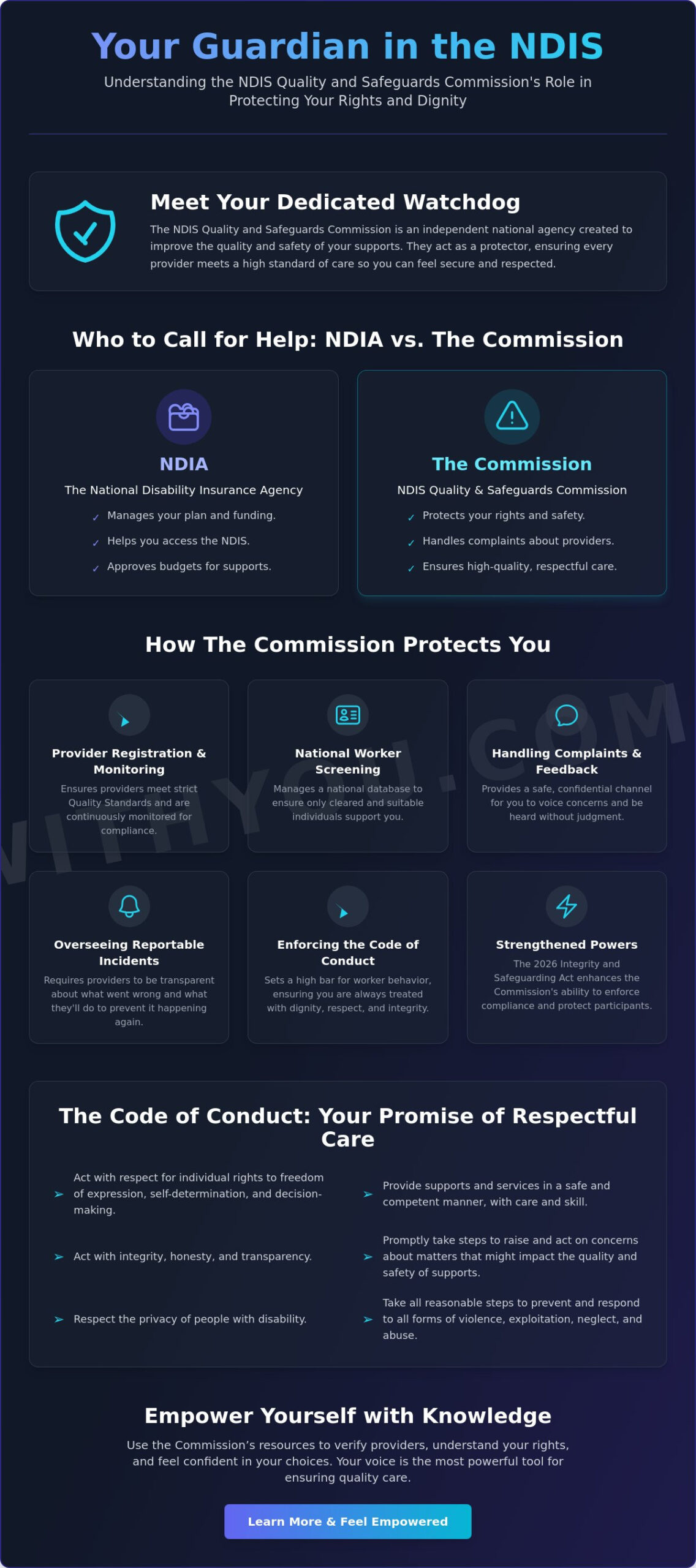
Think of the Commission as a steady, watchful presence in your life. It’s an independent agency created specifically to improve the quality and safety of the supports you receive every day. The ndis quality and safeguards commission role is that of a national regulator, focusing entirely on your rights and your safety. They act as a dedicated watchdog, ensuring every provider meets a high standard of care so you can feel secure in the choices you make.
To get a broader perspective on their history and structure, you might find this NDIS Quality and Safeguards Commission overview helpful. They offer a single, national point of contact across Australia, making it much simpler for you to voice concerns or check quality standards without having to navigate multiple systems. We know that navigating these systems can feel overwhelming, but they’re here to ensure you aren’t doing it alone.
To better understand how the Commission operates and meet the people behind it, watch this helpful video:
Why the Commission Was Created
Before this national body existed, every state and territory had its own set of rules. This often led to confusion and inconsistent levels of protection for families. We moved toward a unified national standard to ensure that no matter where you live, your safety is handled with the same level of care. This unified approach defines the ndis quality and safeguards commission role as a safeguard that stays consistent across every border. This transition also reflects a deeper commitment to person-first language and respecting your individual agency. It’s about seeing the person before the disability and ensuring the system adapts to you, not the other way around.
Who Does the Commission Protect?
The Commission is there for every single NDIS participant. It doesn’t matter if you live in a big city or a remote town, or how you choose to manage your funding. Their reach extends to your family members and carers too. We want you to feel empowered to recognize what truly “good” care looks like. By setting clear benchmarks, the Commission helps you and your loved ones identify providers who don’t just tick boxes, but genuinely value your dignity and growth. You have the right to feel safe, and they’re the team making sure that right is upheld.
Protecting Your Rights: The Core Responsibilities of the Commission
The ndis quality and safeguards commission role serves as a vital shield, ensuring that every interaction you have with a provider is grounded in safety and respect. One of their primary tasks involves the rigorous registration and monitoring of providers. They don’t simply set the bar; they actively check that providers continue to meet strict Quality Standards throughout their service. This oversight includes managing a national Worker Screening database. It’s a proactive way to ensure that only individuals who have been cleared to work in the sector are entering your home or supporting you in the community.
When mistakes happen, the Commission steps in to oversee ‘Reportable Incidents.’ This process requires providers to be transparent about what went wrong and, more importantly, what they’ll do to prevent it from happening again. This regulatory oversight was recently strengthened by the National Disability Insurance Scheme Amendment (Integrity and Safeguarding) Act 2026, which enhanced the Commission’s ability to enforce compliance. You can find detailed information on these regulatory functions on the Official NDIS Commission website. It’s about creating a culture where your safety is the highest priority.
The NDIS Code of Conduct in Practice
The Code of Conduct is more than just a list of rules. It’s a promise that workers will act with integrity, respecting your privacy and your right to express yourself freely. This commitment to excellence extends to every part of your care. For instance, it provides the framework for safe medication administration, ensuring that clinical supports are delivered with the gentle touch and high level of competence you need to stay well. Every worker, whether they’re registered or not, must follow these standards to ensure your dignity remains intact.
Handling Complaints and Feedback
We want you to know that your voice is the most powerful tool in the NDIS. The Commission provides a safe, non-judgmental space where you can share your experiences or voice concerns about a provider. Raising an issue isn’t a burden on the system; it’s a fundamental right. Your feedback helps the entire community by holding providers accountable and driving improvements across the sector. If you ever feel like you need a steady companion to help you navigate these conversations, our disability advocacy services are here to walk alongside you.
NDIS Commission vs. NDIA: Understanding the Difference
It’s completely understandable if you feel a bit confused by the different organizations that make up the NDIS. Many families we talk to find it hard to distinguish between the various bodies when they need help. To put it simply, the National Disability Insurance Agency (NDIA) handles “The Plan,” while the ndis quality and safeguards commission role focuses on “The People.” While the NDIA provides you with the keys to access support, the Commission ensures the road you travel is safe and well-maintained.
Grasping these NDIS Commission vs. NDIA roles helps you feel more in control of your journey. The NDIA manages the administrative side, like deciding who is eligible for the scheme and how much funding they receive. In contrast, the Commission acts as the regulator. They make sure the services you buy with that funding are high-quality and delivered by people who respect your agency. They don’t manage your money; they protect your rights.
When to Contact the NDIA
You should reach out to the NDIA when you need to discuss the structure of your support. This includes times when you want to update your goals, change your funding levels, or check your eligibility for the scheme. If you’re having trouble with the NDIS portal or need help understanding how to manage your budget, they’re the team to call. They’re the architects of the system, focused on the logistical and financial framework that makes your supports possible.
When to Contact the NDIS Commission
The Commission is your point of contact when the human element of support needs attention. If you ever feel unsafe or unhappy with how a service is being delivered, they’re there to listen without judgment. You should contact them if a provider isn’t following the Code of Conduct or if you need to report a serious incident involving worker behavior. They exist to protect your rights and ensure that every interaction you have is safe and supportive. If you need someone to walk alongside you while you manage these different bodies, our NDIS support coordination can provide the steady guidance you need.
Choosing Quality: How the Commission Empowers Your Choice
The ndis quality and safeguards commission role is ultimately about giving you the power to choose your supports with absolute confidence. While the Commission sets strict standards, we believe these should be viewed as a baseline rather than a final destination. High-quality providers don’t just aim to satisfy a regulatory checklist. They strive to exceed those benchmarks because they truly value your well-being and growth. You can always check a provider’s registration status and compliance history through the Commission’s public registers. This transparency provides the peace of mind that the people walking alongside you are committed to excellence and advocacy.
When you’re choosing an NDIS provider, look for those who demonstrate deep intellectual disability expertise. A provider that prioritizes person-centered care will always see you as an equal partner. They’ll have clear, accessible ways for you to provide feedback and will actively show how they use the Commission’s standards to improve your daily experience. It’s about finding a team that honors your agency at every turn.
Identifying a High-Quality Provider
Look for signs of active engagement with the community. A great provider doesn’t hide their processes. Instead, they’re open about how they meet the NDIS Practice Standards and handle your data with care. They should encourage your voice and involve you in decisions about how your supports are delivered. The ndis quality and safeguards commission role ensures these opportunities for feedback exist, but the best providers make those conversations feel like a natural part of your relationship.
Your Journey with ‘Im with you’
At ‘Im with you’, we don’t see the Commission’s rules as administrative hurdles. We embrace them as our core promise to you. Our 2026 award for excellence reflects this deep-seated commitment to being the steady, safe companion you can trust. We’re here to provide the specialized support you need while ensuring your dignity is always protected. Connect with our team today to see how we uphold the highest standards of care.
Your Path to Safe and Empowered Support
You now have the tools to navigate the system with confidence. Knowing that your safety and dignity are protected by a national watchdog makes all the difference. We’ve explored how the ndis quality and safeguards commission role serves as a vital shield, ensuring every provider meets the high standards you deserve. By understanding the difference between funding management and quality regulation, you can take full control of your journey. It’s about choosing partners who truly value your voice and your rights.
At ‘Im with you’, we take these responsibilities to heart. As a 2026 Excellence in Care Award Winner, we maintain full compliance with NDIS Quality and Safeguards Standards. Our team provides specialized support coordination and advocacy, walking alongside you as a steady, reliable companion. We don’t just follow the rules; we treat them as a promise to honor your agency and provide the respectful care you need to flourish.
Experience the ‘Im with you’ difference, where quality care meets true companionship. We’re ready to help you thrive in a community that honors your independence and celebrates your growth.
Frequently Asked Questions
Is the NDIS Commission part of the NDIA?
No, the NDIS Commission is an entirely independent government body. While the NDIA focuses on managing your plan, funding, and eligibility, the ndis quality and safeguards commission role is to regulate providers and ensure your safety. They work alongside each other but maintain separate responsibilities to keep the system fair and secure for everyone involved.
Can I make a complaint to the Commission anonymously?
Yes, you can certainly make a complaint anonymously if that makes you feel more comfortable or safe. The Commission understands that speaking up can sometimes feel overwhelming or scary. They’ll respect your privacy and handle your concerns with a gentle, non-judgmental touch while they look into the issue to ensure you receive the respect you deserve.
What happens if a provider breaches the NDIS Code of Conduct?
If a provider breaches the Code of Conduct, the Commission has the authority to investigate and take firm action to protect participants. Under the National Disability Insurance Scheme Amendment (Integrity and Safeguarding) Act 2026, these powers have been strengthened significantly. Penalties can include fines, compliance notices, or banning the provider from the sector to prevent future harm and maintain high care standards.
Do I have to use a registered NDIS provider?
Whether you must use a registered provider depends on how your plan is managed. If the NDIA manages your funding, you’re required to use registered providers. However, starting July 1, 2026, all platform providers and those offering supported independent living (SIL) must be registered with the Commission. This change ensures that even more participants have the protection of the Commission’s rigorous safety benchmarks.
How do I know if my support worker has been screened by the Commission?
You have every right to ask your provider for confirmation that their staff have a valid NDIS Worker Screening Check. The ndis quality and safeguards commission role includes maintaining a national database that providers use to verify these clearances. These checks are valid for five years and ensure that the people supporting you have been thoroughly vetted for safety and integrity.