

What if the systems meant to track “incidents” weren’t just administrative hurdles, but were actually a direct promise of your safety and dignity? It’s completely natural to feel a bit anxious when things don’t go as planned with your support, and you shouldn’t ever have to fear retaliation just for speaking your truth. Navigating ndis incident management for participants can feel overwhelming, especially when you’re worried about being treated like a number in a complex system or getting lost in confusing jargon.
We’re here to show you that these rules are a powerful tool designed to protect your rights and ensure you receive the compassionate, high-quality care you deserve. You deserve to feel safe, heard, and valued every single day. In this guide, we’ll walk alongside you to explain the exact steps a provider must take to fix problems, from reporting serious concerns to the NDIS Commission within 24 hours to involving you in the resolution. You’ll discover how to find a support team that treats your well-being as their highest priority, turning a confusing process into a clear path toward peace of mind.
Key Takeaways
- Understand how ndis incident management for participants acts as a gentle safety net to protect your dignity and personal well-being.
- Discover the five-step journey we take together to resolve concerns and restore your sense of peace and security.
- Learn to recognize the signs of a high-quality provider, including a commitment to total transparency and a compassionate “no-blame” culture.
- Explore how the “I’m with you” philosophy ensures you’re never alone when navigating challenges within the NDIS system.
What Is NDIS Incident Management and Why Does It Matter to You?
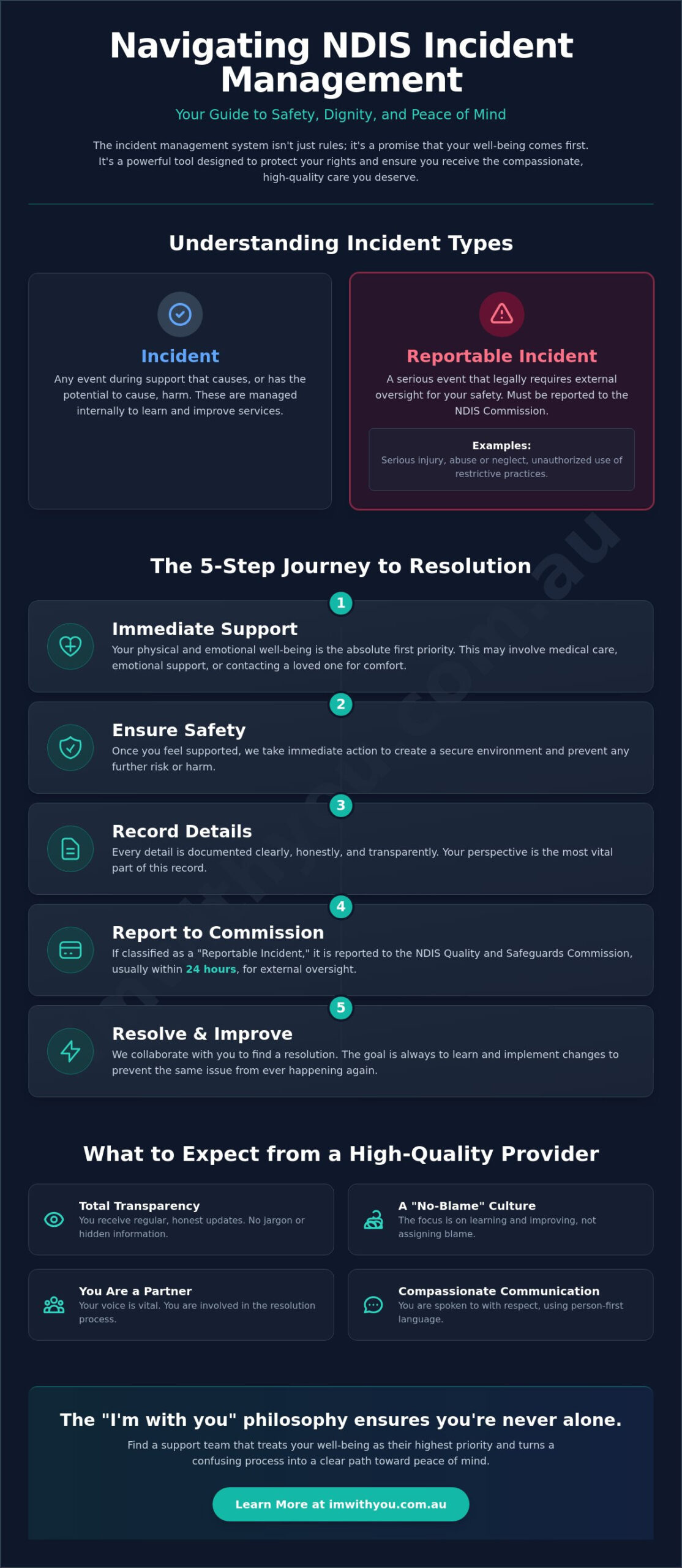
Think of incident management as a gentle, invisible safety net that catches you whenever something goes wrong during your support. It isn’t just a set of government rules; it’s a promise that your dignity and well-being come first. In the context of ndis incident management for participants, we define an “incident” quite broadly. It’s any event that happens while you’re receiving support that causes harm, or even something that simply had the potential to cause harm. We take every situation seriously because you have an absolute right to feel safe, heard, and respected in your own home and community.
This system exists for continuous improvement. It helps us learn from mistakes so we can provide the compassionate care you deserve, rather than just checking boxes for the NDIS Quality and Safeguards Commission. By looking closely at what happened, we can make changes to our services that prevent the same problem from occurring again. It’s a collaborative way to ensure your supports are always evolving to meet your needs.
To better understand how these processes keep you safe, watch this helpful video:
The Difference Between an Incident and a Reportable Incident
While we manage every small concern within our team, some events are classified as “reportable” by law. These are serious situations that must be shared with the Commission to ensure external oversight and your continued safety. Examples include serious physical injuries, any form of abuse or neglect, or the use of unauthorized restrictive practices. A reportable incident is a serious event that triggers an external safety review to ensure the highest standards of care are met.
Your Voice in the Process
Your perspective is the most vital part of any investigation. We don’t just look at reports; we listen to you. We use person-first language to ensure you’re always seen as a unique individual with your own feelings and needs, never just a case number. You’re the expert in your own life, and your feedback helps us build a safer, kinder environment for everyone.
The 5 Essential Steps in an Incident Management Procedure
When something doesn’t go right, it’s our job to walk beside you until you feel steady again. This journey from an incident back to a place of peace follows five specific, essential steps. Whether you’re receiving supported independent living or community support, these steps ensure your rights are protected. Understanding ndis incident management for participants helps you see that these procedures are not just paperwork. They’re a roadmap to your safety. The ultimate goal isn’t just to file a report; it’s to learn and prevent the same thing from ever happening again.
Step 1 & 2: Immediate Support and Safety
Your safety is the heartbeat of everything we do. As soon as an incident occurs, our first and only priority is your immediate physical and emotional well-being. We don’t worry about forms or files until we know you’re okay. This might mean arranging medical care, offering a quiet space to talk, or contacting a loved one to provide extra comfort. We’ll stay with you for as long as it takes for you to feel secure. This immediate support is the foundation of our “I’m with you” commitment.
Step 3, 4 & 5: Recording, Reporting, and Resolving
Once you’re safe, we move into recording, reporting, and resolving. We document every detail clearly and honestly, following the Incident Management Practice Standard to ensure our process is transparent and meets high industry benchmarks. The resolution phase is the most important part for your future. It’s when we look at how we can improve. For example, we might review the six rights of medication to strengthen our safety checks and prevent errors. We turn every challenge into a lesson that helps us provide better care. If you ever feel unsure about your journey, our team is here to offer compassionate support coordination to help you find the right path forward.
What You Should Expect from Your NDIS Provider During an Incident
When you’re at the center of an incident, the way your provider treats you matters just as much as the paperwork they file. A high-quality provider acts with total transparency. They’ll never hide information from you or speak in riddles. Instead, they should offer regular, honest updates so you’re never left in the dark about your own life. This is a core part of effective ndis incident management for participants; it’s about keeping you informed and empowered throughout the entire resolution process.
You should also expect a “no-blame” culture. This means the focus stays on learning and safety rather than looking for someone to punish. When we look at what went wrong, we’re looking for ways to make your support stronger and kinder. Even while an issue is being resolved, your life shouldn’t come to a standstill. Your provider should encourage you to keep finding joy in leisure activities and community connections. Safety processes are meant to support your life, not replace it.
The Right to an Advocate
You don’t ever have to navigate these conversations alone. You have every right to involve a family member, a trusted friend, or a professional advocate in any meeting or discussion. A supportive NDIS provider won’t just “allow” an advocate; they’ll actively help you find one if you feel overwhelmed. Having someone in your corner ensures your voice is heard loud and clear. It’s about making sure you feel steady and supported every step of the way.
Protection from Retaliation
It’s common to feel a flicker of fear about “getting in trouble” for speaking up. We want to reassure you that your bravery is protected. The NDIS Code of Conduct strictly prohibits any provider from taking negative action against you for reporting a concern or filing a complaint. Speaking up is a right, not a risk. If you’re looking for a team that prioritizes your safety and dignity, we invite you to explore our disability advocacy services where your well-being is our only goal.
How ‘Im with you’ Supports Your Journey Toward Safety and Peace of Mind
Our philosophy at “I’m with you” is simple: we’re your steady companion, not just another service provider. We believe that true support is built on a foundation of proximity and trust. This commitment to your safety was recognized with our 2026 excellence award, which reflects our unwavering dedication to superior safety standards. When we talk about ndis incident management for participants, we aren’t just discussing regulations. We’re talking about a human process of healing and restoration that ensures you feel safe in your own skin and your own home again.
We invite you to reach out to us at any time. Even if you just have a small worry or a “what if” question, our doors and hearts are open. You don’t need a major crisis to deserve a conversation about your comfort. We’re here to listen, to validate your feelings, and to ensure that your NDIS journey is one of joy and security. Your peace of mind is the only metric that truly matters to us.
A Proactive Approach to Your Wellbeing
We don’t just wait for incidents to happen so we can fix them. Instead, we work daily to prevent them through a blend of expert training and deep empathy. Our specialized focus on intellectual disability care allows us to anticipate and understand the unique safety needs of every individual. By recognizing the subtle signs of distress or environmental triggers, we create a protective space where you can thrive without fear. We prioritize your agency, ensuring that safety measures never feel like restrictions on your independence.
Our Commitment to You
Our promise to you is steadfast. You’ll be safe. You’ll be heard. Most importantly, you’ll never have to navigate a difficult moment alone. We view incident management as a collaborative bridge back to peace of mind, and we’ll walk across it with you every step of the way. We invite you to take the next step with us today. Let’s build a partnership founded on genuine trust, where your well-being is always the first priority.
Embracing a Future of Safety and Support
Your journey with the NDIS should always feel like a partnership built on respect and absolute safety. We’ve explored how ndis incident management for participants serves as a vital safety net, ensuring your dignity remains protected even when challenges arise. You have every right to transparency, a “no-blame” culture, and the support of an advocate whenever you need it. These aren’t just administrative rules; they’re core promises to keep your well-being at the heart of every interaction.
As a National NDIS Registered Provider, we take these promises to heart. Our 2026 Award for Excellence in Disability Care reflects our deep commitment to person-centered advocacy and support. We’re here to walk alongside you, providing the steady companionship you deserve as you navigate your goals. You don’t have to carry your worries alone, and you don’t have to settle for anything less than compassionate care. Let’s walk this path together; contact Im with you for compassionate NDIS support today. We’re ready to listen and support you with the warmth and patience you deserve.
Frequently Asked Questions
What should I do first if an incident happens during my support?
Your immediate physical and emotional safety is the very first priority. If you’re in danger or hurt, seek medical help or move to a safe space right away. Once you’re out of harm’s way, tell someone you trust, such as a family member or a support worker, so they can help you begin the process of feeling steady again.
Can I make a complaint about an incident even if I wasn’t physically hurt?
Yes, you absolutely can and should report any event that makes you feel unsafe or disrespected. Ndis incident management for participants covers emotional harm, “near misses,” and situations where your rights weren’t upheld. We believe your peace of mind is just as important as your physical health, and every concern you share helps us improve your care.
Will I lose my NDIS funding if I report an incident involving my provider?
No, you’ll never lose your funding for speaking up about your safety or the quality of your supports. Your NDIS plan is yours, and the system is designed to protect you from any form of retaliation. Reporting an incident is actually a brave step that helps ensure you’re receiving the high-quality, compassionate services you’re entitled to.
How long does a provider have to report a serious incident to the NDIS Commission?
Registered providers must notify the NDIS Commission of most reportable incidents within 24 hours of becoming aware of the event. This quick action ensures that external experts can provide oversight immediately. A more detailed report is then required within 5 business days to provide a comprehensive look at how the situation is being resolved.
What happens if I’m not happy with how my provider handled an incident?
You have the right to take your concerns further if you don’t feel heard or satisfied with the outcome. You can contact the NDIS Quality and Safeguards Commission directly to make a formal complaint. Many people also find it helpful to reach out to disability advocacy services, which provide a steady companion to help you navigate these conversations and protect your rights.