

What if the biggest hurdle to your independence isn’t your disability, but the complex language of a bureaucratic system? It’s incredibly draining to feel like a mere number in a system that’s supposed to be about your life. You might worry about funding cuts during reviews or struggle to find the exact words that help a planner see your daily reality. We understand that it’s exhausting to feel you have to fight for every bit of support you need.
This article explores the role of a disability advocate in ndis and how they act as your strategic partner to help you protect your rights and justify the supports you deserve. You’ll discover how an advocate empowers you to navigate the scheme with confidence, ensuring your voice is heard and understood by the NDIA. We’ll show you how to move from feeling overwhelmed by paperwork to feeling secure in the knowledge that you have a knowledgeable companion by your side. We will look at how to translate your lived experience into the specific evidence required for “reasonable and necessary” funding, helping you build a life focused on your strengths and goals.
Key Takeaways
- Learn how an independent advocate ensures your voice is heard and your rights are protected throughout your NDIS journey.
- Discover the specific role of a disability advocate in ndis as a strategic partner who helps you navigate complex systems with renewed confidence.
- Master the art of translating your daily challenges into powerful impact statements that align with the “reasonable and necessary” funding criteria.
- Find out how having a steady companion during your plan review can lower stress and ensure every important detail of your life is accurately shared.
- Understand how a compassionate, expert approach shifts the focus from administrative management toward a life-focused partnership built on your goals.
What is the Role of a Disability Advocate in the NDIS?
At its heart, advocacy is about making sure your voice isn’t lost in the noise of a large system. The primary role of a disability advocate in ndis is to stand beside you, ensuring your rights are protected and your wishes are respected. You’re the absolute expert on your own life and your own needs. An advocate doesn’t take that away from you; they simply help carry the administrative weight so you can focus on living. They empower you to make informed decisions by explaining complex rules in a way that makes sense for your specific situation.
There are different ways this support looks in practice. Self-advocacy is when you speak up for yourself. Systemic advocacy works on a larger scale to change laws and policies for everyone. Individual advocacy, which is what we often focus on within the National Disability Insurance Scheme (NDIS), is when a dedicated person works one-on-one with you to solve a specific problem or reach a certain goal. This partnership creates a safe space where you can explore your options without judgment.
To help you visualize how this partnership works in the real world, watch this helpful video:
The Vital Difference: Advocate vs. Support Coordinator
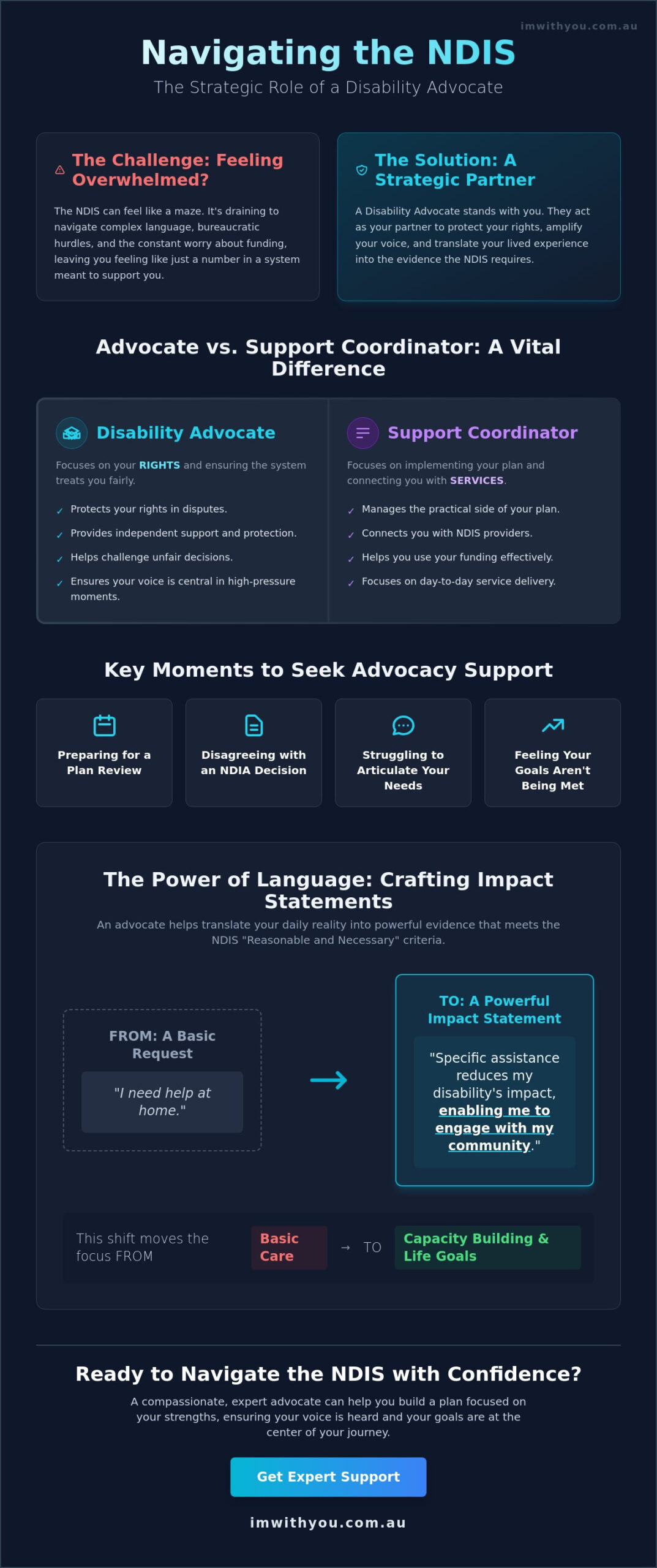
It’s common to wonder why you might need an advocate if you already have support coordination. While an ndis provider helps you implement your plan and connect with daily services, their role is different from an advocate. A support coordinator focuses on the practical management of your plan. An advocate focuses on your rights. If you’re in a dispute with the NDIA or feel your funding doesn’t reflect your needs, an independent advocate provides that extra layer of protection. They aren’t there to manage your services; they’re there to make sure the system treats you fairly.
When Should You Seek an Advocate?
You don’t have to wait for a crisis to ask for help. Certain trigger moments make having an advocate especially valuable. This includes preparing for a plan review or requesting an internal merits review, often called an S100, if you disagree with a decision. For individuals living with an intellectual disability, an advocate ensures their agency remains at the center of every conversation. If you feel your goals aren’t being met or you’re struggling to articulate your needs to a planner, that’s the perfect time to reach out. The role of a disability advocate in ndis is to be your steady companion through these high-pressure moments.
Using Advocacy to Meet “Reasonable and Necessary” Criteria
Securing the right funding isn’t just about listing your needs; it’s about meeting the specific legal standards set out in Section 34 of the NDIS Act. This section is the framework the NDIA uses to decide what’s “reasonable and necessary.” The role of a disability advocate in ndis planning is largely about bridge-building between your daily life and these legal requirements. Organizations like the Disability Advocacy Network Australia emphasize that this independent support is vital for upholding your rights during this process. An advocate helps you prove that a support is effective, beneficial, and represents value for money.
One of the most powerful tools an advocate provides is the “impact statement.” Instead of simply stating a diagnosis, they help you translate your daily challenges into clear evidence. For example, rather than saying you need help at home, they help you explain how specific assistance reduces the impact of your disability on your ability to engage with your community. This shift in language helps planners see the person behind the paperwork. If you ever feel like your needs are being overlooked, our team can help you explore your options for compassionate support that puts you first.
Aligning Supports with Your Life Goals
An advocate links your personal aspirations to NDIS-funded categories by demonstrating how specific supports directly enable you to reach your milestones. They move the conversation away from “basic care” and toward “capacity building.” This approach ensures that every dollar in your plan is tied to increasing your independence and helping you participate in social or economic life on your own terms.
Justifying Complex Living Arrangements
When you’re looking for more significant changes, such as supported independent living ndis, the evidence requirements become much stricter. Advocates act as project managers for your evidence. They help gather multi-disciplinary reports from occupational therapists, psychologists, and other professionals to create a holistic case for your independence. By coordinating these professional voices, an advocate ensures the NDIA receives a complete and undeniable picture of why a specific living arrangement is the right choice for your future.
Practical Ways an Advocate Supports You During an NDIS Review
Reviews can often feel like an interrogation, but they shouldn’t. The role of a disability advocate in ndis reviews is to act as your buffer and your voice. Before you even step into the meeting, I’ll help you organize your thoughts and evidence so nothing gets missed. We’ll look at your goals together and ensure you feel ready to speak your truth. This preparation turns a high-pressure event into a structured conversation where you remain the central figure.
During the meeting, having a steady companion makes a world of difference. It’s easy to forget a vital point when you’re feeling pressured or overwhelmed. I stay focused on the details, ensuring the planner hears everything you intended to say. Afterward, we don’t just wait for the mail and hope for the best. We review the draft plan together to make sure it actually reflects our discussion and includes the supports you requested.
Throughout this process, we always prioritize person-first language to keep the focus on you as an individual. This ensures the resulting plan is built around your aspirations and identity, rather than just a list of medical deficits. It’s about making sure the system sees the person, not just the disability.
The Role of Evidence and Documentation
Sometimes, therapist reports have gaps that lead to unexpected funding cuts. I’ll help you identify these missing pieces before they become an issue. One effective tool we use is a “day in the life” statement. This document highlights exactly why current funding might be falling short by painting a vivid picture of your daily routine and the specific support needed to keep you safe and independent. It provides the human context that clinical reports sometimes miss.
Navigating Disagreements with the NDIA
If your funding is reduced or a request is denied, you don’t have to accept it quietly. There are clear steps we can take together. I’ll support you through the internal review process and, if needed, walk beside you through the Administrative Appeals Tribunal (AAT). This can be a long road, but you won’t walk it alone. If you’re facing a difficult review, reach out so we can start preparing your advocacy strategy today.
Im with you: Your Companion in NDIS Advocacy and Support
I’ve seen how the NDIS can feel like a maze of acronyms and rigid rules. At Im with you, we believe you should never have to walk that path alone. Our 2026 Award for Excellence isn’t just a trophy on a shelf; it’s a reflection of our deep commitment to walking beside you, not just for you. We’ve built our service on the belief that the role of a disability advocate in ndis planning is to be a steady, reliable companion who balances expert industry knowledge with a gentle, human touch. We don’t just see a participant number; we see a person with dreams, preferences, and a right to be heard.
Advocacy isn’t just a separate service we offer; it’s a principle we weave into every part of our support coordination and community participation. Whether we’re helping you prepare for a high-stakes review or supporting you in your daily life, we’re always looking for ways to protect your rights and amplify your voice. The bureaucracy can be heavy, but when you have a knowledgeable friend by your side, the weight feels much easier to manage. We’re here to ensure the system works for you, rather than you having to work for the system.
A Person-Centered Approach to Quality Care
Your dignity and independence are the foundation of everything we do. This person-centered focus extends to even the most technical parts of your support. For instance, when assisting with health-related tasks, we strictly follow the six rights of medication administration. We treat these industry standards as core promises of safety and respect, ensuring you feel secure and cared for in your own home. The Im with you promise is simple: I’m your steady companion through every plan review, every transition, and every milestone you choose to reach.
Let’s Start a Gentle Conversation
If you’re feeling overwhelmed by an upcoming review or frustrated that your current plan doesn’t reflect your life, please reach out. I’d love to start a gentle conversation about how we can support your advocacy needs and help you secure the funding you deserve. There’s no pressure and no judgment here. We’ll simply listen to your story and explore your options together. Remember, your voice is the most important one in the room; I’m just here to make sure everyone else hears it too.
Step Into Your Future With Confidence
You deserve a life that feels full, vibrant, and properly supported. We’ve explored how the role of a disability advocate in ndis transforms a complex bureaucratic process into a manageable journey toward independence. By translating your daily needs into the specific language of the “reasonable and necessary” framework, an advocate ensures your voice remains the most important one in the room. You now have the tools to approach your next review knowing you don’t have to carry the administrative weight alone.
Our team at Im with you is honored to be your steady companion. Our 2026 Award for Excellence in Disability Support reflects our deep commitment to your agency and dignity. We balance specialized expertise in NDIS regulations with a gentle, person-centered approach that always puts your needs first. If you’re ready to feel empowered and less stressed about your funding, let us walk beside you; explore our advocacy-led NDIS supports today. Your goals are within reach, and we’re here to help you claim the future you deserve.
Frequently Asked Questions
Is a disability advocate the same as a lawyer?
No, a disability advocate isn’t the same as a lawyer. While both roles involve protecting your rights, an advocate focuses on helping you express your own views and navigate the administrative side of the system. They provide a gentle, human touch to ensure you’re heard during meetings and planning sessions. If your situation involves complex legal disputes in a court, a lawyer is necessary; however, an advocate is your daily companion for NDIS navigation.
Do I have to pay for a disability advocate in Australia?
Most individual advocacy services in Australia are provided free of charge. The Australian Government funds these supports through the National Disability Advocacy Program to ensure everyone has access to a voice. You don’t need to use your NDIS funding for these independent services. It’s also helpful to know that a new Commonwealth individual disability advocacy program is launching on November 16, 2026, which will continue to offer this vital, no-cost support to our community.
Can my Support Coordinator also act as my advocate?
While your Support Coordinator is a wonderful ally, they shouldn’t be your formal independent advocate. The role of a disability advocate in ndis requires total independence from the services you use. This prevents any conflict of interest if you need to challenge a provider or a decision made by the NDIA. Your Support Coordinator focuses on the practical implementation of your plan, while your advocate focuses purely on your rights and your agency.
What should I do if the NDIS denies my request for an advocate?
The NDIA doesn’t actually “approve” or “deny” your right to an advocate because advocacy is an independent support. You have a fundamental right to have a support person or advocate of your choice present during any meeting or review. If you’re told otherwise, you can calmly remind the staff that the NDIS Act supports your right to representation. You’re never required to face the bureaucracy alone if you’d prefer to have a companion by your side.
How do I find an independent advocate who understands my specific needs?
You can find a knowledgeable advocate through the Disability Gateway or the Disability Advocacy Network Australia website. These tools allow you to search for organizations that specialize in your specific disability or cultural background. Peer networks are also a great way to find a trusted guide who understands your lived experience. Finding the right advocate is about choosing someone who makes you feel safe, non-judged, and completely supported as you pursue your goals.