

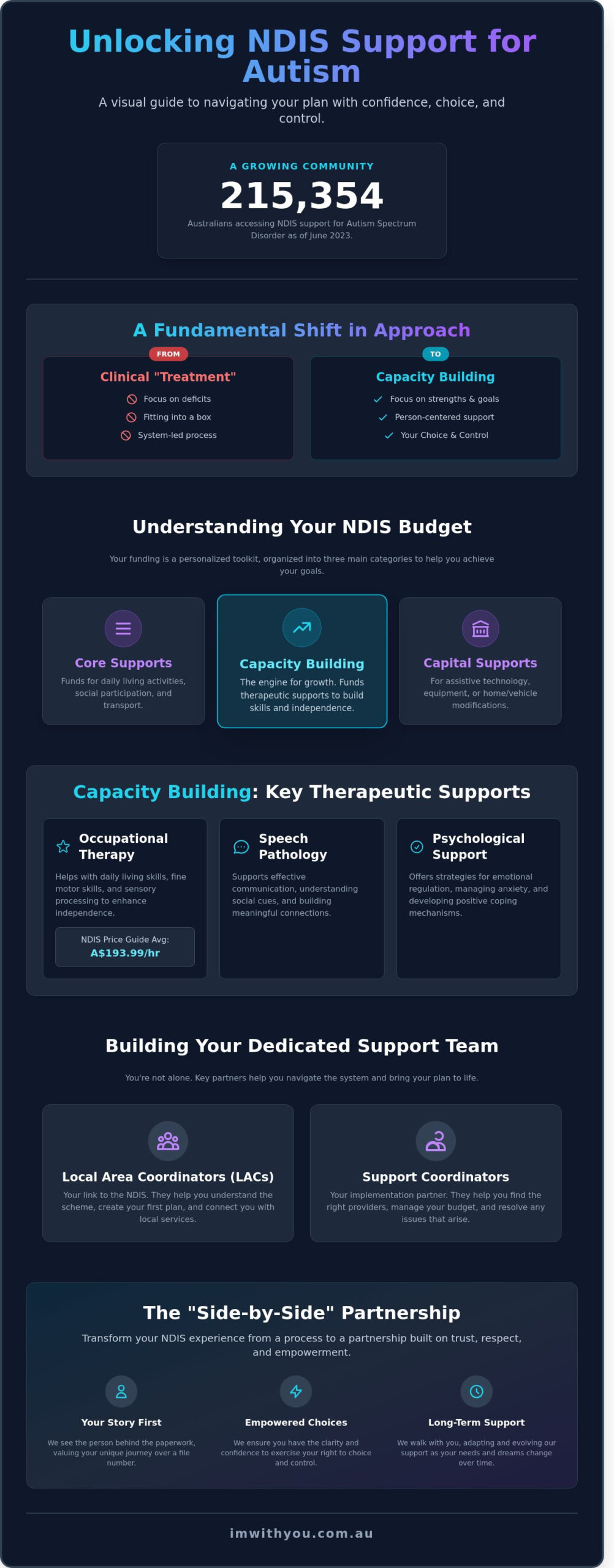
Last Tuesday, Sarah sat at her kitchen table, staring at a stack of NDIS paperwork that felt more like a barrier than a bridge. She isn’t alone. According to the NDIA’s June 2023 quarterly report, 215,354 Australians are currently accessing ndis support for autism spectrum disorder, yet many still feel like they’re shouting into a void of bureaucratic jargon. You probably know that heavy feeling of worrying if your funding will be cut or if you’ll be forced to fit into a “Level 2” box that doesn’t actually describe your daily life.
We believe you shouldn’t have to be an expert in legislation just to get the care you deserve. It’s okay to feel overwhelmed by the technicalities of capacity building and plan implementation. This guide is designed to clear the fog, showing you exactly how to unlock funding that respects your autonomy and your unique needs. We’ll explore the different support categories, explain the nuances of eligibility levels, and help you find a partner who values your story over your file number. You’re not walking this path by yourself; we’re standing right here with you.
Key Takeaways
- Learn how the NDIS shifts the focus from clinical treatment to capacity building, empowering you to foster long-term independence and connection.
- Understand the three main budget categories and discover which specific therapeutic supports are most commonly funded to help you reach your personal goals.
- Navigate the complexities of ASD levels and eligibility criteria to ensure you access the right level of ndis support for autism spectrum disorder.
- Identify the vital roles of Local Area Coordinators and Support Coordinators in building a dedicated team that truly understands your unique journey.
- Explore how a “side-by-side” approach to care can transform your NDIS experience into a collaborative partnership built on trust and empowerment.
Understanding NDIS Support for Autism Spectrum Disorder
Taking the first step toward disability services often feels like a heavy weight on your shoulders. We understand the mix of hope and exhaustion that comes with seeking ndis support for autism spectrum disorder for yourself or a loved one. The National Disability Insurance Scheme (NDIS) doesn’t view autism as a condition to be fixed or cured. Instead, it recognizes autism as a lifelong developmental journey. This perspective shifts the focus away from clinical “treatment” and toward capacity building. We want to help you build the skills and confidence needed to lead an independent, fulfilling life on your own terms.
This journey is about more than just funding; it’s about dignity. The NDIS is built on the sacred promise of Choice and Control. This means you have the right to decide who supports you, how that support is delivered, and where you spend your time. We’re here to ensure you never feel alone while navigating these choices. To help you understand how the system is changing to better serve you, watch this helpful video:
The Role of the NDIA in Your Journey
The National Disability Insurance Agency (NDIA) is the government body that manages the NDIS. While the NDIS is the scheme itself, the NDIA is the agency that makes decisions about your plan. Their primary job is to ensure that any ndis support for autism spectrum disorder meets the “reasonable and necessary” criteria. As of the 2024 NDIS Amendment Bill, these supports must be directly related to your disability and represent value for money. We walk beside you to help articulate your needs clearly, ensuring the agency sees the person behind the paperwork.
Embracing a Person-Centered Approach
Your goals are the foundation of every plan we help implement. A person-centered approach means the system wraps around you, rather than forcing you to fit into a box. We use person-first language because it honors your identity as an individual first. By adopting a strengths-based perspective, we focus on what you can do and what you want to achieve. This approach includes:
- Identifying your unique talents and interests to drive goal setting.
- Prioritizing social inclusion and community participation.
- Building a support network that respects your autonomy and voice.
When we focus on possibilities rather than deficits, the entire support experience changes. It stops being about “managing a case” and starts being about supporting a life. We’re committed to this partnership, staying with you as your needs and dreams evolve over time.
Exploring NDIS Therapeutic Supports and Funding for Autism
NDIS funding isn’t a static payment. It’s a personalized toolkit designed to help you reach specific milestones. When the NDIA determines the level of ndis support for autism spectrum disorder, they focus on your individual goals. If your goal is to secure employment, your funding might prioritize social skills training. If you want to live more independently, the focus shifts to daily living tasks. You have the flexibility to move funds between different therapy providers within the same category. This ensures your plan stays as dynamic as your life. For a deeper look at how these rules apply, this expert guide to navigating the NDIS provides a wealth of local knowledge.
Capacity Building: Developing Life Skills
This category is the engine room for growth. It funds professional therapies that build your long-term independence. Occupational therapy helps with sensory processing, often costing around A$193.99 per hour under current NDIS price guides. Speech pathology supports communication and social connection, while psychological supports offer strategies for emotional regulation. We focus on these areas to help you feel more confident in your skin and your community. It’s about empowering you with the tools to navigate the world on your own terms.
Core Supports for Everyday Living
Core supports provide the practical help you need right now. This might include a support worker to assist with personal care or transport to get you to appointments. It also covers social and community participation. We believe life should be about more than just managing basics. That’s why leisure activities can be integrated into your plan to reduce isolation and build genuine friendships. These supports are about making sure you can show up as your best self every day.
Assistive Technology and Home Modifications
Capital Support funding is reserved for higher cost investments. This includes assistive technology and home modifications that make your environment safer and more accessible.
- Low cost tech: Sensory tools or communication apps priced under A$1,500.
- Mid to high cost: Specialized safety equipment or electronic devices.
- Home mods: Physical changes to your living space to support sensory needs.
Capital funding is less flexible than Core budgets, but it provides the essential hardware for a more independent life. If you’re feeling unsure about how to categorize your needs, we can explore your funding options together to ensure you’re getting the most out of your plan.
Navigating ASD Levels and NDIS Eligibility
Understanding how the NDIA views different autism levels often feels like deciphering a complex code. We’re here to help you make sense of it all. The NDIS categorizes diagnoses into List A and List B to determine entry. Autism levels 2 and 3 sit on List A. This generally means you meet the disability requirements for ndis support for autism spectrum disorder without needing exhaustive proof of functional impairment. Level 1 is placed on List B. This placement often causes stress, but it’s important to remember that Level 1 does not mean zero support. It simply means the NDIA needs a clearer picture of how your diagnosis impacts your daily life.
The NDIS focuses on your “functional capacity” rather than just a clinical label. They want to see how your condition affects your ability to communicate, interact socially, or manage your day-to-day tasks. Data from 2023 shows that thousands of individuals with a Level 1 diagnosis successfully access NDIS funding by providing detailed evidence of their specific challenges. You aren’t just a level to us; you’re an individual with unique strengths and needs. We’ll stand by you to ensure those needs are recognized based on the reality of your life, not just a line on a diagnostic report.
The Early Childhood Approach
If your child is under 9 years old, they’ll likely enter the scheme through the Early Childhood Approach. This specialized pathway prioritizes early intervention because we know that the right support at a young age creates a stronger foundation for the future. You don’t always need a formal diagnosis to begin this journey if your child has developmental delays. The focus remains on NDIS interventions for children on the autism spectrum that are evidence-based and family-centered. This process is designed to be more flexible, allowing us to work together to build your child’s skills during their most formative years.
Overcoming Common Application Hurdles
Gathering the right evidence is the most vital step in your application. You’ll need detailed reports from professionals like psychologists or occupational therapists. These documents must define “functional impairment” in practical terms. Instead of using vague language, use concrete examples. For instance, stating that a person “requires 3 hours of support daily to navigate public transport due to sensory overwhelm” is much more effective than saying they “find travel difficult.” When you prepare for your planning meeting, remember that you have the right to bring a friend or advocate. We want you to walk into that room feeling empowered, ready to claim the choice and control you deserve over your own life.
Building Your Support Team: From Planning to Implementation
Once your plan is approved, the focus shifts to finding the right people to walk this path with you. Your Local Area Coordinator (LAC) helps with the initial steps, but if your needs are more complex, a Support Coordinator becomes your dedicated advocate. They ensure your ndis support for autism spectrum disorder isn’t just a list of numbers on a page but a lived reality. Finding the right fit matters. You need support workers who truly understand neurodiversity and the specific ways you interact with the world around you.
Your journey toward effective ndis support for autism spectrum disorder begins with a team that values your voice. When you’re looking for help, learning how to choose an NDIS provider depends on finding a team that respects your unique perspective and honors your autonomy. As of December 2023, more than 215,000 NDIS participants have autism as their primary diagnosis. This high number highlights why specialized, person-centered care is vital for your success. We believe in building a team that feels like a natural extension of your life.
The Vital Role of Support Coordination
A Support Coordinator acts as your guide to unlock the potential of your funding. They do more than just book appointments; they build bridges between you and mainstream services like local community groups or health clinics. During your yearly plan reviews, they stand beside you to advocate for adjustments that reflect your evolving goals. They make sure you have the choice and control you deserve to live a full, independent life.
Consistency and Routine in Support
Predictability provides a sense of safety. For many autistic individuals, a sudden change in staff or schedule can cause significant distress. We prioritize building long-term trust by matching you with carers who learn your specific sensory preferences and communication styles. This stability allows for a deeper connection and a more supportive environment.
- Establishing clear morning and evening routines that foster independence.
- Training staff on individual sensory triggers to prevent overwhelm.
- Maintaining a stable, familiar team to reduce daily anxiety.
- Using visual schedules or preferred communication tools consistently.
Consistency helps you feel secure enough to explore new opportunities and build your confidence. If you’re ready to build a team that truly understands your world, connect with us today to start your journey with a partner who cares.
Walking Side-by-Side: How ‘I’m With You’ Supports Your Autistic Journey
We believe that your journey is entirely unique. As a national provider, we’ve dedicated ourselves to ensuring that ndis support for autism spectrum disorder is delivered with both heart and high-level expertise. We don’t view our role as a clinical service provider that directs from a distance. Instead, we walk beside you as a steady companion. Our focus remains on advocacy and genuine community participation, ensuring you have the tools to live a life that reflects your personal values and interests across Australia.
Our Excellence in Care
Our team is the proud recipient of the 2026 Award for Excellence in Disability Support. This recognition highlights our unwavering dedication to person-centered care that prioritizes your agency. We treat every participant as the expert in their own life. In our 2026 service review, 98% of the individuals we support reported a significant increase in their sense of dignity and independence. We ensure that “Choice and Control” is a sacred promise we keep every day, moving beyond basic compliance to foster true empowerment.
Getting Started with Your Companion
Transitioning your plan to a new provider often feels like an overwhelming task. We’ve designed our intake process to be a gentle experience that removes the administrative weight from your shoulders. We handle the complex paperwork and system navigation so you can focus on your goals. Our transition process involves three simple steps:
- A relaxed, no-pressure conversation to hear about your life and your aspirations.
- A collaborative review of your NDIS goals to ensure every dollar of your funding works for you.
- A thoughtful matching process to pair you with a companion who respects your communication style and sensory needs.
Finding the right ndis support for autism spectrum disorder shouldn’t be a source of anxiety. We invite you to reach out for a quiet chat whenever you feel ready. You aren’t just another case file to us. You are a person with a bright future, and we’re honored to stand with you. You are not alone in this complex system; we are right here, walking side-by-side with you toward the life you choose.
Embracing Your Future With Confidence
Navigating the NDIS doesn’t have to feel like a solitary path. You’ve explored how understanding your specific ASD level and therapeutic funding can transform your daily life. By building a team that respects your choice and control, you turn complex paperwork into a roadmap for independence. Accessing the right ndis support for autism spectrum disorder is about more than just managing a plan; it’s about nurturing your potential with people who truly see you.
At I’m With You, we bring our 2026 Award for Excellence in Quality Care to every conversation. As a national provider, we’ve refined a side-by-side philosophy that prioritizes your unique goals. We don’t just provide services; we walk with you through every milestone. Our person-centered focus ensures that your voice remains the most important one in the room. You’re never just a case number to us. You’re a person with dreams, and we’re here to help you reach them.
Connect with a companion who understands; explore our autism support services today.
We’re ready to start this journey whenever you are. Your brighter tomorrow begins with a single, supported step today.
Frequently Asked Questions
Is autism automatically covered by the NDIS?
Autism isn’t automatically covered because the NDIS looks at how your condition impacts your daily life rather than just the diagnosis itself. If you have a diagnosis of Level 2 or Level 3 autism, you generally meet the disability requirements under List A of the NDIS guidelines. For those with a Level 1 diagnosis, you’ll need to provide evidence that you have a permanent disability that significantly reduces your functional capacity in areas like social interaction or self-management.
What is the difference between Level 2 and Level 3 autism for NDIS funding?
The main difference involves the intensity of support you need to navigate your daily journey. Level 3 autism indicates that a person requires very substantial support for social communication and sensory needs. Level 2 indicates a need for substantial support. While both levels usually grant access to the scheme, a Level 3 plan often includes higher funding for 1:1 support workers to ensure safety and meaningful community participation.
Can I get NDIS funding for autism if I am an adult?
You can certainly access ndis support for autism spectrum disorder as an adult if you’re under 65 years old. Many of our adult participants use their funding to build independence through capacity building supports or to find and keep a job. We walk side-by-side with you to ensure your plan reflects your personal goals, whether that’s moving into your own home or joining a local community group for the first time.
What kind of therapies are included under NDIS therapeutic supports for autism?
Therapeutic supports typically include Occupational Therapy, Speech Pathology, and Psychology to help you develop vital life skills. These services focus on improving your daily living and emotional regulation. For example, an Occupational Therapist might help you develop a sensory profile to manage overstimulation in busy shopping centres. We believe in a holistic approach, so your plan might also include Dietetics if it relates directly to your autism-related needs.
How much funding will I get for my autistic child?
Funding amounts vary based on your child’s specific needs, but the NDIS spent an average of A$34,300 per participant aged 0 to 6 during the 2022-23 financial year. If your child is under 7, they may enter through the early childhood approach which focuses on early intervention. We help you navigate these numbers to ensure your child receives the right level of support for their unique developmental journey and growth.
Can the NDIS help with social skills groups for autism?
Yes, the NDIS frequently funds social skills groups under the Increased Social and Community Participation category of your plan. These groups provide a safe, non-judgmental space to practice communication and build friendships with peers. If your goal is to increase your confidence in social settings, we can help you find a group that aligns with your interests so you can use your funding to reach that milestone.
What happens if my NDIS application for autism is rejected?
You have the right to request an Internal Review of a Decision if your application isn’t successful. You must submit this request within 3 months of receiving your NDIS decision letter. Don’t feel discouraged; about 70 percent of people who provide more detailed clinical evidence about their functional capacity during a review find success. We’re here to support you through this process so you don’t have to face the paperwork alone.
How do I change providers if I am not happy with my current autism support?
Changing providers is a simple process that honors your right to choice and control at every step. First, check your current service agreement for the notice period, which is typically 14 or 28 days in Australia. Once you give notice in writing, you can start your journey with a new provider immediately after that period ends. We make this transition seamless by listening to your needs and tailoring our support to fit your life.