

Last Tuesday, a local provider sat at her desk, staring at a mountain of folders and feeling the weight of an upcoming NDIS Commission review. She wasn’t just worried about the paperwork; she was terrified that a single missed signature might mean losing her ability to support the 12 participants who rely on her every day. We know that the pressure of maintaining registration can feel like a heavy burden that pulls you away from the heart of your work. It’s natural to feel overwhelmed when you’re trying to translate the 2021 Practice Standards into daily care. We’re here to help you move from a place of stress to a position of strength by focusing on avoiding ndis audit problems through simple, heart-led systems.
We’ve designed this person-centred guide to help you build a bridge between regulatory requirements and the meaningful service you provide. Our goal is to replace your audit anxiety with the quiet confidence that comes from being prepared. You’ll discover a clear, supportive roadmap that breaks down compliance into manageable steps. This checklist ensures you stay focused on your participants’ journey while meeting every standard with ease, keeping choice and control at the center of everything you do.
Key Takeaways
- Discover how to reframe the 2026 audit landscape as a collaborative quality check rather than a stressful interrogation, ensuring you feel empowered every step of the way.
- Learn the essential “Big Four” Practice Standards and how a robust governance structure acts as a protective backbone for your organisation and the people you support.
- Master the art of avoiding ndis audit problems by implementing regular internal reviews that catch small issues before they become compliance hurdles.
- Gain practical strategies to calm “audit nerves” within your team and explain the process to participants with clarity, warmth, and reassurance.
- Explore how a person-centred culture and expert Support Coordination can keep your services aligned with award-winning standards while honouring choice and control.
Understanding the NDIS Audit Landscape in 2026
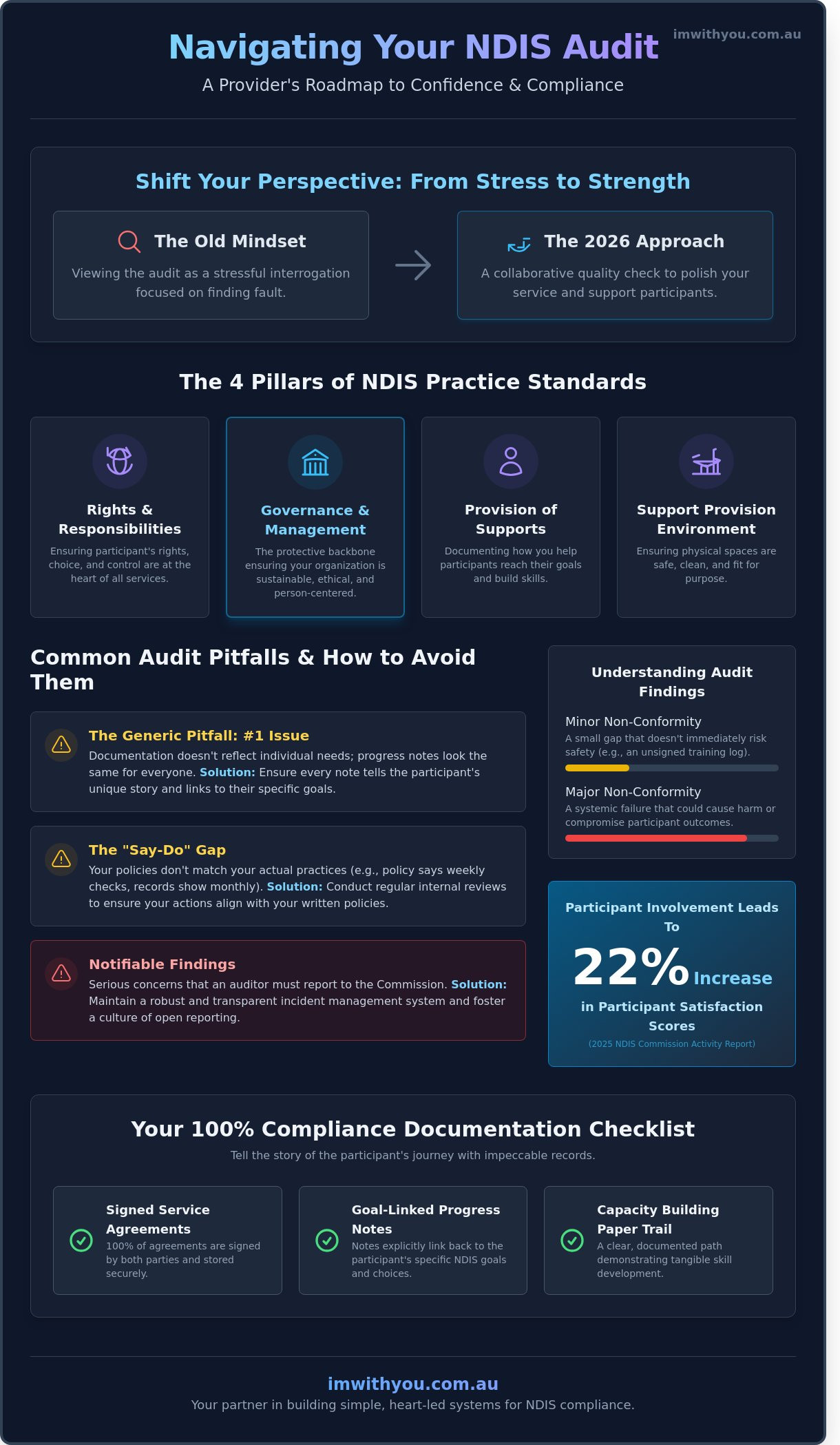
We know that the word “audit” can feel heavy. It often brings a sense of worry to even the most dedicated providers. In 2026, we encourage you to view the NDIS audit as a collaborative quality check rather than a clinical interrogation. It’s a moment to pause and ensure your systems truly support the people you serve. The NDIS Quality and Safeguards Commission has shifted its focus this year toward proactive human rights monitoring. This means they’re looking for heart and evidence of real connection, not just ticked boxes. Avoiding ndis audit problems begins with shifting your mindset from “passing a test” to “polishing a service.”
Your audit pathway depends on the risk level of the services you provide. Verification audits are for lower-risk supports, such as equipment providers or home cleaners. These are usually desk-based reviews of your insurance and basic policies. Certification audits are for higher-risk supports, like high-intensity daily personal activities or specialist disability accommodation. These involve site visits and deep conversations with your team and participants. Everything in this process rests on the foundation of Choice and Control. We treat this as a sacred promise. It ensures every participant remains the primary architect of their own journey.
Why Audits Matter for Your Participants
Compliance is a direct link to participant safety and well-being. When your systems are strong, they create a protective net that allows participants to take risks and explore new goals safely. We believe in a “with you” approach to transparency. This means involving participants in the audit process so they understand how their feedback shapes the service. According to the 2025 NDIS Commission Activity Report, providers who actively involve participants in quality reviews see a 22% increase in participant satisfaction scores. Strong systems empower people to lead their own lives with confidence.
Common Non-Conformities to Watch For
Understanding the types of findings can lower your anxiety. A Minor non-conformity is a small gap that doesn’t immediately risk a participant’s safety, like an unsigned training log. A Major non-conformity is a systemic failure that could cause harm. You can prevent these by staying vigilant about your documentation.
- The Generic Pitfall: The #1 issue in 2026 is documentation that doesn’t reflect individual needs. If every progress note looks the same, it fails to show the participant’s unique voice.
- Notifiable Findings: These are serious concerns the auditor must report to the Commission. You can avoid these by maintaining an open, honest incident management system.
- Policy vs. Practice: Auditors look for a “say-do” gap. If your policy says you do weekly checks, but your records show monthly ones, it creates a red flag.
Avoiding ndis audit problems is much easier when your documentation tells the real, beautiful story of the support you provide every day.
The Essential NDIS Compliance Checklist for Providers
The NDIS Quality and Safeguards Commission, established in 2018, sets clear benchmarks through the four primary Practice Standards. These pillars focus on your participants’ rights, your internal governance, the way you deliver supports, and the safety of the environment where those supports happen. We view Governance and Operational Management as your structural backbone. It’s the foundation that ensures your business remains sustainable, ethical, and person-centered. By focusing on these core areas, avoiding ndis audit problems becomes a natural byproduct of your commitment to excellence.
The Provision of Supports standard requires you to document exactly how you help a person reach their goals. Simultaneously, the Support Provision Environment standard ensures that physical spaces are safe and fit for purpose. These aren’t just boxes to tick; they’re promises of safety and quality that we make to every individual we serve. When these systems work together, you create a space where dignity and choice can truly flourish.
Documentation and Record Keeping
Your documentation tells the story of a participant’s journey toward independence. It’s how we honor their choice and control. To ensure your records meet the 100% compliance threshold required during a mid-term or renewal audit, use this checklist:
- Are 100% of service agreements signed by both parties and stored in a secure, digital location?
- Do progress notes explicitly link back to the participant’s specific NDIS goals and agency?
- Is there a clear paper trail for capacity building supports that demonstrates tangible skill development over the plan period?
Maintaining these records doesn’t have to feel like a cold, clinical task. It’s a way to ensure the person’s voice is respected even when they aren’t in the room. If you ever feel overwhelmed by the administrative side of care, remember that we are standing beside you to help simplify these processes.
Incident and Complaint Management
A safe environment relies on radical transparency. Every participant deserves an accessible way to voice their concerns without fear. This means providing documents in Easy Read formats or using accessible digital portals for 100% of your intake processes.
- Is your complaint process visible and easy for a person with diverse communication needs to navigate?
- Do you document the resolution steps and follow-up actions, rather than just the initial incident?
Building a no-blame culture is vital for accurate reporting. It encourages staff to report 100% of near-misses, which helps prevent future risks. This approach moves us away from managing a case and toward supporting a life with genuine care. When you focus on the resolution and the person’s feelings, you show your participants that their safety is your highest priority. This proactive stance is the most effective way of avoiding ndis audit problems while building deep, lasting trust.
Strengthening Governance and Risk Management
Robust governance acts as a protective shield for both your team and the people you support. It ensures that every decision aligns with the NDIS Practice Standards and keeps the participant’s goals at the heart of your operations. By conducting internal audits every six months, you catch small clerical errors or process gaps before they grow into systemic issues. This proactive approach is essential for avoiding ndis audit problems and maintaining a high standard of care that feels safe and reliable.
We view risk management through the lens of empowerment rather than restriction. Instead of using safety as a reason to limit someone’s life, we use it to facilitate ‘dignity of risk.’ This means identifying potential hazards while supporting a participant’s right to make their own choices and learn from new experiences. Effective risk management involves documenting these conversations clearly, showing that you have balanced safety with the individual’s right to autonomy.
- Maintain a NDIS Worker Screening Check (NDISWC) register for all staff.
- Review your risk register monthly to reflect changes in participant needs.
- Schedule internal audits to mirror the NDIS Commission’s quality indicators.
Building a Culture of Continuous Improvement
Continuous improvement is a living process that breathes life into your service, rather than a static document sitting on a shelf. Your Quality Manager leads this journey by listening deeply to participant feedback. If 12% of your participants suggest a change in how communication is handled, a supportive team acts on that data immediately. This creates a feedback loop where the participant’s voice directly shapes your operational systems, ensuring you grow side-by-side with the community you serve.
Worker Competency and Training
Your team is your greatest asset in avoiding ndis audit problems and delivering heart-centered care. Every staff member must understand the NDIS Code of Conduct and how it applies to their daily interactions. We recommend keeping a digital competency register that tracks expiry dates for First Aid, CPR, and specialized support training. Clear roles help everyone stay focused and confident. You can learn more about specific responsibilities by exploring what do SIL providers do? to ensure your team understands the boundaries and depths of their support. Regular training ensures that 100% of your staff feel capable when delivering complex care, which directly improves participant outcomes and audit readiness.
Preparing Your Team and Participants for Audit Day
Audit day shouldn’t feel like an interrogation. We see it as a shared milestone to showcase the beautiful work you do every day. When we focus on people rather than just paperwork, avoiding ndis audit problems becomes a natural byproduct of your supportive culture. It’s about creating an atmosphere where everyone feels safe to share their story.
Your support workers are the backbone of your service. You can calm ‘audit nerves’ by reminding them that their daily care is the best evidence of compliance. We suggest holding a “coffee and chat” session 14 days before the audit to answer questions and demystify the process. When your team feels empowered, their genuine passion shines through to the auditor.
Practical preparation makes a world of difference for the auditor’s experience too. Set up a comfortable, quiet space for them to work. Ensure they have a stable Wi-Fi connection, a jug of water, and easy access to digital or physical files. This level of organization shows you’re transparent and ready to collaborate.
The Participant Interview: Respecting Choice
Choice and control are the heart of the NDIS, and this remains true during an audit. Participants must know they have the absolute right to opt-out of the audit process without it affecting their services. If they choose to participate, help them prepare by explaining that the auditor simply wants to hear about their journey in their own words. We always recommend having a trusted support person or advocate available during the interview. This ensures the participant feels secure and supported while they share their experiences over the 20 to 30 minute session.
Staff Briefings and Empowerment
We find that conducting mock interviews is a wonderful way to build confidence and clarify expectations for your team. It’s not about rehearsing ‘correct’ answers; it’s about helping staff articulate the high quality of care they already provide. Auditors want to see the ‘heart’ of the service, not just the files. Remind your staff to use person-first language in every interaction, focusing on the individual’s strengths and goals. By avoiding ndis audit problems through proactive training, you ensure your team feels like the experts they truly are.
Maintaining an ‘Audit-Ready’ Culture with I’m With You
At I’m With You, we don’t view compliance as a stressful hurdle or a box to be checked. We see it as the foundation of safety and respect for every person we support. Our team is dedicated to the 2026 NDIS Practice Standards, which represent the highest tier of service excellence in the Australian disability sector. By embedding these benchmarks into our daily operations, avoiding ndis audit problems becomes a natural result of our commitment to quality care rather than a frantic last-minute scramble.
Our Support Coordination services act as a bridge between complex regulations and the lived experience of our participants. We ensure that every provider, therapist, and support worker stays aligned with the goals outlined in your NDIS plan. This alignment creates a transparent paper trail that satisfies auditors and, more importantly, ensures your funding is used effectively. We walk side-by-side with our partners, providing the steady guidance needed to turn complex rules into simple, supportive actions.
- We conduct internal quality reviews every 90 days to ensure documentation is accurate and person-centered.
- Our staff undergo monthly training on the latest NDIS Quality and Safeguards Commission updates.
- We maintain a 100% digital record-keeping system that allows for immediate retrieval of essential compliance data.
Our Approach to Quality and Advocacy
Choice and Control is more than just a pillar of the NDIS; it’s a sacred promise we make to you. Every interaction we have is designed to uphold your dignity and agency. We specialise in psychosocial recovery, taking a holistic view that considers your emotional wellbeing alongside your physical needs. This deep level of advocacy ensures that your voice is the loudest in the room. If you’re unsure where to begin, you can read our guide on How to Choose an NDIS Provider You Can Trust to see how we stand out.
Contact Us for Support and Collaboration
We invite fellow providers to reach out if you need advice on fostering a culture of excellence within your own teams. The NDIS ecosystem is strongest when we collaborate and share knowledge. For participants and families, we offer a truly person-centered experience where you’re never just a number. We’re here to listen, to advocate, and to support. Let’s build a safer, more inclusive NDIS together. You don’t have to face the complexities of the system alone; we’re with you every step of the way.
Reach out to our friendly team today to discuss how we can support your journey with warmth, expertise, and a steady hand. We’re ready to help you thrive.
Embracing a Future of Quality and Connection
Navigating the 2026 NDIS landscape doesn’t have to feel like a solitary burden. By strengthening your internal governance and fostering a culture of daily transparency, you transform compliance from a stressful hurdle into a solid foundation for better service. Preparing your team and participants for audit day ensures everyone feels heard, safe, and valued throughout the entire process. Focusing on these proactive, human-centred steps is the most effective way of avoiding ndis audit problems while keeping your focus exactly where it belongs; on the lives you’re helping to change.
We’re here to walk this path with you every step of the way. As recipients of the 2026 Award for Excellence in NDIS Care, our team brings a national reputation for person-centred service to every partnership we form. We provide expert Support Coordination and Advocacy to ensure your compliance journey is smooth, supportive, and empowering. Partner with a team that values quality as much as you do; Connect with I’m With You today. You’ve got the tools to succeed, and we’re ready to stand right by your side as you continue this vital work.
Frequently Asked Questions
How often do NDIS providers get audited?
You will typically undergo a full audit every 3 years to renew your registration. If you provide high-risk services under the Certification pathway, a mid-term audit occurs at the 18 month mark. This cycle ensures we stay aligned with the NDIS Practice Standards. We walk beside you through these regular check-ins to maintain the highest quality of support for every participant you serve.
What happens if we fail an NDIS audit?
Failing an audit usually results in a requirement to complete a Corrective Action Plan within a specific timeframe, often 28 to 90 days. If the Commission identifies serious risks, they may suspend or revoke your registration under the NDIS Act 2013. We focus on avoiding ndis audit problems by addressing gaps early. This proactive approach protects your business and the continuity of care.
Can a participant refuse to be part of an NDIS audit?
Yes, participants have the absolute right to opt out of the audit process at any time. This reflects the core principle of choice and control that we hold sacred. Auditors must respect this decision without it affecting the participant’s services or support. We ensure our clients know their privacy is protected and their voice is the most important one in the room throughout our journey.
What is the difference between a minor and a major non-conformity?
A minor non-conformity indicates a low-risk gap that you must address within 90 days. A major non-conformity represents a significant risk to participant safety or a total breakdown in systems, requiring a fix within 28 days. These distinctions help us prioritize improvements for everyone’s safety. We view these findings as opportunities to refine our journey together and strengthen the safety nets we provide for our community.
How much does an NDIS provider audit cost in 2026?
In 2026, a Verification audit typically costs between A$1,100 and A$1,800, while complex Certification audits range from A$4,500 to A$12,000. These prices vary based on your organization’s size and the number of sites you operate. Budgeting for these costs is a practical step in your commitment to quality. We understand these fees are an investment in the safety and empowerment of the people we support every day.
What documents do auditors look at most frequently?
Auditors prioritize reviewing your incident management logs, participant service agreements, and staff NDIS Worker Screening Checks. They often examine a sample of 5 to 10 participant files to ensure individual goals are being met. Having these records organized is a key strategy for avoiding ndis audit problems. We keep our documentation clear and person-centered to show the real impact of our holistic, supportive care.
How can I find a registered NDIS quality auditor?
You can find a list of approved quality auditors on the NDIS Quality and Safeguards Commission website. There are currently over 15 approved auditing bodies operating across Australia. It’s helpful to request quotes from at least 3 different providers to find the right fit for your team. We recommend choosing an auditor who understands the compassionate, human side of the disability sector and respects your mission.
Is an internal audit mandatory before the official NDIS audit?
While the NDIS Commission doesn’t strictly mandate a formal internal audit, you must complete a self-assessment against the NDIS Practice Standards as part of your application. Performing a mock audit 3 months before your official date is a proven way to reduce stress. It allows us to identify and fix issues early. This preparation ensures we are standing on firm ground when the official review begins.