
Feeling a little disconnected from your local community, or perhaps wondering how to use your NDIS plan for something more than just the usual group activities? You’re not alone. The journey to meaningful social connection can sometimes feel confusing, leaving you wondering what’s possible and what’s considered ‘reasonable and necessary’. That’s why we’re here, walking side-by-side with you to explore the possibilities. In this guide, we’ve gathered a list of inspiring community participation NDIS examples that go beyond the expected.
We’ll show you how to transform your NDIS plan into real-world connections, from joining a local sports team to starting a small business or volunteering for a cause you love. You’ll leave with a clear list of ideas to discuss with your Support Coordinator, a better understanding of how to link these activities to your capacity-building goals, and the confidence to truly embrace your right to Choice and Control. It’s time to build a life rich with connection and purpose, and we’re with you every step of the way.
Key Takeaways
- Understand how community participation is about more than just social outings; it’s a key part of building skills for work, study, and economic independence.
- Get inspired with practical community participation NDIS examples, from joining a local sports team to volunteering, that you can actively pursue with your funding.
- Learn the difference between your Core and Capacity Building budgets so you can confidently ask for the right support in your NDIS plan or review meeting.
- See how finding a support worker who shares your passions can transform participation from a simple activity into a genuine, shared experience.
What is NDIS Community Participation? Understanding Social and Economic Inclusion
At its core, NDIS community participation is about your right to be an active and valued member of your local area, just like anyone else. It’s about moving beyond the four walls of your home to connect with people, explore interests, and build a life that feels rich and meaningful to you. The National Disability Insurance Scheme (NDIS) recognises that true inclusion is a cornerstone of well-being, which is why these supports are a vital part of so many NDIS plans.
To see what this looks like in practice, this short video offers a great overview:
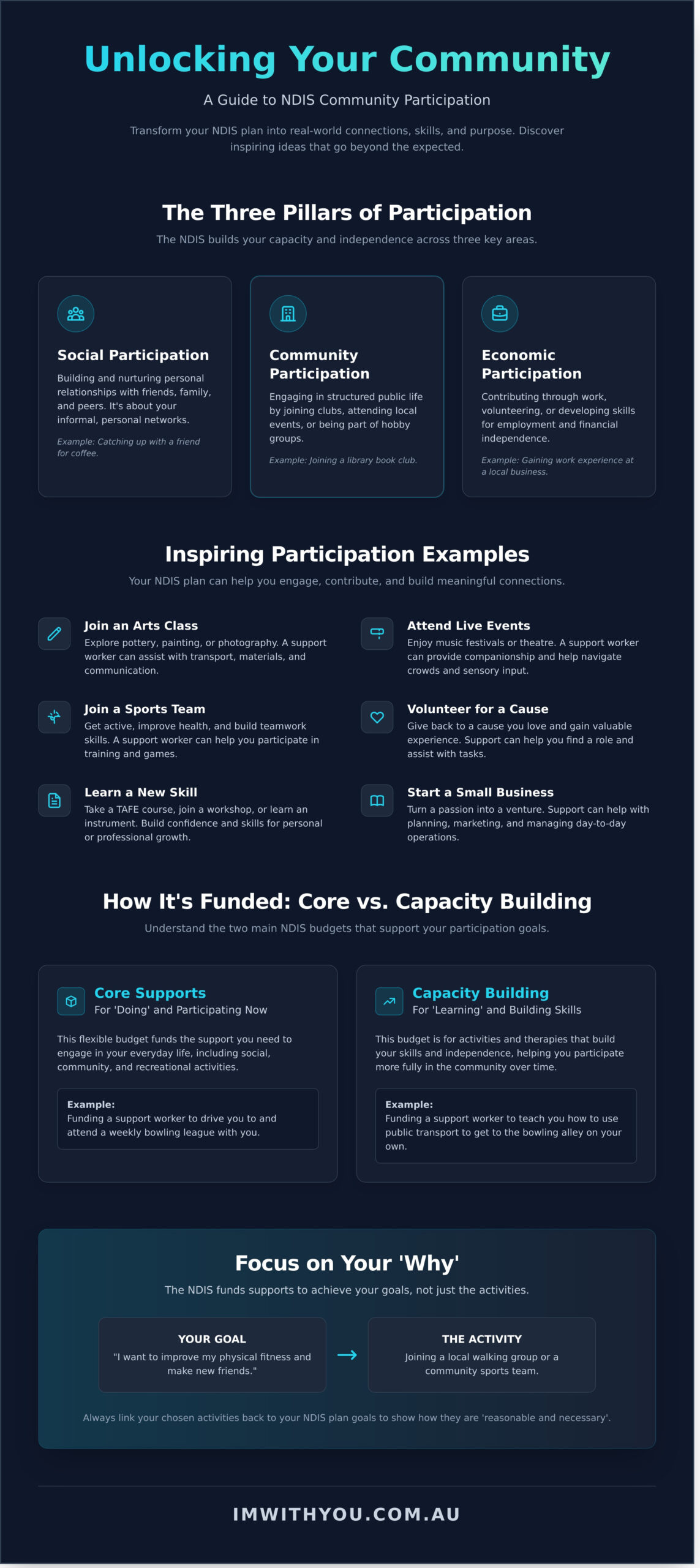
The NDIS views participation through three key pillars, all aimed at building your capacity and independence:
- Social Participation: Building and nurturing personal relationships with friends, family, and peers.
- Community Participation: Engaging with the public world through clubs, local events, sports, or hobby groups.
- Economic Participation: Contributing through work, volunteering, or developing skills for employment.
We understand that taking that first step can feel overwhelming. That’s why our ‘With You’ philosophy is so important. Having a trusted companion by your side to attend a local event or join a new class can make all the difference, transforming anxiety into a shared, positive experience.
The Difference Between Social and Community Participation
While they sound similar, social and community participation are slightly different. Social participation is about your personal, informal networks-like catching up with a friend for coffee. Community participation involves engaging in more structured public life, such as joining a library book club or a local gardening group. Together, they create a powerful support system that reduces isolation and significantly improves mental and emotional well-being.
Why Your Goals Matter More Than the Activity
The NDIS doesn’t fund activities; it funds the supports you need to achieve your goals. This is a crucial distinction. Instead of thinking, “I want to go to the park,” your NDIS goal might be, “I want to build social confidence by meeting new people in a public space.” The activity (going to the park) is simply the path to achieving your goal. When exploring community participation NDIS examples, always link them back to your personal journey. In this context, “Reasonable and Necessary” means the NDIS will fund supports that are directly related to your disability and are required to help you pursue your specific plan goals.
10 Inspiring Social and Community Participation NDIS Examples
True community participation is about more than just being present-it’s about actively engaging, contributing, and building meaningful connections. Your NDIS plan, through either Core Supports or Capacity Building funding, is designed to empower you on this journey. A dedicated support worker can stand side-by-side with you, helping to bridge gaps and foster a sense of belonging.
Let’s walk through some wonderful community participation NDIS examples to spark your imagination. We believe in finding the perfect fit for your unique goals and passions, and we are with you every step of the way.
Creative and Recreational Pursuits
Expressing yourself and sharing your interests is a powerful way to connect with others. We can help you find safe, inclusive spaces where your voice can be heard and your creativity can flourish.
- Joining a local arts class: Whether it’s pottery, painting, or photography, a support worker can assist with transport, help set up your materials, and facilitate communication with the instructor to ensure the environment meets your sensory and accessibility needs.
- Attending live events: From a music festival to a local theatre production, you shouldn’t have to miss out. A support worker can provide companionship, help navigate crowds, and find quiet spaces if you feel overwhelmed, ensuring the experience is enjoyable from start to finish.
- Community gardening projects: Connect with nature and your neighbours by getting your hands dirty. A support worker can assist with physical tasks and help you engage with fellow gardeners, while ensuring the space has accessible features like raised garden beds.
Sports, Fitness, and Adventure
Moving your body and challenging yourself in a supportive setting can do wonders for both physical and mental wellbeing. It’s about finding joy in movement, whatever that looks like for you.
- Inclusive sports teams: Joining a wheelchair basketball, modified football, or boccia team is a fantastic way to build friendships and teamwork skills. Your support worker can help with transport to games and training, and be your number one cheerleader from the sidelines.
- Gentle fitness groups: A local walking club or an accessible yoga session offers a low-pressure way to stay active and socialise. We can help you find a group that matches your pace and support you to participate confidently.
- Learning a new skill: Have you ever wanted to try swimming or therapeutic horse riding? These activities build incredible confidence and capacity. A support worker can provide practical assistance, ensuring your safety and comfort as you learn.
Social Connection and Advocacy
Finding your tribe and using your voice are fundamental parts of living a rich, fulfilling life. These activities empower you to build your network and contribute to a more inclusive community.
- Peer support groups: Connecting with people who have similar lived experiences can create a profound sense of belonging. A support worker can accompany you to your first few meetings, providing a familiar and reassuring presence until you feel settled.
- Volunteering for a cause you love: Giving back to the community at a local charity or animal shelter can build skills and a strong sense of purpose. We can help you find a role that aligns with your passions and provide on-site support if needed.
- Disability advocacy groups: This is where your right to Choice and Control truly comes to life. Participating in an advocacy group allows you to help shape your community. A support worker can assist with transport and help you prepare to share your valuable insights.
Economic Participation: Examples of Building Skills and Work Readiness
There is a common misconception that NDIS community participation is only about social outings or hobbies. While connecting with others for fun is incredibly important, this support is also a powerful tool for building your economic independence. It’s about creating pathways toward your professional goals, whether that means further study, finding a job, or even starting your own small business. Your NDIS plan, through its Capacity Building funding, is designed to empower you on this journey, providing the foundation for you to develop skills and grow your confidence in a professional setting.
Exploring these goals is a core part of your right to choice and control. There are many creative community participation ndis examples that focus on building work-readiness, and we are here to help you find the ones that feel right for you.
Volunteering as a Pathway to Employment
Volunteering is a wonderful, supported step into the professional world. It’s a practical way to build a current resume, gain valuable references, and practice workplace skills in a lower-pressure environment. We can walk beside you to find a role that matches your strengths and interests-perhaps at a local animal shelter, a community garden, or an op-shop. A support worker can be there with you as you learn the ropes, helping you navigate new routines and social dynamics with confidence.
Micro-enterprises and Skill-Building Workshops
Economic participation can also mean creating your own opportunities or learning specific, practical skills. This could look like turning your passion into a small “micro-business,” such as selling your artwork online or offering a dog-walking service in your neighbourhood. It can also involve more structured learning to build your capabilities and independence. Your NDIS funding can support you to:
- Attend workshops to learn practical skills like computer literacy, budgeting, or advanced cooking.
- Enrol in a TAFE or adult education course that aligns with your career goals, with a support worker to assist you in the classroom.
- Join a group program that teaches you how to manage your own small business finances or market your services.
These are just a few community participation ndis examples that show how you can use your plan to build a bridge toward your economic aspirations, step by step.
Navigating Your Plan: How to Get These Activities Funded
It’s one thing to dream about joining a local choir or learning to swim, but it’s another to understand how your NDIS plan can fund that journey. We know it can feel overwhelming, but we are right here with you, ready to make it clear. Let’s walk through how to align your plan with your aspirations for community connection.
Core Supports vs. Capacity Building
Your NDIS plan is thoughtfully divided into different budgets. For community activities, you’ll mainly use two key areas:
- Core Supports: Funding under Assistance with Social and Community Participation is for the direct, hands-on help you need from a support worker to attend an activity. This could be transport to a class or 1:1 support during the event.
- Capacity Building: Funding under Increased Social and Community Participation is for the activity or program itself, such as course fees, tuition, or group class costs that help you build new skills and independence.
In short, you use Core Supports for the person who helps you participate, and Capacity Building for the program or class that teaches you new skills.
Setting NDIS Goals for Success
Your NDIS goals are the key that unlocks funding. They must clearly and directly link to the activities you want to pursue. Instead of a general goal like “I want to be more social,” a SMART (Specific, Measurable, Achievable, Relevant, Time-bound) goal provides a clear roadmap for your planner.
Example Goal: “To improve my physical and mental wellbeing, I want to attend a group yoga class twice a week for the next 12 months. This will help me build friendships in my local area and learn new coping strategies for my anxiety.”
When preparing for your plan review, gathering evidence is vital. A letter from your therapist or a report from your current support worker explaining how these activities support your goals can make a powerful impact. They can provide professional insight into the benefits of specific community participation ndis examples you’ve discussed.
This is where a Support Coordinator becomes an invaluable partner. They help you articulate your goals, find suitable programs, and gather the right evidence. A great Support Coordinator ensures your right to Choice and Control is always at the heart of the conversation, helping you build a plan that truly reflects the life you want to lead. If you need a guide to stand beside you on this journey, I’m With You is here to help.
Why the Right Support Makes All the Difference: The ‘Im With You’ Approach
The powerful community participation ndis examples we’ve explored are more than just activities-they are stories of connection and personal growth. This kind of success hinges on one crucial element: the right support. At Im with you, we move beyond the clinical model of care to build genuine companionship. We believe the best support comes from someone who truly connects with you, which is why we carefully match you with support workers who share your passions, hobbies, and sense of humour. This person-centred approach is the foundation of our commitment to an award-winning standard of care, setting a benchmark for 2026 and beyond.
Walking Side-by-Side: Our Philosophy
We don’t lead from the front; we walk side-by-side with you. Our philosophy is grounded in being a steady, reliable presence on your journey. We focus on your unique strengths and aspirations, not on deficits. This positive approach helps build confidence and empowers you to explore new possibilities. By understanding what you can do and what you love to do, we help you build the skills and networks for a richer life. Learn more about our Support Coordination services and how we can help map out your path.
Your Choice, Your Control, Our Support
The NDIS promise of “Choice and Control” is at the core of everything we do. You are the expert in your own life, and you decide which activities and goals matter most. Getting started with us begins with a simple, unhurried conversation. We listen to your story, understand your goals, and then help you build a dedicated support team that you feel comfortable and connected with. This collaborative process ensures your support is tailored perfectly to you.
The right support can help you rediscover joy, connection, and a sense of belonging in your community. It’s about more than just accessing services; it’s about living the life you choose with confidence. If you’re ready to explore what’s possible, we’re here to walk the path with you.
Contact us today to start your community journey.
Let’s Bring Your Community Goals to Life
Finding your place in the community is a deeply personal journey, and your NDIS plan is designed to support you every step of the way. As we’ve explored, community participation is about much more than just activities-it’s about building meaningful connections, developing new skills, and achieving true social and economic inclusion. The array of community participation NDIS examples, from creative arts to volunteering, shows that the possibilities are as unique as you are.
At I’m With You, our person-centered approach puts your Choice and Control at the heart of everything we do. Our highly trained companions are matched to you based on shared interests, ready to walk alongside you on your journey. As recipients of the 2026 Award for Excellence in Disability Care, we are committed to helping you navigate your plan and connect with activities that bring you joy and purpose.
You don’t have to navigate this journey alone. Your vibrant community life is waiting to be discovered, and we’re here with you. Let’s find your community together-Connect with our team.
Frequently Asked Questions About NDIS Community Participation
Is community participation only for people who want to work?
Absolutely not. While community participation can certainly build skills for employment, its heart lies in enriching your entire life. It’s about pursuing your passions, whether that’s joining a choir, learning to paint, or volunteering for a local cause. We believe it’s about finding what brings you joy and connection. We are with you on your journey to discover activities that build your confidence, create friendships, and help you feel a true sense of belonging.
Can I use my NDIS funding to pay for club membership fees?
This is a common question, and the answer is usually no. The NDIS doesn’t cover costs that anyone in the community would be expected to pay, like a gym membership or sports club fee. However, your plan can absolutely fund the disability-related support you need to attend and participate. This means funding a support worker to go with you, help you engage with others, and build your skills and confidence in that environment.
How many hours of community support can I get in my plan?
There is no set number of hours, as your NDIS plan is tailored completely to you and your unique journey. The amount of funding you receive for community access is directly linked to your personal goals and what the NDIS considers ‘reasonable and necessary’ to help you achieve them. When we stand beside you in your planning, we help you articulate your needs so your plan truly reflects the support required to live the life you choose.
What happens if I am too anxious to go out in public?
We understand completely, and you are not alone in feeling this way. Your NDIS plan can be a gentle and powerful tool for building confidence at a pace that feels safe for you. We can start small, with a support worker you trust, perhaps for a quiet coffee or a walk in the park. This capacity-building support is designed to help you develop coping strategies and feel more secure, empowering you to gradually embrace the community on your own terms.
Can my support worker drive me to my community activities?
Yes, they can. If getting to and from your activities is a barrier, using a support worker for transport is a great option. This needs to be discussed and agreed upon, and the cost is typically claimed from your plan’s transport budget at a set rate per kilometre (e.g., A$0.97 per km). We will always be transparent about these costs, ensuring you maintain choice and control over your budget and how you get around your community.
Does the NDIS cover the cost of my support worker’s entry fee to an event?
Yes, in most cases, it does. If you need a support worker to be with you to attend a ticketed activity like a movie, a concert, or a football match, the price of their ticket is considered a necessary cost of your support. This amount can be paid for using your NDIS funding. This ensures you can fully participate in the events you love, with the right person right there with you, without being financially disadvantaged.
What is the difference between group support and 1:1 community access?
The main difference is in the level of personalised attention and the social setting. With 1:1 community access, a support worker is dedicated entirely to you for a specific activity. In group-based support, you participate in an activity with other NDIS participants and share support staff. Both are wonderful community participation NDIS examples; 1:1 is great for targeted skill-building, while group settings are fantastic for building social connections in a supportive environment.
How do I change my NDIS goals to include more social activities?
Your goals should always reflect your current aspirations, and you have the right to change them. You can prepare to discuss new social goals at your next scheduled plan reassessment. If your needs have changed significantly and you can’t wait, you can request an unscheduled plan review. We can support you in gathering your thoughts and articulating why new community participation NDIS examples and goals are important for your wellbeing and independence.