

What if your daily work felt less like a checklist of clinical tasks and more like walking beside a person on their unique journey toward independence? You’ve probably felt the weight of the 2025 NDIS Quality and Safeguards Commission updates or the exhaustion that comes from the unpredictable schedules of casual roles. It’s common to worry that the heart of care is getting lost behind paperwork and clinical detachment.
We’re here to help you rediscover that heart while you explore the latest personal care assistant jobs available across Australia. You’ll learn how to launch a career that prioritizes your well-being alongside those you support, ensuring you find a team that stands with you through every challenge. This guide provides a clear roadmap for 2026, covering essential qualifications and the shift toward true person-centered care that empowers every individual’s choice and control.
Key Takeaways
- Understand the profound shift toward the social model of care, where your role focuses on empowering NDIS participants through Choice and Control.
- Navigate the essential legal requirements for personal care assistant jobs in Australia, including the NDIS Worker Screening Check and mandatory certifications.
- Look beyond common myths to discover a daily reality rich with human connection and varied support that honors every individual’s unique journey.
- Learn how to craft a person-first resume that resonates with values-driven providers and helps you find a team where you truly belong.
- Discover why joining an award-winning team like Im with you means having a steady companion by your side as you build your career in care.
Table of Contents
- What is a Personal Care Assistant? Defining the Role in 2026
- Essential Qualifications for Personal Care Assistant Jobs in Australia
- The Daily Reality: Myth-Busting the PCA Career
- How to Find and Land the Right PCA Job
- Why Your PCA Journey Starts with "I’m With You"
What is a Personal Care Assistant? Defining the Role in 2026
By 2026, the heart of personal care assistant jobs has shifted toward a model of deep, human partnership. We view the PCA as more than just a service provider. You are the vital bridge that connects an NDIS participant to their community and their personal goals. This role has moved far away from the clinical medical model that once treated individuals like patients in a system. Following the 2023 NDIS Review, the industry has fully embraced the social model of disability. This approach prioritizes Choice and Control as a sacred promise. You don’t just manage a schedule; you support a life. The modern PCA acts as a companion who stands beside a participant, ensuring they lead a life defined by their own preferences rather than their limitations.
The 2026 industry shift emphasizes holistic wellbeing over simple task completion. It’s no longer enough to just tick boxes on a care plan. Data from the 2025 Workforce Strategy Report shows that 82 percent of participants now prioritize emotional connection and community presence as their top requirements for support. While the general definition of What is a Personal Assistant? usually involves administrative tasks or office scheduling, an NDIS PCA focuses on the human element. Your empathy is your most powerful tool. It allows you to navigate complex days with a gentle, human touch that makes a participant feel safe, heard, and respected. We believe that standing beside someone is more impactful than leading from the front.
This role requires a unique blend of professional competence and emotional intelligence. You’ll find that the most successful assistants are those who view their work through a lens of empowerment. Whether you’re helping someone prepare for their day or supporting them at a social event, your presence should provide a sense of security. The 2026 landscape demands a commitment to social inclusion, where every action you take helps to lower the barriers of stress and anxiety for the person you support. It’s a journey of companionship where trust is the foundation of every interaction.
The Core Responsibilities: Beyond the Basics
Your work involves assisting with grooming, meal preparation, and mobility, always centered on dignity. We don’t just help someone get dressed; we support them in choosing an outfit that reflects their personality. Social participation is equally vital. You help participants engage with hobbies and friends, acting as a bridge to the community. Above all, you advocate for their voice, ensuring their agency remains the priority in every care decision.
PCA vs. Disability Support Worker: Is there a difference?
Within the Australian NDIS framework, terminology has shifted. While Disability Support Workers often focus on broad capacity building, personal care assistant jobs are now recognized as a specialized branch. This role centers on intimate, one-on-one daily living support and high-intensity care. By 2026, this specialization requires a higher level of personal connection, distinguishing it as a dedicated path for those who excel in direct, person-centered companionship and holistic support.
Essential Qualifications for Personal Care Assistant Jobs in Australia
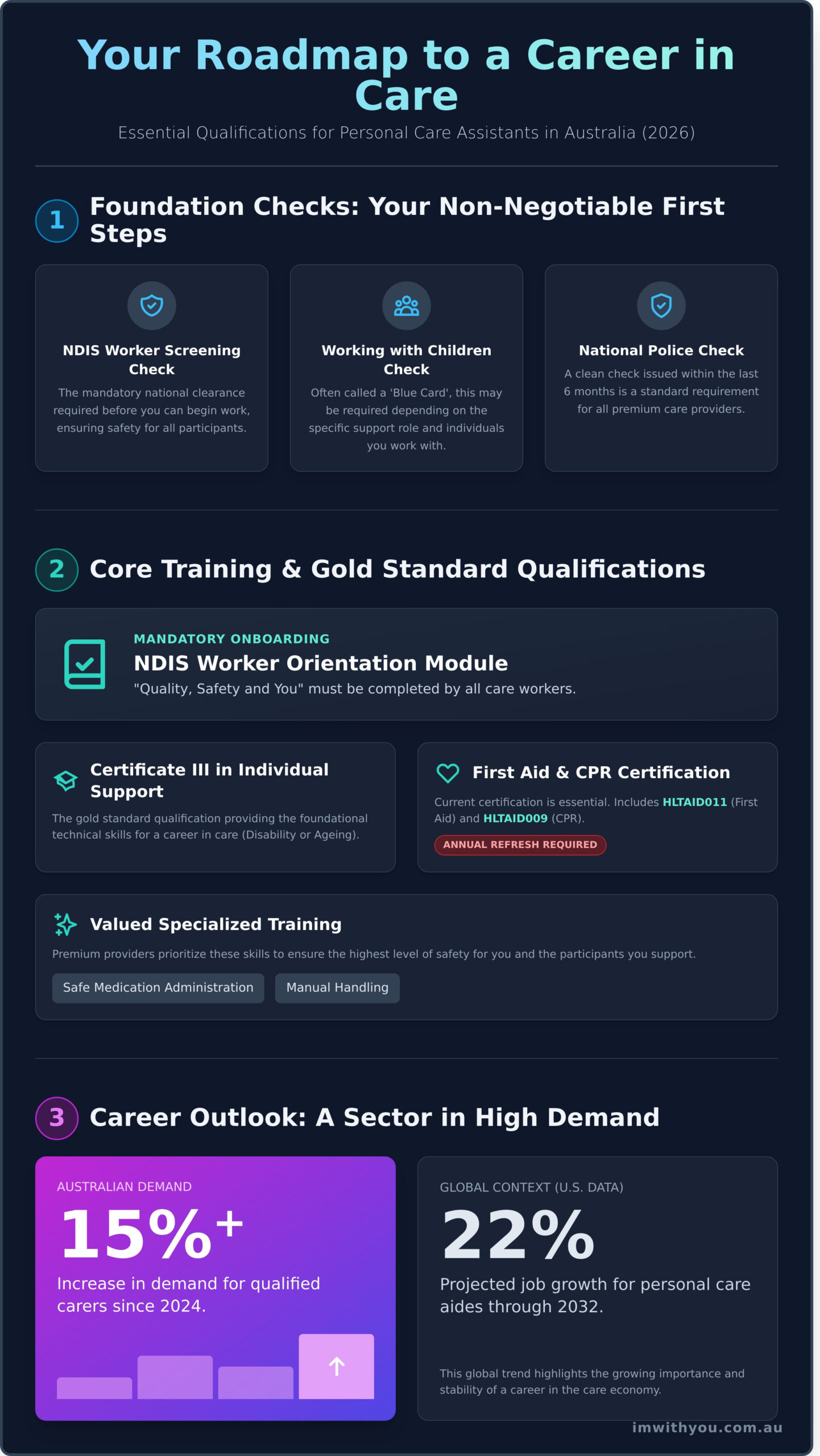
Securing one of the many available personal care assistant jobs in 2026 requires a blend of legal compliance and heartfelt dedication. The NDIS Quality and Safeguards Commission has raised the bar for entry, ensuring every participant receives support that’s both safe and empowering. You’ll need a valid NDIS Worker Screening Check before you begin your journey. This national clearance replaces various state-based systems, though you might still need a Working with Children Check, often called a Blue Card, depending on your specific role. These checks aren’t just paperwork. They’re a promise of safety we make to the people we support.
The Australian government now requires all care workers to complete the NDIS Worker Orientation Module, “Quality, Safety and You.” Most premium providers, including the team at I’m With You, also look for a clean National Police Check issued within the last six months. This rigorous vetting process reflects a global trend in the care economy. For context, the U.S. job outlook for personal care aides shows a 22% projected growth through 2032, highlighting how vital these roles are becoming worldwide. In Australia, we’ve seen a similar surge, with a 15% increase in demand for qualified carers since 2024.
Education and Certifications
A Certificate III in Individual Support (Disability or Ageing) remains the gold standard for anyone entering the field. It provides the technical foundation you need to handle complex situations with confidence. You’ll also need a current First Aid certificate (HLTAID011) and CPR certification (HLTAID009), which must be refreshed annually. We value specialized training in Safe Medication Administration and Manual Handling because these skills protect both you and the participant. Providers like I’m With You prefer these certifications because they demonstrate a professional commitment to the “Choice and Control” of every individual.
Soft Skills: The “Unteachable” Requirements
Technical skills get you the job, but soft skills make you a companion. Active listening is your most powerful tool. You’ll need to interpret non-verbal cues and understand the unspoken needs of those you walk alongside. This work requires immense emotional resilience. You’re often the steady presence in someone’s challenging day, so practicing your own self-care is vital to avoid burnout. We look for people who can maintain an “unhurried” rhythm. In a world that’s always rushing, your ability to provide person-centered support at the participant’s own pace is what sets you apart.
The sector has shifted toward mandatory ongoing professional development. By 2026, most registered providers expect staff to complete at least 20 hours of additional training each year. This might include micro-credentials in autism awareness, mental health first aid, or trauma-informed care. If you’re ready to start a career built on empathy and professional excellence, you can explore our current opportunities and see how we support our team members’ growth. We don’t just hire staff; we partner with advocates who believe in social inclusion. Your journey in personal care assistant jobs starts with these core requirements, but it’s fueled by your genuine desire to make a difference.
- NDIS Worker Screening Check: Mandatory for all risk-assessed roles.
- First Aid & CPR: Must stay current and verified.
- Certificate III: The preferred baseline for professional support.
- Annual Training: A commitment to 20 hours of professional growth.
We believe that when you’re well-prepared, you feel more confident. That confidence allows you to focus on what truly matters: the person standing right in front of you. Every certification you earn is a tool that helps you protect the dignity and independence of the people we serve together.
The Daily Reality: Myth-Busting the PCA Career
When you first look at personal care assistant jobs, you might wonder if the role is limited to domestic chores or basic hygiene. This is a common misconception that misses the heart of what we do. While physical support is part of the day, your presence is actually about fostering independence and creating a life of dignity. You aren’t just a worker; you’re a companion walking side-by-side with someone as they pursue their own goals. In 2024, NDIS data shows that over 660,000 Australians rely on this tailored support to engage with their communities, proving that your impact reaches far beyond the four walls of a home.
Your day might begin with helping a participant prepare for their morning, but it quickly evolves into a collaborative journey. One hour you’re assisting with meal preparation, and the next you’re supporting a participant at a local community hub or a job interview. When you review a Personal Care Aide occupational profile, you see a complex list of duties that require adaptability and deep empathy. This variety keeps the role fresh and ensures that no two shifts feel the same. You’re there to provide the bridge between a participant’s current abilities and their future aspirations.
We view your role as a vital contributor to “Capacity Building,” which is a core pillar of the NDIS framework. This means you don’t just “do for” the person; you “work with” them. If a participant’s goal is to manage their own budget, you might spend time together sorting through receipts or using banking apps. This approach honors their Choice and Control, ensuring they remain the driver of their own life. It requires a delicate balance of professional boundaries and genuine friendship. You’re a professional who cares deeply, providing a safe space where the participant feels heard and respected.
Myth vs. Reality in Modern Care
- Myth: It’s a low-skill job. Reality: It requires high emotional intelligence and complex observation skills. You must detect subtle changes in a participant’s mood or health, often before they even realize it themselves.
- Myth: You work in isolation. Reality: You’re a key player in a wider support team. You’ll regularly communicate with Support Coordinators and family members to ensure the participant’s plan stays on track.
- Myth: There is no room for growth. Reality: This role is the foundation for a long-term career. Many of our team members transition into care management, therapy assistant roles, or specialized psychosocial recovery coaching.
Safety and Quality Standards
Safety is a sacred promise we make to every participant. We follow the 6 Rights of Medication: the right person, right medication, right dose, right route, right time, and right documentation. Following these steps isn’t just a checklist; it’s how we protect the people who trust us. Incident management is another critical area where your observation skills shine. By reporting small changes or near-misses immediately, you help us prevent larger issues and keep the environment secure for everyone involved. Safe Medication Administration stands as the cornerstone of 2026 care quality, ensuring every participant receives the right support at the right time.
Choosing personal care assistant jobs means committing to a career where your humanity is your greatest asset. You’ll find that the technical skills are easily learned, but the ability to listen and empower is what truly transforms lives. We’re here to support you with the training and resources you need to feel confident in every shift, ensuring you never have to walk this path alone.
How to Find and Land the Right PCA Job
Finding the right fit for your career starts with looking far beyond a simple job description. You want to find a community where your empathy is valued as much as your practical skills. Searching for personal care assistant jobs is a journey of finding a provider who views the NDIS as a vehicle for human rights rather than just a set of administrative tasks. When you research potential employers, look for mission statements that mention standing beside participants. This alignment ensures you’ll feel supported in your role rather than feeling like a cog in a clinical machine.
Evaluating Potential Employers
You deserve an environment that nurtures your growth while protecting your wellbeing. During your research, ask direct questions about their support structures. Do they offer regular, monthly clinical supervision? How do they proactively handle worker burnout? In 2026, industry data showed that providers with structured supervision programs saw a 22% increase in staff retention compared to those without. You should look for the Choice and Control philosophy in every facet of their service delivery. Award-winning providers, such as those recognized in the 2026 Excellence in Disability Care awards, typically offer 15% higher investment in staff training, which provides you with better long-term career security. If a provider speaks more about rigid schedules than participant agency, they might not be the right partner for your professional journey.
Mastering the Interview
Managers in this space look for heart and advocacy. You can use the STAR method (Situation, Task, Action, Result) to describe specific moments where you solved a problem while keeping a person’s dignity at the center. Instead of just listing tasks, describe a time you protected a participant’s agency during a difficult choice. Demonstrating a deep understanding of NDIS pillars shows you’re ready to be a knowledgeable guide. To understand what participants are looking for in their support team, you can read our guide on Choosing an NDIS Provider. This perspective helps you tailor your answers to reflect the high standards of care and companionship that participants truly value.
Your resume is the first place to showcase your commitment to person-first language. It’s a simple but powerful shift. Instead of writing that you managed a patient, write that you supported a person to achieve their daily goals. This choice of words proves you see the individual first, not their disability or their support plan. Empathy is a technical skill in the world of personal care assistant jobs; don’t be afraid to highlight your emotional intelligence alongside your certificates. Managers want to see that you can build immediate trust and partnership with the people you support.
The trial shift is your opportunity to demonstrate the concept of standing beside a participant. It isn’t just a test of your physical ability to help; it’s a test of your presence. Avoid the common mistake of rushing in to take over a task to show you’re hardworking. Instead, take a breath and ask, “How would you like me to support you with this today?” This small invitation honors the participant’s control over their own life. It shows you’re a steady companion who walks at their pace, providing a sense of security and respect from the very first minute.
Ready to start a career where you truly make a difference? View our current opportunities and join a team that values your heart and your expertise.
Why Your PCA Journey Starts with “I’m With You”
Choosing where to build your career is a significant decision. At I’m With You, we don’t just offer roles; we offer a partnership. We’re proud to share that our commitment to high-quality disability support led to us being named the 2026 award-winner for Excellence in Care. This recognition reflects our dedication to the people we support and the incredible staff who make that support possible every day. We believe that being a steady companion is the highest form of service. This means we stand beside our participants during their most challenging moments and celebrate their smallest wins with genuine joy.
Your experience as a staff member mirrors the experience of our participants. You’ll find that we prioritise your well-being just as much as the people in your care. We’ve moved away from the high-pressure, high-volume models that leave workers feeling drained. Instead, we focus on a holistic approach that includes dedicated psychosocial recovery support for both our clients and our team. You are never just a number on a roster or a line in a spreadsheet. You’re a vital part of a family that values your unique perspective and your capacity for empathy.
We understand that the NDIS environment can feel complex. That’s why we act as your knowledgeable guide, ensuring you have the tools and the confidence to provide exceptional care. Our leadership team is always accessible, providing a safety net of professional expertise and emotional reassurance. When you join us, you’re stepping into a culture where your voice is heard and your professional growth is a shared priority.
Our Culture of Support
We walk side-by-side with our staff from the very first day. Our mentorship program isn’t a one-off induction; it’s a continuous journey of growth. In 2025, we implemented a peer-support framework where experienced mentors provide weekly check-ins for all new team members. This ensures you’re never left to navigate difficult situations alone. We intentionally limit our participant-to-manager ratios to ensure quality over volume, allowing for deeper connections and better outcomes.
Advocacy is at the heart of what we do. We don’t just provide services; we champion social inclusion and fight for the rights of every individual. When you look for personal care assistant jobs, you’re often looking for a place where your work has meaning. At I’m With You, your role involves capacity building and empowering participants to take up space in their communities. We provide specialised training in psychosocial recovery, giving you the skills to support mental health with nuance and compassion.
Join the Award-Winning Team
We’re currently looking for heart-led individuals to join our growing family across Australia. We offer flexible scheduling that respects your personal life because we know that a well-rested carer is a compassionate carer. Our “I’m With You” promise is built on three pillars: Choice, Control, and Compassion. These aren’t just NDIS buzzwords to us. They’re sacred promises that guide how we treat our participants and how we treat you. We empower you with the agency to make decisions that best serve the person you’re standing beside.
If you’re ready to move away from clinical detachment and toward a career filled with human connection, we want to hear from you. Our application process is designed to be simple and stress-free, reflecting the supportive environment you’ll find here. Finding personal care assistant jobs that offer both professional stability and emotional fulfilment is rare, but it’s exactly what we strive to provide every day.
Take Your First Step Toward a Purposeful Career
Choosing a path in care means more than just ticking off daily tasks; it’s about championing the dignity of every individual you support. You’ve seen how the right qualifications and a commitment to advocacy can transform a role into a lifelong calling. Australia’s NDIS landscape is evolving, and the demand for compassionate people to fill personal care assistant jobs is higher than ever. It’s a journey that requires patience, but the rewards of seeing a participant achieve their goals are immeasurable.
At I’m With You, we’re proud to lead the way. Our team was honored with the 2026 Award for Excellence in Care, proving our person-centered approach works. When you join us, you’re backed by our dedicated Support Coordination team and advocacy specialists who ensure you have the tools to succeed. We don’t just hire staff; we build a community that believes in choice and control for everyone. Your growth is our priority, and we’ll be there to guide you every step of the way.
Start your career journey with an award-winning team-apply today
We’re ready to stand beside you as you begin this chapter. You’ve got the heart for care, and we’re ready to help you shine.
Frequently Asked Questions about Personal Care Assistant Jobs
Do I need a degree to become a Personal Care Assistant in Australia?
You don’t need a university degree to start your journey in this rewarding field. Most employers require a Certificate III in Individual Support (CHC33021), which provides the foundational skills for personal care assistant jobs across Australia. This qualification ensures you’re ready to support others with dignity and professional competence while upholding their choice and control.
How much do Personal Care Assistant jobs pay in 2026?
By 2026, entry-level personal care assistant jobs in Australia are projected to pay between A$33.50 and A$39.20 per hour based on recent Fair Work Commission wage increases for the care sector. These rates reflect a 15 percent increase introduced in 2023 to better value the essential work you do. Weekend shifts and public holidays often attract penalty rates reaching A$55.00 per hour or more.
Can I work as a PCA while I am still studying my Certificate III?
Yes, you can often find employment as a student PCA once you’ve completed your first clinical placement or specific core modules. Many NDIS providers and aged care facilities offer traineeships where we walk side-by-side with you during your training. This allows you to gain hands-on experience and earn an income while you finish your qualification.
What is the difference between a PCA and a Registered Nurse?
The primary difference lies in the clinical scope of practice and the level of medical responsibility. A PCA supports daily living activities like dressing and social participation; a Registered Nurse (RN) manages complex wound care and clinical assessments. Think of the PCA as the steady companion for daily life and the RN as the lead for specialized medical interventions.
What are the “6 Rights of Medication” for PCAs?
The 6 Rights are a vital safety checklist: the right person, the right medication, the right dose, the right route, the right time, and the right documentation. Following these steps ensures every individual receives their support safely and accurately. We treat these protocols as a sacred promise to protect the health and well-being of those we support.
Is there a difference between aged care and disability PCA roles?
Aged care roles focus on supporting individuals through the natural aging process, while disability roles center on NDIS goals like capacity building and community inclusion. In disability support, you’re often helping a person achieve specific life milestones and independence. Both roles require deep empathy, but the daily tasks vary based on the individual’s unique journey and NDIS plan.
What happens if I encounter an incident while on a shift?
You must prioritize the immediate safety of everyone involved and then report the event to your supervisor within 24 hours. Most organizations use a digital Incident Report Form to document what happened and what steps were taken to provide support. We’re here to guide you through this process so you never feel alone when challenges arise during your shift.
How many hours a week do Personal Care Assistants typically work?
Most PCAs work between 20 and 35 hours per week, depending on whether they’re permanent part-time or casual employees. Shift lengths usually range from 4 to 12 hours, giving you the flexibility to balance work with your personal life. This variety allows you to choose a schedule that fits your lifestyle while providing consistent support to those who rely on you.