

Last Tuesday, Sarah sat at her kitchen table in Melbourne, staring at a 30-page NDIS plan that felt more like a legal contract than a support system for her son. She isn’t alone; many of the 4.4 million Australians living with a disability feel like a case number rather than a person with unique dreams. Securing ndis funding for intellectual disability should feel like an open door, yet the technical jargon often makes it feel like a locked gate. You likely feel the weight of every plan review, worrying that a misunderstood word might lead to a sudden funding cut.
We believe your journey deserves more than just clinical management; it requires a partner who stands beside you. This guide clarifies the system so you can reclaim your sense of choice and control. We’ll walk through the three essential funding pools, translate terms like Capacity Building into real-world support, and help you prepare for your next planning meeting with total confidence. You’ll learn how to find a provider that sees the person first and the plan second, ensuring we are always with you.
Key Takeaways
- Understand how the NDIS prioritizes the functional impact of your condition over a simple diagnosis, ensuring your support reflects your unique daily reality.
- Explore how to navigate ndis funding for intellectual disability to secure the essential resources needed for social safety and long-term independence.
- Learn to distinguish between Core and Capacity Building supports to balance your immediate daily needs with the skills required for a more independent future.
- Discover a simple, step-by-step approach to transforming your personal aspirations into SMART goals that the NDIS can effectively fund and support.
- Find out how walking side-by-side with a compassionate partner can help you exercise true choice and control over every aspect of your NDIS journey.
Understanding NDIS Eligibility for Intellectual Disability
We know that applying for NDIS support feels like a heavy task. It’s often more than just filling out paperwork; it’s about sharing the intimate details of your life or your child’s daily challenges with a large government system. At Im with you, we understand that this process can feel overwhelming and deeply personal. You aren’t just looking for a budget; you’re looking for a partner to help build a life full of dignity and purpose. The NDIS defines eligibility through a ‘Permanent and Significant’ framework, meaning the disability is likely to be lifelong and has a major impact on your ability to complete everyday tasks without help.
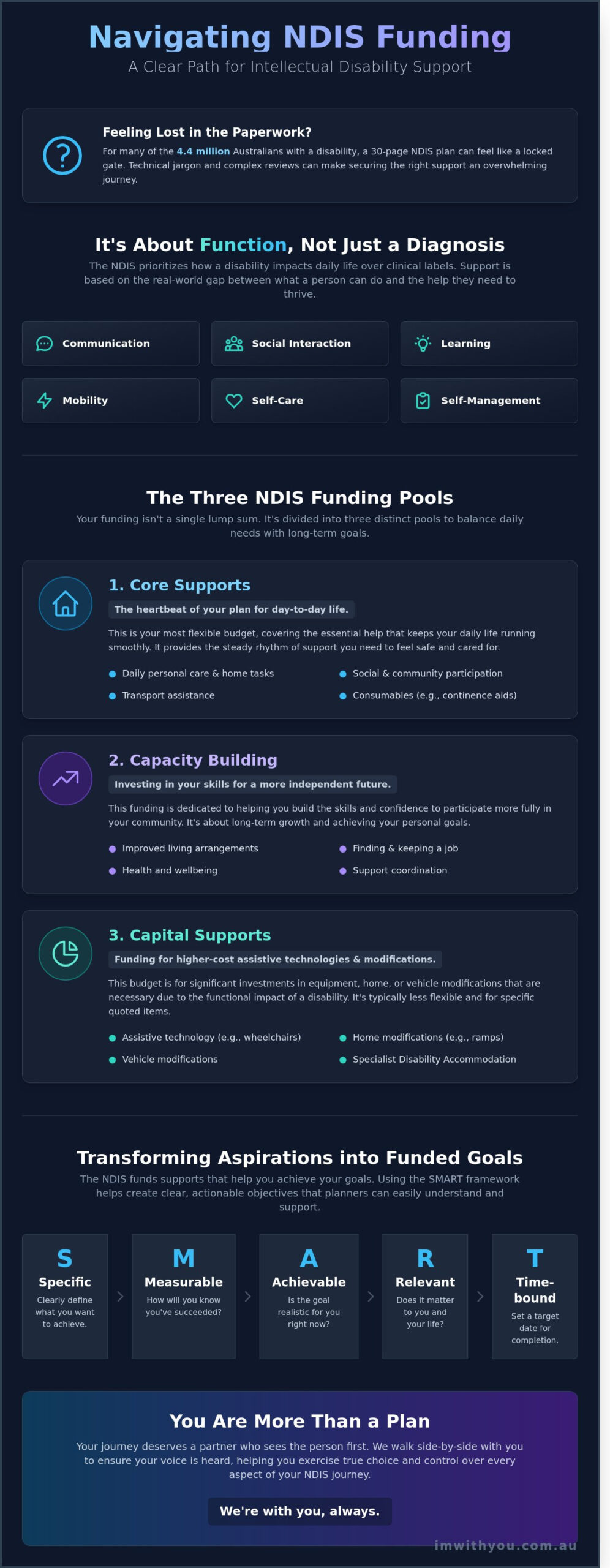
A diagnosis alone doesn’t automatically guarantee ndis funding for intellectual disability. Since the NDIS Act was established in 2013, the focus has shifted away from clinical labels toward functional impact. The NDIA evaluates how a disability affects six specific areas: communication, social interaction, learning, mobility, self-care, and self-management. They want to see the real-world gap between what a person can do independently and the support they need to participate in their community. We walk beside you during this assessment to ensure your story is told accurately and with the respect you deserve.
The Section 24 Requirements Explained
To meet Section 24 of the NDIS Act, you must provide evidence that the impairment is permanent. While a formal diagnosis often includes an IQ score below 70, the NDIS places a much higher value on ‘Adaptive Functioning.’ This looks at practical, everyday skills rather than just test results. For example, can you manage your own money, safely use public transport, or maintain healthy social relationships? What is an Intellectual Disability? It is a condition defined by significant limitations in both intellectual functioning and adaptive behavior. We help you gather reports from psychologists or occupational therapists that highlight these social and practical skills. This evidence is the key to proving that your support needs are both genuine and lifelong.
Early Intervention for Children with Intellectual Disability
For children under 9 years of age, the NDIS uses the Early Childhood Approach. This pathway focuses on providing the right support as early as possible to give your child the best chance at a more independent future. We see this as building a vital foundation. In the 2022-23 NDIS quarterly reports, data showed that early intervention significantly improved developmental outcomes for thousands of Australian children. When your child approaches their 9th birthday, we help you manage the transition from the early childhood pathway to a standard NDIS plan. This ensures their ndis funding for intellectual disability remains stable and adapts as they grow into their teenage years and beyond.
This journey isn’t a one-time event; it’s a continuous path of growth and adaptation. Your needs will change as life evolves, and the NDIS is designed to be a lifelong companion in that process. We treat your “Choice and Control” as a sacred promise, ensuring you always have the final say in how your supports are delivered. By focusing on your strengths and possibilities, we help turn complex regulations into a clear plan for a supported, inclusive life.
Breaking Down the Three NDIS Funding Pools for ID
Understanding your NDIS plan sometimes feels like learning a new language while you are already trying to manage a busy life. We are here to help you translate those complex figures into a life of dignity and choice. Your ndis funding for intellectual disability is not just a single lump sum. It is thoughtfully divided into three distinct pools. Each pool serves a specific purpose in your journey toward a more inclusive life. These categories ensure that your immediate needs are met while you also build a foundation for the years ahead.
Core Supports: Assistance with Daily Living
This is your most flexible budget. It covers the essential help that keeps your day-to-day life running smoothly. If you need a support worker to help with morning routines or preparing meals, this is where that funding lives. We see this pool as the heartbeat of your plan. It provides the steady rhythm of support you need to feel safe and cared for in your own home. Under current 2024 NDIS pricing arrangements, these funds help you stay connected to your world through several key areas:
- Daily activities: Help with personal care, showering, or keeping your home tidy.
- Social and community participation: Support to join a local cricket club, attend an art group, or head to a community festival.
- Transport: Assistance with costs like A$0.97 per kilometer for provider travel or fixed transport allowances to help you get to work or medical appointments.
Capacity Building: Developing New Skills
We think of this pool as an investment in your future self. It focuses on growth, learning, and independence. This is where you access therapeutic supports like speech pathology, occupational therapy, and psychology. These professionals work with you to find new ways of communicating or managing daily tasks. Many families find Inclusion Australia’s NDIS resources helpful for understanding how advocacy and skill-building go hand-in-hand to improve long-term outcomes. This budget category also covers:
- Employment support: Helping you find a job that matches your talents and provides a sense of purpose.
- Improved life choices: Funding for plan management or support coordination so you don’t have to handle the heavy administrative lifting alone.
- Health and wellbeing: Specialized exercise physiology or dietetics tailored to your specific needs.
Capital Supports: Technology and Home Modifications
This pool is for the big-picture items that change how you interact with your environment. It is generally for high-cost pieces of equipment or structural changes to your home. For example, if you need a specialized communication device that costs A$4,500 to help you express your needs, it comes from this budget. It also covers home modifications, such as installing handrails or lowering kitchen benches, to ensure your home remains a place of comfort and safety. These are often one-off investments that provide a massive boost to your autonomy.
These three pools don’t exist in isolation; they work together to support your whole life. Your therapist from the Capacity Building pool might suggest a new communication strategy. Your support worker from the Core Supports pool then helps you practice that strategy every single day. This collaborative approach ensures that every dollar of your ndis funding for intellectual disability moves you closer to your goals. If you feel overwhelmed by these categories, we can explore your plan together to make sure you are getting the most out of every support available to you.
Navigating the ‘Mild’ vs. ‘Profound’ Funding Debate
We often hear from families who feel caught in a “grey area.” You might worry that a diagnosis of “mild” intellectual disability means your needs aren’t significant enough for the Agency to take notice. It’s a common fear, but we want you to know that your daily challenges are real and valid. The NDIS doesn’t just fund a diagnosis; it funds the support needed to bridge the gap between where you are and where you want to be. A “mild” label can be incredibly misleading. While someone might speak clearly or move independently, they may face 24-hour risks related to social safety, financial exploitation, or complex decision-making. These “invisible” challenges are the heart of your claim for support.
The way the Agency measures these needs is changing. By 2026, the Functional Capacity Assessment (FCA) will become the primary benchmark for determining ndis funding for intellectual disability. This shift moves the focus away from clinical IQ scores and toward your actual life experience. We’re moving toward a system that asks “How can we help you thrive?” rather than “How disabled are you?” To prepare for this change, you should familiarise yourself with the NDIS eligibility requirements to ensure your documentation speaks the right language. We’ll walk beside you through this process, making sure every nuance of your daily life is captured with care and precision.
The Power of Evidence and Documentation
Your GP’s letter is a vital starting point, but it’s rarely enough on its own. It confirms the “what,” but it doesn’t always explain the “how.” To build a strong case, we need to gather impact statements from the people who see your daily life. This includes family members, long-term carers, or even a local sports coach who understands your support needs. These stories provide the human context that a clinical report might miss. Functional impact occurs when a person can identify individual Australian coins but cannot safely calculate the correct change needed for a A$15.50 grocery bill, leading to significant financial vulnerability. By documenting specific moments like this, we transform a medical record into a compelling narrative of your life. We’ll help you collect these details so the Agency sees the whole person, not just a file number.
Overcoming Funding Denials or Low Budgets
Receiving a plan that feels insufficient can be heartbreaking. If your budget doesn’t reflect your needs, remember that you have the right to a “Request for Review” under Section 100 of the NDIS Act. You have a 3-month window from the date of your plan approval to lodge this request. It’s a time to stay calm and persistent rather than feeling defeated. We recommend using Support Coordination to gather more robust evidence during this period. A Support Coordinator can help you find an Occupational Therapist or a Speech Pathologist to conduct a more detailed assessment that highlights gaps in your current funding. We focus on reframing “deficits” into “opportunities for capacity building.” Instead of saying you “can’t” do something, we explain how a specific A$2,500 investment in skill-building can lead to greater independence over the next 12 months. This proactive approach keeps the focus on your growth and your future. You aren’t alone in this fight; we’re right here with you, ensuring your voice is heard and your rights are protected.
Maximising Your Plan: Goal Setting for Intellectual Disability
Setting goals for your NDIS plan can feel like a heavy responsibility. It is more than just a list of tasks; it’s a roadmap for the life you want to live. We believe that your goals should reflect your heart and your unique potential. Because 18% of NDIS participants have an intellectual disability as their primary diagnosis, the NDIS has established clear pathways to help you articulate what you need. We’re here to walk beside you through this five-step process to ensure your voice is heard.
Step 1: Identify your long-term aspirations. Think about where you want to be in three or five years. Do you dream of moving into your own home by 2027? Perhaps you want to find a job or build a lasting circle of friends. These big-picture dreams are the foundation of your plan.
Step 2: Break aspirations into ‘SMART’ short-term goals. NDIS planners look for goals that are Specific, Measurable, Achievable, Relevant, and Time-bound. Instead of saying “I want to be more independent,” we can frame it as “I want to learn to use the bus to get to the shops twice a week by December 2024.”
Step 3: Link every support to a specific goal. The NDIA won’t fund a support unless it’s tied to a documented goal. If you need 1:1 support for community access, ensure your goal specifically mentions community participation or social skill development. This ensures your ndis funding for intellectual disability is directed exactly where it matters most.
Step 4: Prepare your ‘Day in the Life’ story. This is a powerful way to explain your support needs. Describe what a typical Tuesday looks like, including the moments where you struggle. It’s not about focusing on deficits; it’s about showing the planner exactly where support can create a bridge to independence.
Step 5: Review the draft plan for Choice and Control. Before you finalise anything, check that you have the freedom to choose your own providers. We treat Choice and Control as a sacred promise. It’s your life, and you should always be the one in the driver’s seat.
Writing Goals That Get Funded
Precision is your best friend when writing goals. Moving from a vague request like “I want help” to a specific outcome like “I want to build my social communication skills to join a local cricket club” makes a difference. Under Section 34 of the NDIS Act 2013, every support must be “reasonable and necessary.” By focusing on capacity building and community inclusion, you demonstrate how the funding will reduce your reliance on formal supports over time. Examples include goals for learning to cook healthy meals or managing a weekly budget of A$200 independently.
Preparing for Your NDIS Planning Meeting
You don’t have to do this alone. We encourage you to bring a trusted family member, a friend, or a professional advocate to your meeting. They can provide emotional support and help you remember important details. It’s vital to communicate the reality of your “worst days.” While we always focus on hope and growth, the NDIS needs to understand the full level of support required when things are difficult. If you need an interpreter, the NDIS provides TIS National services at no cost to ensure your cultural and linguistic needs are fully respected during the conversation.
If you’re feeling overwhelmed by the planning process, we’re ready to stand by your side. Reach out to our compassionate team for guidance on your NDIS journey.
Walking Side-by-Side: How ‘Im with you’ Supports Your Journey
We believe that your NDIS plan is more than just a budget; it’s a bridge to a life filled with purpose and connection. Our team approaches every interaction with a commitment to person-centered care that honors your dignity at every turn. We don’t see a participant as a case number. We see a person with unique dreams and the absolute right to lead a self-directed life. By focusing on your strengths, we ensure that every decision respects your voice and your vision for the future.
Managing ndis funding for intellectual disability requires more than just administrative oversight. It requires a partner who understands the nuances of the Australian disability sector and the specific challenges families face. Our Support Coordination team works tirelessly to help you unlock the full potential of your budget. We’ve seen families increase their community engagement hours by an average of 45% within the first six months of partnering with us. This isn’t just about service delivery; it’s the ‘I’m with you’ difference. We provide premium care that feels like family, ensuring you have a steady companion to lean on when the path becomes complex.
Specialized ID Support Services
Our community participation programs aren’t generic or one-size-fits-all. We tailor every activity to your specific interests, whether that’s joining a local swimming club in Brisbane or attending specialized vocational workshops. We also provide robust advocacy during plan implementations and reviews. If your needs change, we stand beside you to ensure your ndis funding for intellectual disability reflects those new realities. For more background on how these supports fit into your daily life, explore our article Understanding Intellectual Disability: A Guide for Families for deeper context.
Our team focuses on building your capacity so you can enjoy greater independence. In 2025, our advocacy efforts helped 92% of our participants secure the specific assistive technology they needed to improve their communication and daily living skills. We’re here to ensure you have the tools to thrive, not just get by. We treat the pillars of Choice and Control as sacred promises, helping you navigate your options with confidence and clarity.
Start Your Journey with a Trusted Partner
The NDIS system often feels like a maze, but we’re here to help you navigate it with ease. Our dedication to quality and safety led to our 2026 Award for Excellence, a recognition that reflects our 98% participant satisfaction rate across our national services. We don’t lead from the front or direct from above. Instead, we walk beside you, providing a sense of security that you’re never alone in your challenges. This collaborative approach lowers the barriers of stress and anxiety, allowing you to focus on the joy of progress.
Taking the first step toward a more empowered life is a significant moment. We invite you to reach out and experience a partnership based on trust, reliability, and a genuine commitment to social inclusion. Our experts are ready to listen to your story and help you turn your goals into tangible outcomes. It’s time to move toward a life of greater independence and joy. Let us walk beside you on your NDIS journey.
Your Path to a Supported Future Starts Today
Securing the right ndis funding for intellectual disability is about more than just filling out forms; it’s about claiming your right to a full and independent life. You’ve now seen how clear goal setting and understanding the three funding pools can transform your NDIS plan from a document into a roadmap. Whether you’re navigating the complexities of funding labels or looking to maximize your capacity building budget, you don’t have to walk this path alone.
At I’m With You, we bring the expertise of our 2026 Award for Excellence in Disability Care to every conversation. Our specialized Support Coordination team provides national coverage across Australia, helping families manage complex plans with confidence and ease. We treat your choice and control as a sacred promise, ensuring you always have a steady companion by your side. You deserve a partner who values your journey as much as you do. We’re ready to provide the clarity and reassurance you need to thrive. Let’s take the next step toward your goals together.
Connect with a compassionate NDIS expert today
Frequently Asked Questions
What conditions fall under ‘intellectual disability’ for NDIS funding?
The NDIS recognizes conditions that significantly impact your intellectual functioning and your ability to manage daily life tasks independently. Common examples include Down syndrome, Fragile X syndrome, and Fetal Alcohol Spectrum Disorder. If your IQ score is below 70 and you struggle with adaptive behaviors like communication or self-care, you’ll likely meet the criteria for NDIS funding for intellectual disability. We’ll stand beside you to ensure your application reflects your true support needs.
Can I get NDIS funding if my child has a global developmental delay but no diagnosis yet?
Yes, your child can access support through the NDIS early childhood approach even without a formal diagnosis. This pathway is specifically for children under 9 years old who show significant delays in reaching milestones. The 2023 NDIS guidelines emphasize early intervention to help your child build skills as soon as possible. We’re here to guide you through this initial journey, making sure your family feels supported every step of the way.
How much funding does the average person with an intellectual disability receive?
While every plan is unique to the individual’s goals, the NDIS Quarterly Report from June 2023 shows the average annualised committed support for participants with an intellectual disability is approximately A$77,000. This amount covers various supports like therapy, personal care, and community participation. Your ndis funding for intellectual disability is designed to be flexible, giving you the choice and control to use it for the services that matter most to your life.
Does NDIS funding cover specialized schooling or private tuition for ID?
No, the NDIS doesn’t cover costs that are the responsibility of the Australian education system, such as school fees, specialized classrooms, or private tutoring. Under the NDIS Act 2013, the scheme only funds supports that aren’t more appropriately funded by another service system. However, we can help you use your funding for therapy sessions that take place at school or for building social skills that help you succeed in educational environments.
What happens to my NDIS funding when I turn 65?
If you’re already an NDIS participant before you turn 65, you can choose to stay with the NDIS for the rest of your life. This ensures you keep the support you’ve grown used to as you age. If you haven’t joined the NDIS by your 65th birthday, you’ll generally receive support through the My Aged Care system instead. We’ll continue walking with you through these transitions to ensure your care remains consistent and reliable.
Can NDIS funding be used for respite care for families supporting someone with ID?
Yes, the NDIS provides for respite through a category called Short Term Accommodation and Assistance. This usually includes funding for up to 28 days of support per year, allowing the participant to stay in a safe environment while their family takes a necessary break. We believe that supporting your family is a vital part of supporting you. This funding helps maintain the health and wellbeing of everyone involved in your care journey.
Is there a difference between intellectual disability and a learning disability in the NDIS?
Yes, the NDIS distinguishes between these two based on how they impact your daily life and cognitive function. An intellectual disability involves a broad range of challenges and an IQ typically below 70, which often qualifies for ndis funding for intellectual disability. A learning disability, like dyslexia, is usually specific to one area like reading. While a learning disability alone might not always meet the NDIS access requirements, we can explore how your specific functional impacts might still qualify you for support.
How do I find an NDIS provider that specializes in intellectual disability?
You can find specialist providers by using the NDIS Provider Finder tool on the official website or by asking your Support Coordinator for recommendations. There are currently over 16,000 registered providers in Australia, so it’s important to look for those with specific experience in “Development-Life Skills.” At I’m With You, we pride ourselves on being a steady companion in this process. We’ll help you interview potential providers to ensure they align with your values and goals.