

What if the most stressful ten minutes of your shift became the moment you felt most confident in your role? We understand that standing in a kitchen or a bedroom with a blister pack can feel overwhelming, especially when you know that even a small oversight affects someone’s quality of life. You aren’t alone in that feeling. Data from the NDIS Quality and Safeguards Commission highlights that medication management is a top priority for safety, yet many support workers still feel the weight of clinical pressure in a home environment. By focusing on the 6 rights for medication, you can replace that worry with a structured, reliable process that puts safety and dignity at the heart of every interaction.
This article will show you how to master this essential framework so you can deliver support with total precision. We’ll explore how to manage complex charts and meet the specific documentation standards required for high quality care. You’ll gain a clear, repeatable checklist that ensures you’re doing more than just giving a pill; you’re honoring a person’s health and independence. Let’s walk through these six steps together to build a foundation of trust and care that lasts. We’re here to help you turn a complex task into a simple, safe, and supportive routine.
Key Takeaways
- Understand how the 6 rights for medication create a reliable safety net, ensuring every dose is delivered with the precision and warmth you deserve.
- Master a repeatable, step-by-step checklist that empowers you to provide safe support while protecting the health and well-being of those in your care.
- Learn practical ways to create a “No Interruption Zone” to minimize distractions and maintain a calm, focused environment during medication handling.
- Explore how to honor the “Right to Refuse” as a cornerstone of participant dignity, ensuring choice and control remain at the heart of every interaction.
- Discover why our award-winning commitment to excellence makes us a trusted companion, walking side-by-side with you to provide premium, person-centered support.
Understanding the 6 Rights for Medication Administration in Disability Care
Your health and safety are the heartbeat of everything we do. The 6 rights for medication represent the industry-standard safety framework designed to prevent errors and ensure you feel secure during your daily routine. This isn’t just a list of rules; it’s a promise that you’ll receive exactly what you need at the precise moment you need it. By following this systematic approach, we transform a clinical task into a moment of reliable, person-centered support.
Within the NDIS environment, these rights form the backbone of a support worker’s Duty of Care. Since the NDIS Quality and Safeguards Commission established its practice standards in July 2018, the focus on participant safety has remained a top priority. We view medication safety as a fundamental pillar of Choice and Control. When you know your medication is handled with absolute precision, you gain the confidence to lead your life with independence and dignity.
To better understand how these principles protect you, watch this helpful video:
Why a Systematic Approach Matters
Routine can sometimes lead to a sense of complacency, which is why a formal checklist is so vital. Even a small oversight can impact your health or damage the trust we’ve built together. Using a structured method allows us to slow down and focus entirely on you. While clinical settings often rely on technology like the five rights of medication administration to track doses, the disability sector adds an extra layer of human connection. The 6 Rights serve as the universal language of safe care in Australia.
The Role of the Support Worker and Carer
We believe in walking beside you, not just performing a service. There’s a clear boundary between medication support, where we help you take your own medicine, and medication administration, which involves more complex clinical tasks. Regardless of the level of help, our goal is to be “with you” through every step to reduce any anxiety you might feel. This person-centered management ensures that the 6 rights for medication are applied with empathy, making your well-being the priority during every single interaction.
The 6 Rights Checklist: A Step-by-Step Breakdown for Every Dose
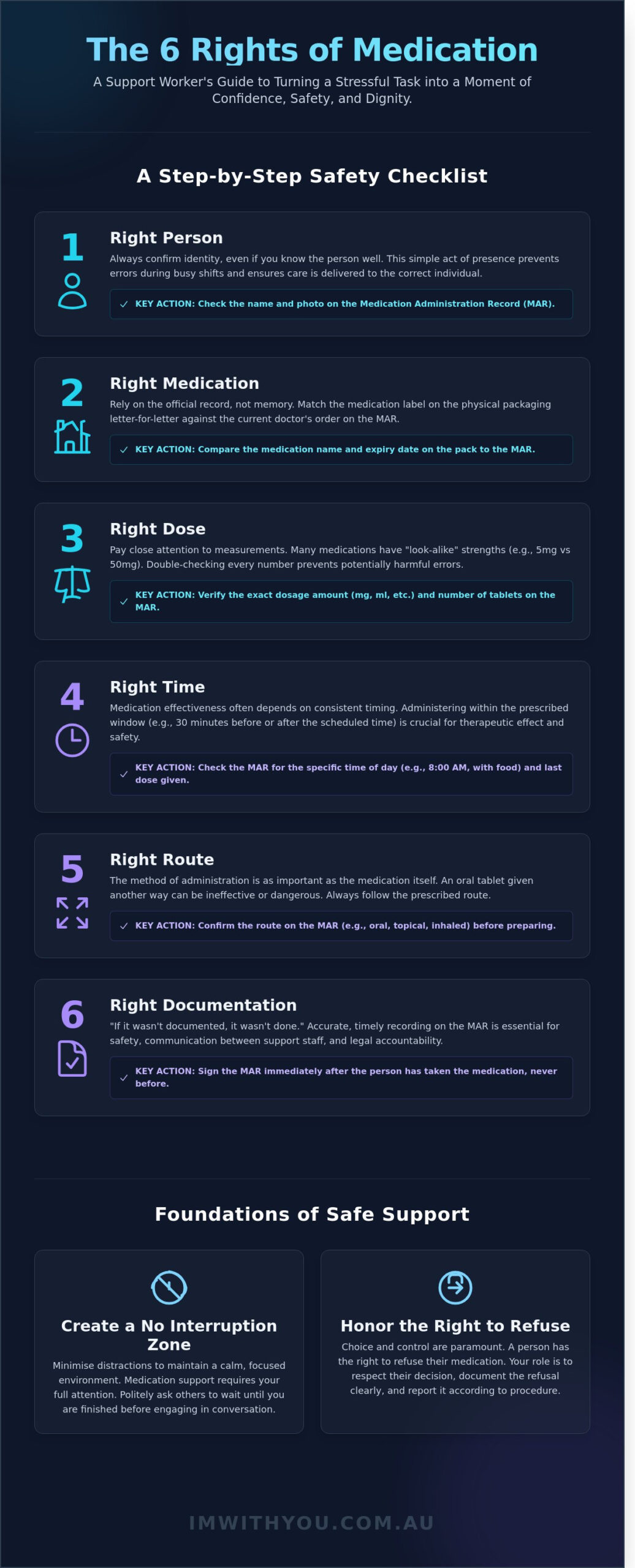
Every time we support someone with their health, we follow a sacred sequence. Think of the 6 rights for medication as a protective circle we draw around the person we’re supporting. If you skip even one step, that circle breaks and the safety net fails. This isn’t just a clinical task; it’s a moment where we ensure a participant feels safe, seen, and respected. We always keep the Medication Administration Record (MAR) open and visible. It serves as our shared map, and we cross-reference it at three distinct points before the medication ever reaches the person’s hand.
Right Person, Right Medication, and Right Dose
Verifying the Right Person is about more than recognizing a familiar face. Even if you’ve supported a participant for 500 days, always check their name and photo on the MAR. It’s a simple act of presence that prevents errors during busy transitions or shift changes. When confirming the Right Medication, we look at the physical label on the packaging and match it letter-for-letter against the doctor’s current order. We don’t rely on memory. For the Right Dose, we pay close attention to the exact measurements. Many medications have “look-alike” strengths, such as a 5mg tablet versus a 50mg tablet. Understanding these medication administration rights helps us maintain the highest standards of safety while protecting the individual’s well-being. We double-check every number because precision is a form of care.
Right Route, Right Time, and Right Documentation
The Right Route ensures the body absorbs the support exactly as the doctor intended. We distinguish clearly between a tablet taken orally, a topical cream, or liquid drops. Using the wrong path can make a treatment ineffective or even harmful. Timing is just as vital. The Right Time usually involves a specific window, typically 30 minutes before or after the scheduled slot, to ensure the medication works with the body’s natural rhythm. Finally, we reach the Right Documentation. This is our golden rule; if it isn’t recorded immediately, the next person in the support circle won’t know it happened. We document every success and every refusal to keep the journey transparent and safe. If you’re looking for more ways to empower your support team, we’re ready to walk that path side-by-side with you. Following the 6 rights for medication isn’t just about compliance; it’s about honoring the trust placed in us every single day.
Implementing Medication Safety in Your Daily Support Routine
We believe that supporting someone with their health is a sacred responsibility. It’s a journey we take together to ensure comfort and dignity. To make this process as safe as possible, we focus on creating a rhythm that prioritizes focus and presence, ensuring the 6 rights for medication are met every single time. By slowing down and following a consistent routine, we honor the person’s choice and control over their own wellbeing.
Creating a Calm and Focused Environment
Safety begins long before a tablet leaves its packaging. We start by ensuring the space is well-lit and organized, with all necessary supplies within reach. You should always perform thorough hand hygiene first, as this simple act protects the participant’s health. Before you begin, explain what’s happening to the person you’re supporting. This keeps them at the center of the process and reduces anxiety.
We use a “No Interruption Zone” to keep our focus sharp. Research published in the Archives of Internal Medicine shows that each interruption during medication administration increases the risk of a procedural error by 12.1%. By politely asking others to wait, you create a protective bubble for the participant. Following established Medication Administration Safety Guidelines helps us build a culture of safety that protects everyone involved. It’s about being present in the moment, side-by-side with the person you support.
Using the Medication Administration Record (MAR) Correctly
Your MAR chart is a vital map for the participant’s care. In Australia, a standard MAR chart is a grid that clearly lists the medication name, strength, dose, and the specific time it’s due. You must sign the chart immediately after the participant has swallowed the medication. Don’t sign it before they take it, and don’t wait until the end of your shift. This real-time recording prevents dangerous double-dosing errors.
Sometimes, things don’t go as planned. If a participant refuses a dose or if a dose is missed, you must record this “non-event” using the specific codes on your MAR, such as ‘R’ for refusal. We treat these moments with empathy and respect for the individual’s autonomy. If an error occurs, our NDIS Incident Management Procedures guide explains how to respond with transparency and care. When handling PRN, or “as-needed” medications, applying the 6 rights for medication ensures we respect their health and their choices. Always check the MAR for the last time a PRN dose was given to avoid exceeding the maximum daily limit, keeping their safety as our steady guide.
Managing Challenges: Refusals, Errors, and Complex Needs
Even with the most careful preparation, the journey of medication support can sometimes take an unexpected turn. We understand that real life doesn’t always follow a perfect script. Sometimes a participant might say “no,” or you might notice a discrepancy during your final check. When these moments happen, remember that we are standing right beside you. Our priority is always the safety and dignity of the person we support, ensuring they feel heard and respected even when challenges arise.
If your check of the 6 rights for medication reveals a mismatch between the label and the support plan, stop immediately. Don’t administer the dose. Instead, contact your supervisor or a pharmacist for clarification. This isn’t a failure; it’s a vital safety catch that protects the person in your care. We approach these hurdles with a focus on solutions rather than blame.
Supporting the Right to Refuse
Choice and control are more than just NDIS pillars; they’re sacred promises we make to every individual. Every participant has the legal and moral right to refuse medication. We distinguish between a temporary refusal, where someone might just need 15 minutes of quiet space, and a long-term choice to stop a treatment. If a refusal occurs, wait a short while and offer the medication again with a gentle, non-pressured approach. If they still decline, notify your supervisor or the relevant health professional. Document the event using factual, neutral language that respects the participant’s autonomy without making them feel like they’ve done something wrong.
What to Do If an Error Occurs
Mistakes can feel overwhelming, but your immediate response defines the path to safety. If an error happens, check the participant’s wellbeing first. Stay calm and stay with them. If there’s any sign of physical distress, call 000 immediately. For expert guidance on specific medication mishaps, call the Poisons Information Centre on 13 11 26. We practice open disclosure, which means being honest and transparent with the participant and their family. Following the NDIS Incident Management and Reportable Incidents Rules 2018, you must report the error to your provider within 24 hours. This process ensures we learn together and continue to provide the highest standard of care.
We believe in walking side-by-side through every challenge to create a safer, more inclusive environment. If you need guidance on managing complex support needs or navigating NDIS protocols, reach out to our dedicated team for compassionate, expert advice.
Choosing a Support Partner Committed to Excellence and Safety
At I’m with you, your safety isn’t just a checkbox; it’s the foundation of every relationship we build. We understand that managing health can feel like a heavy burden for many families. That’s why we’ve built our entire support model around the 6 rights for medication, ensuring that every dose is handled with the precision and care you deserve. Our commitment to these standards was officially recognized when we received the 2026 Award for Excellence in Disability Support. This honor reflects our rigorous internal audits and our refusal to compromise on your wellbeing.
Every support worker we hire undergoes intensive training that goes beyond basic compliance. We focus on the intersection of technical mastery and person-centered empathy. Our team doesn’t just follow a chart; they understand the person behind the prescription. This ensures that the 6 rights for medication are applied with a gentle, human touch that respects your dignity and individual routine. We believe that professional expertise should always feel like a warm, supportive conversation rather than a clinical procedure.
Our Holistic Approach to Your Journey
We don’t see medication as a separate task to be finished. Instead, we weave safety into your broader capacity building and independent living goals. Having a steady companion who understands your specific health needs allows you to focus on your life, not just your symptoms. This consistency builds deep trust and ensures that small changes in your health are noticed immediately by someone who truly knows you.
If you’re wondering how to find the right fit for your needs, you might find our guide on How to Choose an NDIS Provider You Can Trust helpful. We believe that true independence starts with the security of knowing you’re in safe hands. Our approach is designed to lower the stress of navigating complex plans, giving you the space to breathe and grow.
Standing Beside You for a Safer Future
You don’t have to manage complex health requirements alone. We’re here to walk alongside you, offering the technical expertise and emotional warmth that makes a real difference in your daily life. Our team prioritizes your choice and control, ensuring that your voice is always heard in every care decision. We invite you to join a community where safety is treated as a sacred promise rather than a regulatory requirement.
Choosing a community that values your dignity means choosing a partner who is as invested in your health as you are. We are ready to provide the support coordination or direct care services you need to live your best life. Connect with our award-winning team at Im with you today to start a conversation about your future.
Empowering Your Health Journey with Safe Medication Support
Your health journey is a deeply personal experience, and managing your daily dose shouldn’t feel like a source of stress. By following the 6 rights for medication, you ensure every step of your care is handled with the precision and respect you deserve. This approach moves beyond simple safety; it’s about protecting your choice and control every single day. Whether you’re navigating complex needs or establishing a new routine, having a steady companion makes all the difference in maintaining your independence and peace of mind.
At I’m With You, we’re proud to stand beside you as an NDIS Registered Provider. Our commitment to your wellbeing earned us the 2026 Award for Excellence in Disability Support, proving that high-quality care is built on a foundation of trust. As specialists in high-intensity personal activities, we understand the nuances of complex health requirements and the importance of a gentle, human touch. We’re here to walk this path with you, ensuring you feel heard and supported at every turn. Discover how our award-winning support team puts your safety first. You’re never alone in this process, and we’re ready to help you thrive with confidence and dignity.
Frequently Asked Questions
What are the 6 rights for medication administration?
The 6 rights for medication are the essential safety checks we follow: Right Person, Right Medication, Right Dose, Right Route, Right Time, and Right Documentation. We use these steps to ensure every dose supports your health journey without any mistakes. By following this sequence every single time, we create a safe environment where you can feel confident in your daily routine. It’s more than just a list; it’s our promise of professional care.
Can a support worker administer medication without a MAR chart?
You shouldn’t administer medication without a Medication Administration Record (MAR) chart, as it’s the primary tool for tracking your safety. The NDIS Quality and Safeguards Commission requires clear, written records for 100% of administered doses to prevent errors. Without a MAR chart, the risk of double-dosing or missing a dose increases. We always ensure a clear record is in place to protect your wellbeing and maintain the high standards you deserve.
What should I do if a participant refuses their medication?
If you refuse your medication, we respect your right to choice and control immediately. We’ll wait 15 to 20 minutes before gently offering it again, as sometimes you might just need a little more time or space. If you still choose not to take it, we’ll document the refusal on your MAR chart and notify your healthcare provider or supervisor within 2 hours. Your autonomy is our priority throughout this entire process.
Is the 6 rights framework the same for family carers and professional support workers?
The 6 rights for medication framework applies to both family carers and professional support workers because safety is a universal need. While family members might not have the same strict reporting paperwork as a registered NDIS provider, the 6 core checks remain the gold standard for preventing accidents. Using this framework at home ensures that 100% of the people you love receive their support safely and consistently, regardless of who is helping.
What is the difference between medication ‘support’ and ‘administration’ under the NDIS?
Medication support involves prompting you to take your medicine or helping you open a blister pack, while administration means the worker takes full responsibility for the 6 rights. Under NDIS Practice Standards, support is typically for those who retain 100% of their cognitive capacity for health decisions. Administration is a more intensive task where the worker physically delivers the dose. We’ll work side-by-side with you to decide which level of help fits your life.
How often should the 6 rights be checked?
You must check the 6 rights 3 separate times during every single administration event to ensure total accuracy. We check when we first take the medication from storage, again when we prepare the dose, and a final time before you take it. This triple-check method is a proven way to catch potential errors before they happen. It ensures that every 1 of your doses is handled with the highest level of care and attention.
What happens if I forget to document a medication dose?
If you forget to document a dose, it’s considered a medication error under the NDIS Incident Management rules from 2018. You should contact your supervisor or the participant’s doctor within 60 minutes to confirm the dose was actually given. We don’t guess or fill in the charts later. Instead, we follow the formal incident reporting process to ensure everyone stays safe and informed. We’re here to solve these moments together with transparency.
Does the NDIS require specific training for medication administration?
Yes, the NDIS requires workers to meet the High Intensity Support Skills Descriptor for 2023 if they’re administering complex medication. This involves completing a recognized training module and having their competency assessed by a Registered Nurse. We believe that 100% of support workers should feel confident and skilled before they help. This training ensures we provide the professional, safe support you deserve while walking alongside you on your journey toward independence.