

What if the label “disability” wasn’t a weight to carry, but a key that unlocked the exact support you’ve been searching for? For the 65,000 Australians currently accessing NDIS support for their mental health, the term psychosocial disability often feels clinical or even stigmatizing. You might feel that your experience is too invisible for a government system, or perhaps you’re tired of explaining why some days are harder than others. It’s completely natural to feel overwhelmed when you’re trying to heal while also deciphering complex terminology.
We’re here to walk beside you as you reclaim your narrative. In this guide, we’ll clarify how the 2026 NDIS standards define your support options and help you overcome the specific barriers that stand in your way. You’ll discover how the right recovery-oriented framework empowers you to lead your own journey. We’ll break down the steps to accessing help so you can finally experience the Choice and Control you deserve, ensuring you never have to face these challenges alone.
Key Takeaways
- Understand the vital difference between a medical diagnosis and a psychosocial disability, focusing on how social barriers impact your daily life and inclusion.
- Explore the NDIS Recovery-Oriented Framework, a person-centered approach designed to support your unique journey toward independence and well-being.
- Learn how to navigate the NDIS application process with confidence by identifying the specific evidence and professional support required for a successful outcome.
- Discover how standing side-by-side with a dedicated partner simplifies the NDIS system, ensuring you have the support needed to exercise true choice and control.
Defining Psychosocial Disability: More Than a Diagnosis
When you start your journey toward support, it’s helpful to understand that having a mental health condition doesn’t always mean you have a disability. In the Australian context, we use the term psychosocial disability to describe the challenges that arise when a person’s mental health interacts with a social or physical environment that isn’t inclusive. It isn’t just about a medical label or a list of symptoms. Instead, it’s about how those symptoms affect your ability to take part in the world around you. We focus on person-first language because you’re a person who happens to live with a disability, and your identity is much bigger than any NDIS category.
To better understand how this concept shapes the support you receive, watch this helpful webinar:
The NDIS uses this specific term to unlock funding for recovery-oriented support. This means the focus stays on your long-term goals and your right to live a meaningful life. We’re here to help you move beyond just managing a condition toward actually thriving in your community. By recognizing the social barriers you face, we can work together to remove them, ensuring you have the same opportunities as everyone else.
Mental Health vs. Psychosocial Disability
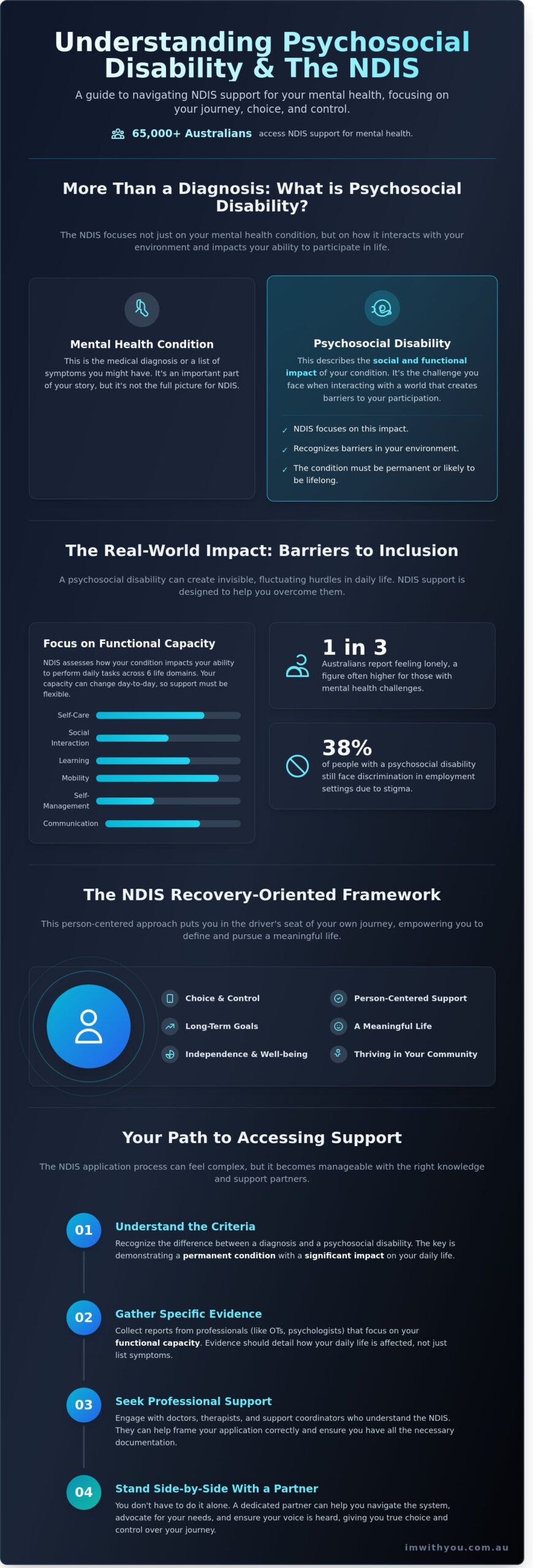
Not every mental health challenge qualifies for NDIS funding. Under the 2026 guidelines, the NDIS looks for “permanence” and “significant impact” on your daily life. This means the condition is likely to be lifelong and creates a substantial barrier to your independence. A psychosocial disability is the mismatch between a person’s mental health and the social or physical environment that prevents them from participating fully in life. We focus on this gap to provide the right tools for your specific journey.
The Role of Functional Capacity
Functional capacity is the way the NDIS measures your ability to complete daily tasks across six key life domains, such as self-care and social interaction. We’ve seen a vital shift in 2026 from focusing on clinical symptoms to prioritizing life participation. Your capacity can change from day to day, which is why your support plan must be flexible. This approach protects your Choice and Control, allowing you to scale your support up or down based on your needs at any given moment. We stand beside you to ensure your plan reflects the reality of your life, not just a snapshot in time.
The Impact on Daily Life and Social Inclusion
Living with a psychosocial disability often means managing invisible hurdles that others might not see. It’s more than a medical label; it’s the way social anxiety, fluctuating stamina, or communication challenges affect your ability to take part in the community. You might find that loud environments or crowded spaces exacerbate your symptoms, making a simple trip to the shops feel exhausting. The NDIS definition of psychosocial disability focuses on these functional impacts, acknowledging that your environment plays a massive role in your wellbeing. We understand that these barriers aren’t your fault, and you don’t have to face them alone.
Social isolation remains a significant hurdle across Australia. The 2024 State of the Nation report on social connection found that one in three Australians feel lonely, but for those with mental health challenges, this figure is often much higher. We prioritize trauma-informed care because we know your past experiences shape your present. By creating a safe, non-judgmental space, we help you rebuild connections at your own pace. This approach ensures that support delivery feels like a partnership rather than a clinical process.
Navigating Social and Environmental Barriers
Stigma remains a primary barrier to equality. In 2025, research indicated that 38% of people with psychosocial disability still face discrimination in employment settings. Whether it’s education or the workplace, these hurdles can feel insurmountable without the right advocate. We stand beside you to challenge these barriers, ensuring your voice is heard in every community setting. Advocacy isn’t just about speaking up; it’s about changing the environment to fit your needs and protecting your dignity.
Fluctuating Needs and the Journey
Your support needs aren’t static. One week you might feel empowered and independent, while the next requires more intensive care. This is the episodic nature of disability that the NDIS recognizes. We don’t just manage a case; we support a life. This means your plan stays flexible, moving with you through the highs and lows of your unique journey. We focus on your strengths, helping you maintain choice and control even when things feel uncertain. If you ever feel like the system is too complex to handle alone, we’re ready to walk this path with you.
The NDIS Recovery-Oriented Framework
The NDIS Psychosocial Disability Recovery-Oriented Framework represents a vital shift in how we support one another. It moves away from the traditional medical model, which often focused purely on symptoms and clinical deficits. Instead, this framework prioritizes your personal empowerment. By 2026, the NDIS has fully integrated these practices to ensure that Understanding Psychosocial Disability involves looking at your whole life rather than just a diagnosis. We believe that you are the expert in your own experience, and our role is to stand beside you as you reclaim your agency.
The framework is built upon six key principles that guide every interaction within the NDIS ecosystem in 2026. These principles include:
- Promoting a culture of hope: Believing in your potential for a fulfilling life.
- Supporting individual identity: Helping you move beyond the label of a patient.
- Encouraging personal responsibility: Empowering you to take the lead in your decisions.
- Building on strengths: Focusing on what you can do rather than what you can’t.
- Facilitating social inclusion: Connecting you with your community in meaningful ways.
- Individualized support: Acknowledging that your journey is unique to you.
We treat Choice and Control as a sacred promise. This framework ensures that you have the final say in your support team and the rhythm of your daily life. It’s about dignity and the right to lead a life that feels authentic to you.
Recovery as a Personal Journey
Recovery is rarely a straight line. It’s a deeply personal process of living a meaningful life, even if symptoms of psychosocial disability persist. This journey is fueled by hope and self-determination. Support Coordination plays a crucial role here by helping you implement your plan in a way that mirrors your values. We work with you to find services that respect your pace and celebrate your progress, ensuring you never feel like a number in a system.
Capacity Building for Independence
Capacity building is the practical side of empowerment. We focus on tangible skills that help you navigate the world with confidence. This might include learning to manage a monthly budget, developing social skills for community groups, or establishing a morning routine that feels grounding. We always start with your strengths. By focusing on what’s working, we build a foundation for lasting independence. You can find more advice on selecting the right team for this journey in our guide on How to Choose an NDIS Provider You Can Trust.
For many, the responsibility and companionship of a pet can be a powerful tool for building routine and confidence. If you’re exploring this path, you can discover I Wuff You Dog Training for expert guidance on strengthening that human-animal bond.
Accessing NDIS Support for Psychosocial Disability
Beginning your NDIS journey feels like a big step, but you don’t have to walk this path alone. The process starts when you complete an Access Request Form (ARF). We recommend working closely with your GP or psychiatrist to ensure the NDIA understands how your psychosocial disability affects your daily life. According to the June 2024 NDIS Quarterly Report, over 66,000 Australians now receive support for primary psychosocial conditions, proving that help is available when you have the right evidence.
The NDIS uses a specific legal framework called “Reasonable and Necessary” to determine your funding. For your support to meet this criteria, it must be related to your disability, represent value for money, and be likely to help you achieve your goals. It’s a system designed to complement, not replace, the clinical mental health services provided by state governments. We stand beside you to ensure your plan reflects your actual needs rather than just a medical label.
Gathering the Right Evidence
Success starts with the “Evidence of Psychosocial Disability” form. The NDIA focuses on functional capacity rather than clinical diagnosis alone. They want to know if you struggle with social interaction, self-management, or performing household tasks. Family members can provide a “Carer Statement” to describe the support they provide every day. This personal perspective adds vital context that a 15-minute doctor’s appointment might miss.
- Focus on your “worst days” to show the full impact of your condition.
- Ensure your health professional uses the NDIS functional domain language.
- Include reports from any allied health professionals you’ve seen in the last 12 months.
Setting Meaningful Life Goals
Your goals act as the engine for your funding. If you tell a planner, “I want to feel better,” they may find it hard to allocate specific supports. Instead, we help you translate that feeling into an actionable outcome like, “I want to build the confidence to use public transport independently.” This specific goal allows the NDIS to fund a recovery coach or support worker to assist you. Your goals should reflect your unique aspirations and the life you want to lead, not just the symptoms you want to manage.
When you’re ready to take the first step toward independence and dignity, you can reach out to our compassionate team for guidance on your application. We believe in your potential to thrive with the right support system behind you.
Standing Side-by-Side: How ‘Im with you’ Supports You
Living with a psychosocial disability means your journey has unique peaks and valleys. At I’m With You, we don’t view your NDIS plan as a set of administrative tasks. We see it as the foundation for your independence. Our team walks beside you, offering a steady hand when the path feels steep. We’ve built our service on the belief that professional expertise should always feel human, warm, and deeply personal. We’re here to ensure you never feel like just another case number in a system.
Personalised Support Coordination
The NDIS system often feels like a puzzle with shifting pieces. Our Support Coordinators act as your guide, helping you translate complex funding into real-world action. We focus on three core areas to ensure your plan works for you:
- Funding Implementation: We ensure you understand every dollar of your budget so you can use it effectively.
- Community Connection: We link you with local therapeutic supports and social activities that align with your personal goals.
- Steady Companionship: When life changes, we stay by your side to adjust your supports accordingly.
We take the stress out of the paperwork. This lets you focus on your recovery and your future. Our team remains a constant, reliable presence through every transition you face.
Our Promise of Advocacy
Supporting someone with a psychosocial disability requires more than just technical knowledge; it requires a commitment to dignity. We treat Choice and Control as more than just a policy requirement. To us, it’s a sacred promise. You are the expert in your own life. Our role is to provide the tools and advocacy you need to lead it on your terms. This commitment to quality care earned us the 2026 Excellence in Disability Support Award, a recognition that reflects our dedication to every person we serve.
Our approach is non-judgmental and patient. We know that trust is earned through consistency. Whether you’re looking for new providers or need someone to stand up for your rights, we’re here. You don’t have to face the system alone. Reach out to our friendly team for a gentle chat about your needs and discover how we can support your journey today.
Embrace Your Future With Confidence and Care
Navigating the complexities of a psychosocial disability doesn’t have to be a solitary path. You’ve seen how the 2026 NDIS recovery framework prioritizes your personal goals, focusing on social inclusion and meaningful daily participation. By understanding your rights to Choice and Control, you can transform your NDIS plan into a tool for genuine independence. As a National NDIS Provider, we’re here to ensure those promises become your reality. We’re proud to be the recipient of the Awarded for Excellence in Disability Care 2026, reflecting our commitment to high-quality, person-centered support.
Our team provides expert NDIS Support Coordination that balances technical knowledge with a gentle, human touch. We’ll stand beside you as you build your capacity and reclaim your future. You deserve a partner who values your dignity as much as your progress. Let’s walk this journey together, connect with our team today. Your brighter tomorrow is waiting, and we’re ready to help you reach it.
Frequently Asked Questions
Is a mental health diagnosis the same as a psychosocial disability?
No, a mental health diagnosis is a clinical label while a psychosocial disability refers to the functional impact that condition has on your life. Under Section 24 of the NDIS Act 2013, the scheme focuses on how your symptoms affect your ability to communicate, move, or manage your self-care. We’ll help you document these impacts across the 6 functional domains to ensure your application reflects your lived experience.
Can I get NDIS funding for depression or anxiety?
You can access funding for depression or anxiety if the condition is likely to be permanent and results in a substantially reduced functional capacity. The NDIS 2026 operational guidelines require evidence that you’ve exhausted clinical treatments and still require support in 1 or more life areas. We’ll stand beside you to gather the psychiatric reports needed to prove these challenges are a lasting part of your journey.
What kind of supports does the NDIS fund for psychosocial disability?
The NDIS funds various capacity building and core supports specifically designed for your psychosocial disability. This includes hiring a Psychosocial Recovery Coach or a support worker to assist with social outings and household organization. In 2026, these funds remain flexible, allowing you to prioritize assistance with self-care or community access depending on your energy levels and recovery goals each week.
What happens if my support needs change frequently?
You can use your flexible core budget to increase or decrease support as your symptoms fluctuate. NDIS plans in 2026 utilize Section 47A variations, which allow for quicker plan adjustments when your circumstances shift unexpectedly. We’re with you as your needs change, ensuring your plan stays as dynamic as your recovery journey and provides more help during difficult periods without requiring a full review.
Do I need a Support Coordinator for my psychosocial recovery?
While a Support Coordinator isn’t mandatory, the NDIS often recommends a Psychosocial Recovery Coach for participants with complex mental health needs. These specialists spend 70 percent of their time on coaching for resilience and 30 percent on coordinating your services. They act as a knowledgeable guide who walks alongside you, helping you navigate the system while focusing on your personal empowerment and long-term independence.
How do I prove my psychosocial disability to the NDIS?
You must provide a completed Evidence of Psychosocial Disability form signed by a psychiatrist, GP, or clinical psychologist. This document must confirm your condition is likely to be permanent and detail how it limits your participation in 1 of the 6 main life domains. We’ll help you coordinate with your clinicians to ensure they use the specific language the NDIS requires to understand your daily struggles.
Can I choose my own support workers with a psychosocial disability?
Yes, you have full choice and control over who provides your support and when they visit your home. Whether you’re self-managed or use a plan manager, you can select independent contractors or specific staff from registered providers who make you feel safe. We’ll stand with you to ensure you feel respected by the people you invite into your life, as building trust is vital for recovery.
Is NDIS support available for people with coexisting disabilities?
Yes, the NDIS provides holistic support for individuals who live with multiple conditions simultaneously. Data from the June 2024 quarterly report shows that 30 percent of NDIS participants have more than one disability type recorded in their plan. We’ll work with you to ensure all your needs, whether they’re physical, sensory, or mental health related, are addressed in a single, cohesive plan that supports your entire personhood.