

What if the most effective way to improve your communication wasn’t by hiding your autistic traits, but by embracing them? For the 1 in 70 Australians on the autism spectrum, traditional therapy has often felt like a series of instructions on how to blend in. You’ve likely felt the heavy weight of masking during social skills training or the frustration of being told to practice eye contact when it feels physically painful. We agree that you shouldn’t have to perform to be heard, especially when working with an autistic slt who values your natural voice.
In this guide, you’ll discover how neuro-affirming support transforms the therapy journey from “fixing” a deficit into building genuine self-advocacy. We’ll walk you through using your NDIS capacity building budget to find a therapist who stands beside you. This approach replaces outdated behavioral goals with empowerment and respects your sacred right to choice and control.
Key Takeaways
- Understand how working with an autistic slt provides a unique, lived-experience perspective that prioritises authentic connection over clinical “social skills” training.
- Discover the shift toward neuro-affirming care and how the “Double Empathy Problem” is reshaping communication support in Australia.
- Learn how to effectively use your NDIS “Capacity Building – Improved Daily Living” budget to fund person-centred speech pathology.
- Access a practical checklist to ensure your therapist is AHPRA-registered and committed to trauma-informed, affirmative practices.
- Explore how we walk side-by-side with you to navigate the NDIS and find a professional who truly respects your individual communication journey.
What is an Autistic SLT and Why Does Lived Experience Matter?
An autistic slt is a university-qualified Speech and Language Therapist who also happens to be autistic. This dual identity means they’ve spent years studying the science of communication while living the internal reality of a neurodivergent life. For decades, traditional therapy relied on a medical model that viewed autism as a collection of deficits to be fixed. We believe in a different path. By embracing the social model of disability, an autistic professional focuses on how the world can better support your child, rather than asking your child to change who they are.
This shift is deeply rooted in the neurodiversity paradigm. To understand the foundation of this movement, you can explore What is Neurodiversity? to see how we view different brains as natural, valuable variations of the human experience. When a therapist shares this lived experience, they bring “insider knowledge” to every session. They understand how sensory processing or a different way of thinking feels from the inside out.
To better understand how this perspective shapes therapy, watch this helpful video:
Lived Experience vs. Clinical Expertise
While clinical degrees provide the tools, lived experience provides the compass. An autistic slt bridges the gap between complex theory and your daily reality. They can often spot the subtle signs of “autistic burnout” long before it leads to a total shutdown. This is critical because traditional “high intensity” therapy can sometimes push a child too hard. A neuro-affirming therapist knows when to pivot, ensuring your child feels safe and regulated. Neuro-congruent therapy allows a child to see their own communication style reflected back with pride, forming the foundation of a healthy, resilient identity.
The Rise of Neuro-Affirming Care in Australia
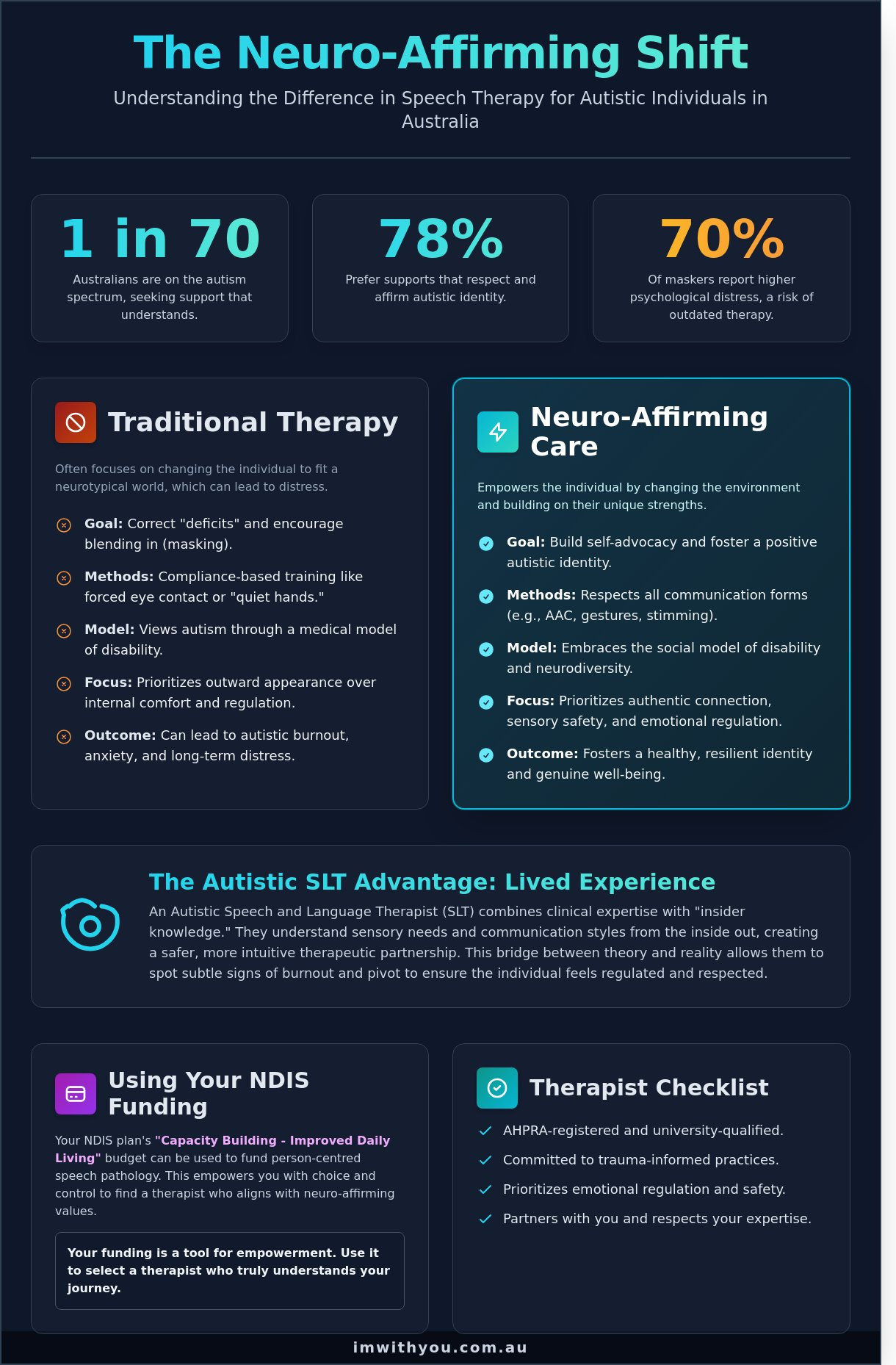
In Australia, we’re seeing a powerful shift toward affirmation. Many families are moving away from compliance-based goals, such as forced eye contact or “quiet hands,” which can cause long-term distress. According to a 2023 report from the Aspect Research Centre for Autism Practice, 78% of participants expressed a strong preference for supports that respect autistic identity. This is where your NDIS funding becomes a tool for empowerment. We treat the NDIS pillar of “Choice and Control” as a sacred promise. You have the right to select a therapist who doesn’t just “manage a case” but truly understands the journey you’re on. Australian practitioners are now leading a global movement that prioritizes dignity and authentic connection over simple behavioral modification.
- Focuses on strengths rather than deficits.
- Prioritizes emotional regulation and sensory safety.
- Respects all forms of communication, including AAC and gestures.
- Builds a collaborative partnership with your family.
The Neuro-Affirming Shift: How Autistic SLTs Differ from Traditional Therapy
Traditional therapy models often prioritize “fitting in.” You might have seen goals focused on sitting still or using rigid tools like Picture Exchange Communication Systems (PECS) to request basic items. An autistic slt sees your child’s development through a different lens. They prioritize internal comfort over outward appearance. This means moving away from compliance-based training and toward authentic connection. We look at how the environment can change to support your child, rather than demanding your child change to suit a neurotypical world. It is a journey of partnership where your child’s unique way of being is celebrated, not corrected.
Rejecting Masking and Compliance
Forcing a child to maintain eye contact or stop stimming can lead to significant long-term burnout. A 2023 study published in the journal Autism found that 70% of autistic adults who frequently masked their traits experienced higher levels of psychological distress. Your autistic slt understands this lived experience deeply. They phase out goals like “forced eye contact” because they know it can be physically painful or distracting for neurodivergent individuals. Instead, they support Gestalt Language Processing (GLP), recognizing that repeating phrases or “echolalia” is a valid, meaningful way to communicate. By following the principles of Neurodiversity-Affirming Care, we ensure your child feels safe to be their true self.
The Double Empathy Problem Explained
Communication isn’t a one-way street where the autistic person is “broken.” Dr. Damian Milton introduced the Double Empathy Problem in 2012, which suggests that communication breakdowns happen because two different neurotypes process the world differently. Both sides find it hard to understand the other. An autistic therapist doesn’t try to “fix” your child’s social style. Instead, they help build a shared language that respects both neurotypes. We work side-by-side with you to bridge this gap, ensuring your child’s voice is heard and respected in every setting. This collaborative approach empowers your family to exercise true Choice and Control throughout your NDIS journey. By focusing on sensory regulation and self-advocacy, we help your child navigate the world without losing themselves in the process.
Navigating the NDIS: Funding and Finding an Autistic SLT in Australia
The NDIS landscape can feel like a complex map to read, but you don’t have to navigate it alone. We believe that your funding should serve your unique goals, especially when seeking a therapist who truly understands the neurodivergent experience. Your Choice and Control isn’t just a policy term; it’s our promise to help you find a path that feels right for your family.
Understanding NDIS Funding Categories
Most families access speech pathology through the Capacity Building – Improved Daily Living budget. Under the 2023-24 NDIS Pricing Arrangements, therapeutic supports (line item 15_056_0128_1_3) are capped at A$193.99 per hour in most states. When you prepare for a plan review, focus on how an autistic slt meets the ‘reasonable and necessary’ criteria. You can argue that a therapist with lived experience provides a higher level of cultural safety. This specific connection often leads to better engagement and more meaningful progress toward communication goals, making it a highly effective use of your budget.
Your management type determines who you can hire:
- Self-managed: You have the most flexibility to hire any provider, regardless of their NDIS registration status.
- Plan-managed: You can choose non-registered providers, provided they have the appropriate insurance and qualifications.
- NDIS-managed: You are limited to NDIS-registered providers only.
How to Find Autistic SLTs in Australia
Finding a therapist who shares your child’s neurotype requires looking beyond standard listings. The Speech Pathology Australia (SPA) ‘Find a Speech Pathologist’ directory is a helpful tool. While there isn’t a ‘lived experience’ filter yet, you can search for practitioners who list ‘neuro-affirming’ or ‘neuro-divergent’ in their clinical interests. We also recommend exploring the Reframing Autism provider directory or neurodivergent-led social media groups like ‘Neurodivergent Speech Pathologists Australia’.
At I’m With You, we advocate for participants finding the right cultural and neuro-fit because we know that a shared perspective creates a safer space for growth. We’ll walk beside you as you interview potential candidates. Don’t be afraid to ask a therapist directly about their neurotype during an initial intake call. A genuine autistic slt will appreciate the value you place on this connection. We’re here to support you in making sure your team reflects the identity and strengths of your child.
What to Look for: A Checklist for Choosing the Right Therapist
Finding the right autistic slt means looking beyond the degree on the wall to find a partner who truly sees your child’s potential. Start with the professional essentials; ensure they’re registered with the Australian Health Practitioner Regulation Agency (AHPRA) and hold a current membership with Speech Pathology Australia. As of 2024, there are over 15,000 speech pathologists in the country, but finding one who aligns with a neuro-affirming philosophy is what makes the difference. You deserve a therapist who explicitly uses terms like “neuro-affirming” and “trauma-informed” in their practice descriptions, as these aren’t just labels, they’re a commitment to your child’s dignity.
We view “Choice and Control” as a sacred promise rather than a checkbox. Ask if the therapist involves your child in setting their own communication goals. If they can’t provide examples of strengths-based progress reporting, they might still be stuck in an outdated medical model. A strengths-based report focuses on what your child can do, such as “successfully advocated for a break,” rather than listing “deficits” or failures to meet neurotypical standards. We want to see your child’s unique voice celebrated, not corrected.
The Discovery Call: Questions to Ask
Your first 15-minute chat is a vital window into how the therapist works. Ask them directly: “How do you handle sensory needs during a session?” A supportive autistic slt will discuss environmental adjustments or sensory breaks without hesitation. Ask what progress looks like in their practice. If their answer focuses on “compliance” or “following instructions,” their communication style might not match the empowering, person-centered approach your family needs. Listen for a tone that sounds like a steady companion, not a distant clinician.
Red Flags to Avoid in SLT
Trust your instincts if you encounter a therapist who focuses on “extinguishing” repetitive behaviors like stimming. Stimming is a vital tool for self-regulation, and stopping it can lead to unnecessary distress. Any goals that prioritize looking “normal” over being comfortable are significant red flags. Flexibility is also essential for a successful journey. If a therapist refuses to offer telehealth or home visits when a clinic environment causes sensory overload, they’re ignoring the 2022 NDIS guidelines regarding individualised, reasonable, and necessary supports. We believe you deserve a guide who walks beside you, adapting to your child’s needs as they change.
If you’re feeling overwhelmed by the search for the right provider, our team is here to stand with you and help you navigate your NDIS options.
How ‘I’m With You’ Supports Your Communication Journey
Finding an autistic slt who aligns with your family’s values shouldn’t feel like an uphill battle. At Im with you, we understand that the NDIS often feels like a maze of complex acronyms and rigid paperwork. Our commitment is to walk side-by-side with you, acting as a steady companion while you build a life that celebrates neurodiversity. We don’t just manage cases; we support people. By focusing on your child’s strengths rather than their perceived deficits, we help you create a support network that feels safe and affirming.
Our approach ensures that your Choice and Control remains a sacred promise. We believe you’re the expert on your own life and your child’s needs. Our role is to provide the professional NDIS expertise required to make those needs a reality. We help you vet providers to ensure they don’t just “tolerate” neurodivergence but actively celebrate it. This means looking for therapists who understand that communication is about connection, not compliance.
Empowerment Through Support Coordination
We help you translate your family’s personal goals into the specific, NDIS-friendly language needed for successful plan implementation. This clarity is vital when navigating the A$193.99 hourly rate for therapy services outlined in the current NDIS Price Guide. We advocate for your right to specialised care, ensuring your funding is used effectively to connect you with an autistic slt or a neuro-affirming professional who shares your neurotype. Our team handles the heavy lifting of provider research, so you can focus on what matters most: your family.
- We vet every provider to ensure their practice is trauma-informed and affirming.
- Our coordinators help you prepare for plan reviews with data-backed evidence of progress.
- We prioritise providers who respect sensory needs and individual communication styles.
Your Journey, Your Way
The Im with you promise is simple: no clinical detachment, just genuine human support. We’ve seen how the right advocate can reduce the stress of disability services by over 60% for families feeling overwhelmed. We’re here to lower those barriers of anxiety with a calm, capable presence. Taking the first step is as easy as having a supportive conversation with us about your vision for the future. We’re ready to listen whenever you’re ready to talk.
Embracing a Future of Authentic Communication
Choosing a neuro-affirming path transforms speech therapy from a clinical requirement into a journey of self-discovery. By prioritizing lived experience, an autistic slt provides a safe space where your natural way of communicating is respected rather than corrected. You now have the tools to navigate the NDIS landscape and the checklist needed to find a therapist who truly aligns with your values.
At I’m With You, we’re dedicated to standing beside you every step of the way. We’re recognized as person-centered advocacy experts and are highly valued for our excellence in NDIS Care. Our team acts as specialists in Choice and Control; we ensure your voice remains the most important one in the room. We don’t believe in one-size-fits-all solutions because your journey is entirely your own. We’re ready to help you unlock a world of confident, comfortable communication.
Connect with a team that understands your journey
You’ve got the strength to lead the way; we’re just here to make sure you never have to walk it alone.
Frequently Asked Questions about Autistic SLTs
What is the difference between a traditional SLT and an autistic SLT?
The primary difference lies in lived experience and the therapeutic lens used during your sessions. While a traditional therapist relies on clinical training, an autistic slt combines professional expertise with a deep, personal understanding of neurodivergent communication. They often move away from the medical model of “fixing” a deficit. Instead, they apply the Double Empathy Problem theory, first framed by Damian Milton in 2012, to bridge the gap between different communication styles.
Can I use my NDIS funding for an autistic speech therapist?
You can certainly use your NDIS budget to work with an autistic slt if they are a qualified provider. These services are typically funded under the Capacity Building; Improved Daily Living category of your plan. Most therapists in Australia charge the standard NDIS rate of A$193.99 per hour. We believe in your right to exercise Choice and Control, ensuring you find a professional who truly resonates with your family’s journey and values.
Does an autistic SLT work with non-speaking individuals?
Yes, many autistic therapists specialise in supporting non-speaking or minimally verbal individuals through robust AAC systems. Research indicates that 30 percent of autistic children may be minimally verbal, and an autistic therapist often has a unique perspective on the importance of total communication. They focus on giving your child a voice through tools like Proloquo2Go or LAMP. This approach prioritises functional communication and autonomy over the traditional pressure to produce spoken sounds.
Is neuro-affirming therapy less effective than traditional methods?
Neuro-affirming therapy is highly effective because it prioritises long term mental health and genuine connection over compliance. Traditional methods often focus on reducing autistic traits, but a 2023 study showed that affirming care leads to better self esteem and reduced burnout. By focusing on your child’s natural strengths and interests, the therapist builds a foundation of trust. This side by side approach creates lasting skills that help your child navigate the world without losing themselves.
How do I know if my current speech therapist is neuro-affirming?
You can identify a neuro-affirming therapist by looking at the goals they set for your child. If their plan includes “increasing eye contact” or “reducing stimming,” they may still be using older, compliance based frameworks. A neuro-affirming professional will focus on sensory regulation, self advocacy, and finding joy in communication. Ask them if they follow the Neurodiversity Paradigm. Their answer should reflect a commitment to supporting your child’s identity rather than changing their natural behaviour.
What should I do if there are no autistic SLTs in my local area?
Telehealth is a wonderful option that allows you to connect with the right professional regardless of your postcode. Statistics from 2022 show that 90 percent of Australian speech pathologists now offer remote sessions, which can be less overwhelming for children who prefer their home environment. If you prefer face to face support, look for a local therapist who actively engages in neuro-affirming professional development. We are here to help you explore these options so you never feel alone.
Can an autistic SLT help with social anxiety and masking?
An autistic therapist is uniquely positioned to help your child navigate the heavy burden of masking. Research from 2019 suggests that constant masking is linked to a 7.2 times higher risk of mental health struggles in neurodivergent people. Your therapist will work with you to identify sensory triggers and social pressures that lead to anxiety. They provide a safe, non-judgmental space where your child can practice being their authentic self while learning healthy ways to advocate for their needs.
Do I need a formal diagnosis to see an autistic SLT?
You don’t need a formal diagnosis to begin your journey with a supportive therapist. Many families seek help while they are on waitlists, which can currently exceed 12 months in some parts of Australia. Under Section 24 of the NDIS Act, support is often based on functional capacity rather than a specific label. Whether you have a piece of paper or are just starting to understand your child’s needs, an affirming therapist will walk with you from day one.