

It’s a moment that can freeze you with fear: you look at someone you care about, and in an instant, you know something isn’t right. That feeling of helplessness, of not knowing what to do or say, can be overwhelming. But in a health crisis, clarity is your greatest strength. Knowing how to recognise a key symptom, like the one-sided smile stroke may cause, can empower you to act quickly and confidently when every second counts.
We are with you on this journey to understanding. In this gentle guide, we’ll walk you through the simple yet vital F.A.S.T. method for identifying stroke symptoms. We want to give you the confidence of knowing exactly what to do in an emergency and help you feel prepared to offer meaningful, compassionate support on the path to recovery. You are not alone, and you can be ready to help.
Key Takeaways
- Learn how the simple F.A.S.T. method, including the ‘smile stroke’ test, empowers you to confidently recognise the key signs of a stroke.
- Discover the most critical steps to take in a stroke emergency, helping you stay calm and act decisively when every second is vital.
- Understand that the journey doesn’t end in the hospital and explore the compassionate path to recovery that follows a stroke event.
- Find out how dedicated support can help you or your loved one navigate life after a stroke, focusing on rebuilding independence and dignity with someone by your side.
The F.A.S.T. Method: A Simple Way to Spot a Stroke
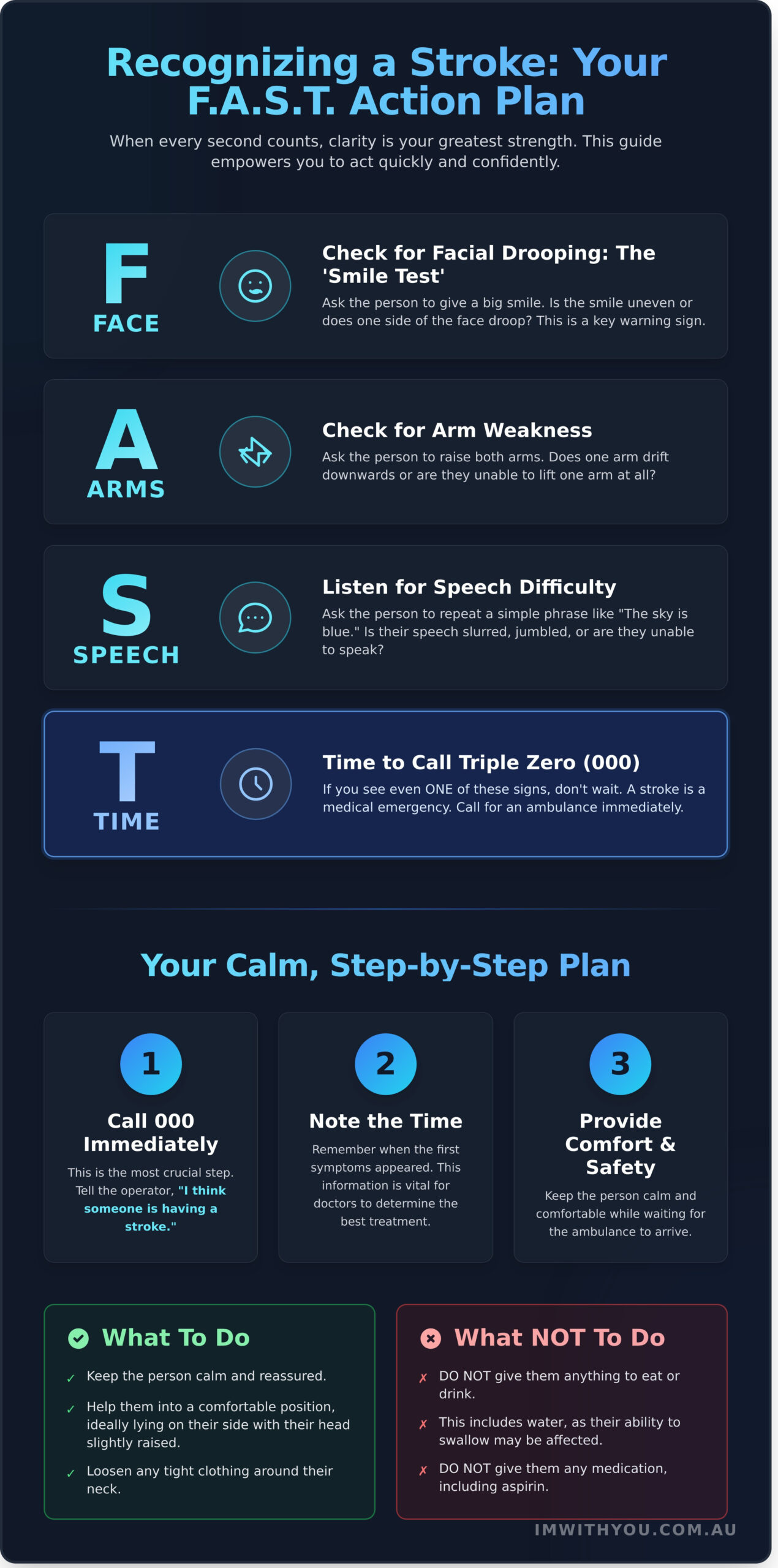
When you suspect someone is having a stroke, every second is precious. We know how overwhelming and frightening this moment can be, but there is a simple yet powerful tool that can give you clarity and confidence to act. It’s called The F.A.S.T. Method, a straightforward guide trusted by paramedics and doctors across Australia and around the world to identify the most common signs of a stroke. The final letter, ‘T’, stands for Time to call Triple Zero (000). It’s a vital reminder that you must seek immediate medical help as soon as you notice even one of the following signs.
F is for Face: The ‘Smile Test’ Explained
The first step is to look closely at the person’s face. Does one side appear to be drooping, or do they mention that it feels numb? To perform the ‘smile test’, gently and calmly ask them to give you a big smile. If the smile looks uneven, lopsided, or only one side of their mouth moves upwards, this is a key warning sign. This visible sign of a smile stroke happens because the stroke can interrupt the brain’s messages to the facial muscles, causing a loss of control on one side.
A is for Arms: Checking for Weakness
Next, you can check for any new or sudden weakness in the arms. Ask the person to close their eyes and raise both of their arms straight out in front of them, as if holding a tray. See if they can hold them there for about 10 seconds. A significant sign of a stroke is if one arm begins to drift downwards, or if they are unable to lift one arm at all. They might also tell you that one arm feels heavy, numb, or “dead.” This indicates a potential loss of strength on one side of the body.
S is for Speech: Listening for Difficulty
Finally, listen carefully to how the person is speaking. A stroke can have a direct impact on communication. Ask them to repeat a simple phrase, such as “The sky is blue in Perth.” Notice if their speech is slurred, jumbled, or hard to make out. They may not be able to speak at all. It’s also important to be aware of their comprehension; if they seem confused, can’t find the right words, or have trouble understanding what you are saying, this is another serious sign that requires immediate action.
T is for Time: Your Calm, Step-by-Step Emergency Plan
Seeing a loved one experience a stroke is a deeply frightening moment. In that rush of adrenaline, it can be hard to think clearly. But we are with you, and having a simple plan can make all the difference. Once you recognise one of the key indicators, such as the uneven smile of a F.A.S.T. Warning Signs, your next actions are the most important. Time is the most critical factor in treating a stroke and preserving brain function. This calm, step-by-step plan is designed to help you act decisively to get your loved one the professional medical help they need as quickly as possible.
Step 1: Call Triple Zero (000) Immediately
This is the most crucial step. A stroke is a medical emergency, and this is not a ‘wait and see’ situation. Even if the symptoms, like facial drooping or slurred speech, seem to improve or disappear, you must call for an ambulance. These could be signs of a transient ischaemic attack (TIA), which is often a precursor to a major stroke. When you call, calmly and clearly tell the operator, “I think someone is having a stroke.” They will guide you with questions; answer them to the best of your ability.
Step 2: Note the Time the Symptoms Started
This piece of information is vital for the medical team. Knowing the exact time the first symptoms appeared helps doctors determine the best course of treatment. For many types of ischaemic stroke (caused by a clot), there is a critical window of time where clot-busting medication can be most effective. If you didn’t see the stroke happen, simply note the time the person was last seen well. In the stress of the moment, it’s easy to forget, so write it down on a piece of paper or send a text to yourself.
Step 3: What to Do While Waiting for the Ambulance
While you wait for paramedics to arrive, your role is to provide comfort and safety. Focus on these simple, reassuring actions to support the person and prevent further harm. A key part of managing a potential smile stroke is ensuring the person is safe until professionals take over.
- Keep the person as calm and comfortable as you can. Reassure them that help is on the way.
- If they are conscious, help them into a comfortable position. Lying on their side with their head slightly raised is often best, especially if they feel nauseous.
- Loosen any tight clothing around their neck, such as a tie or a buttoned-up collar.
- Do not give them anything to eat or drink, not even water. Stroke can affect the ability to swallow, and this could cause them to choke.
- Do not give them any medication, including aspirin, as it could worsen certain types of stroke.
Beyond the Emergency: Understanding the Journey of Recovery
The rush of the hospital may be over, but your true journey is just beginning. This next chapter is not just about medical recovery; it’s about rediscovering yourself, your strengths, and your voice after a stroke. It’s a path of regaining independence, and we want you to know that you will have support every step of the way.
What Happens After the Hospital?
Transitioning from the hospital back home or to a rehabilitation facility marks a significant new phase. Here, you’ll begin working with a dedicated team, often including physiotherapists for movement, occupational therapists for daily living skills, and speech pathologists to support communication. Every stroke is different, and so is every recovery. Our goal is to stand with you, helping you access the support you need to live a full and meaningful life on your terms.
Navigating Challenges with Compassion
The path forward will have its challenges. Aphasia can make finding the right words feel incredibly frustrating, and physical changes, like those from a smile stroke that affects facial expressions, can impact how you connect with others. The emotional weight of these changes is real. This is why patience and compassion-for yourself and from others-are so vital. The Mayo Clinic describes a comprehensive journey of recovery that honours these complexities. Celebrating every small victory is essential, because healing involves the heart and mind just as much as the body.
Finding Your Support System in Australia
Please remember, you do not have to navigate this alone. In Australia, the National Disability Insurance Scheme (NDIS) can provide funding for essential supports to help you rebuild your skills and capacity. Services like Support Coordination are designed specifically to help you understand your NDIS plan and connect with the right providers, taking the stress out of the process. Your focus should be on your wellbeing, and our focus is on ensuring you have the right team beside you. We are here to walk with you on this journey.
How We Can Be With You After a Stroke
The journey of recovery after a stroke is deeply personal, filled with unique challenges and victories. At Im with you, we understand that regaining communication and independence is about more than clinical therapies; it’s about rebuilding a life of dignity, connection, and purpose. We are here to walk that path beside you, offering holistic support that honours your individual journey and empowers you to move forward with confidence.
Person-Centred Support for Your Goals
Your recovery is defined by what matters most to you. We begin by listening. Perhaps your goal is to return to a beloved hobby, reconnect with friends at your local club, or simply manage daily tasks at home with greater ease. Our support is built entirely around your aspirations. In line with the NDIS principle of ‘Choice and Control’, you are at the heart of every decision. Together, we create a flexible, supportive plan that helps you achieve your goals, one step at a time.
Building Confidence and Community Connection
Aphasia and the effects of a stroke can often lead to feelings of isolation. Our compassionate support workers can be the bridge back to an engaged and active life. We can be with you on outings, assist with transport to appointments, or help you rejoin community groups. It’s about rediscovering the small joys, like sharing a genuine smile. Stroke recovery is a deeply personal journey, and we focus on building your confidence both inside and outside the home, helping you feel safe and empowered to connect with the world again.
A Compassionate Team by Your Side
More than just a service, we offer true companionship. Our team understands the emotional and psychological toll a stroke can take on you and your family. We provide a safe, non-judgmental space where you feel heard and respected. We are your advocates, ready to help you navigate services and speak up for your needs. You are not alone on this journey. When you’re ready, we’re here to listen. Let’s start a conversation about how we can support you.
From Recognition to Recovery: We’re With You Every Step
Knowing how to spot the signs of a stroke is a powerful skill. From checking for a one-sided smile stroke symptom to remembering the F.A.S.T. acronym, your quick action can make all the difference. But the moments after the emergency are just as crucial. The journey of recovery is deeply personal, and it’s a path you do not have to walk by yourself.
If you or a loved one are navigating life after a stroke, you don’t have to do it alone. As an award-winning NDIS provider for excellence in quality care, we are here to walk beside you with a person-centred approach that honours your choices and dignity. Our dedicated team acts as your trusted advocate, ensuring you feel supported and empowered every step of the way. Discover how our compassionate support can be with you on your journey.
Your strength is remarkable, and with a trusted partner by your side, a fulfilling life is within reach.
Frequently Asked Questions
What is the difference between a stroke and a TIA (mini-stroke)?
A Transient Ischaemic Attack (TIA), or ‘mini-stroke’, is a temporary warning sign where blood flow to the brain is briefly blocked. The symptoms are temporary and typically resolve without causing permanent damage. A full stroke, however, involves a longer-lasting blockage or a bleed that can lead to lasting brain injury. We encourage you to treat any stroke-like symptoms as a medical emergency, as a TIA can be a precursor to a major stroke.
Can someone fully recover after having a stroke?
Recovery is a deeply personal journey, and it looks different for everyone. While some people make a full recovery, others learn new ways to live fulfilling lives with ongoing challenges. The brain has a remarkable ability to adapt, especially with dedicated rehabilitation like speech and occupational therapy. We believe in focusing on your strengths and possibilities, and we are here to walk alongside you, supporting every step of your unique recovery path and celebrating your progress.
Are the symptoms of a stroke different for men and women?
The most common symptoms, remembered by the F.A.S.T. test (Face drooping, Arm weakness, Speech difficulty, Time to call 000), apply to everyone. A key sign is if a person can’t smile after a stroke. However, women can sometimes experience less typical symptoms like sudden fatigue, confusion, or nausea. It is so important to be aware of all potential signs and to seek immediate medical help if you have any concerns for yourself or a loved one.
What are the main risk factors for a stroke?
Many stroke risk factors are linked to our lifestyle and can often be managed with support. The most common ones include high blood pressure, high cholesterol, smoking, diabetes, and an irregular heartbeat. Maintaining a healthy diet, engaging in regular physical activity, and managing stress are powerful steps you can take. Understanding these risks is the first step toward empowerment and taking control of your health journey, and we can help you find resources to support you.
How can I support a loved one emotionally after they’ve had a stroke?
Your presence and patience are powerful gifts. The emotional journey after a stroke can feel overwhelming, so creating a safe, reassuring space is key. Listen more than you speak, validate their feelings of frustration or sadness, and celebrate every small victory. Help them reconnect with hobbies and friends where possible. Remember, you are not alone in this either. Supporting a loved one is a huge role, and it’s important to ensure you have support for yourself too.
What is aphasia and how does it affect communication after a stroke?
Aphasia is a communication challenge that can happen when a stroke damages the language centres of the brain. It’s important to remember that aphasia does not affect a person’s intelligence-their thoughts and ideas are still there. It can make it difficult to find words, speak in sentences, understand what others are saying, read, or write. Each person’s experience is unique, and with compassionate support and speech therapy, many people find new ways to communicate and connect.