

Imagine sitting at your kitchen table on a Tuesday evening, holding a blister pack and feeling that familiar flutter of worry in your chest. You want everything to be perfect for your loved one, but clinical checklists can feel like a foreign language when you’re already tired from a long day. We know that supporting someone with their health needs under the NDIS isn’t just a task; it’s a vital responsibility that carries the weight of 100% accuracy every single day. It’s completely normal to feel overwhelmed by technical requirements or the fear of making a mistake.
We are here to walk beside you as you learn the six rights of medication administration, turning complex safety protocols into a gentle, reliable routine. By mastering these steps, you’ll replace that evening anxiety with the quiet confidence that you’re protecting your loved one’s health while honoring their dignity and choice. This guide breaks down each safety check into clear, everyday language so you can meet NDIS standards without losing the human touch that makes your care so special.
Key Takeaways
- Understand how the six rights of medication administration create a protective safety net, moving clinical standards into the warmth and comfort of your home.
- Learn how to verify medication details with both precision and dignity, ensuring every dose is handled with the gentle care your loved one deserves.
- Discover how to balance essential safety protocols with the NDIS pillars of choice and control, including a supportive approach to the right to refuse.
- Master the practical use of Medication Administration Records (MAR) to stay aligned with the latest 2026 NDIS Quality and Safeguards Commission guidelines.
- Explore how we stand beside you to transform routine administration into meaningful moments of connection, empowerment, and holistic support.
What are the Six Rights of Medication Administration?
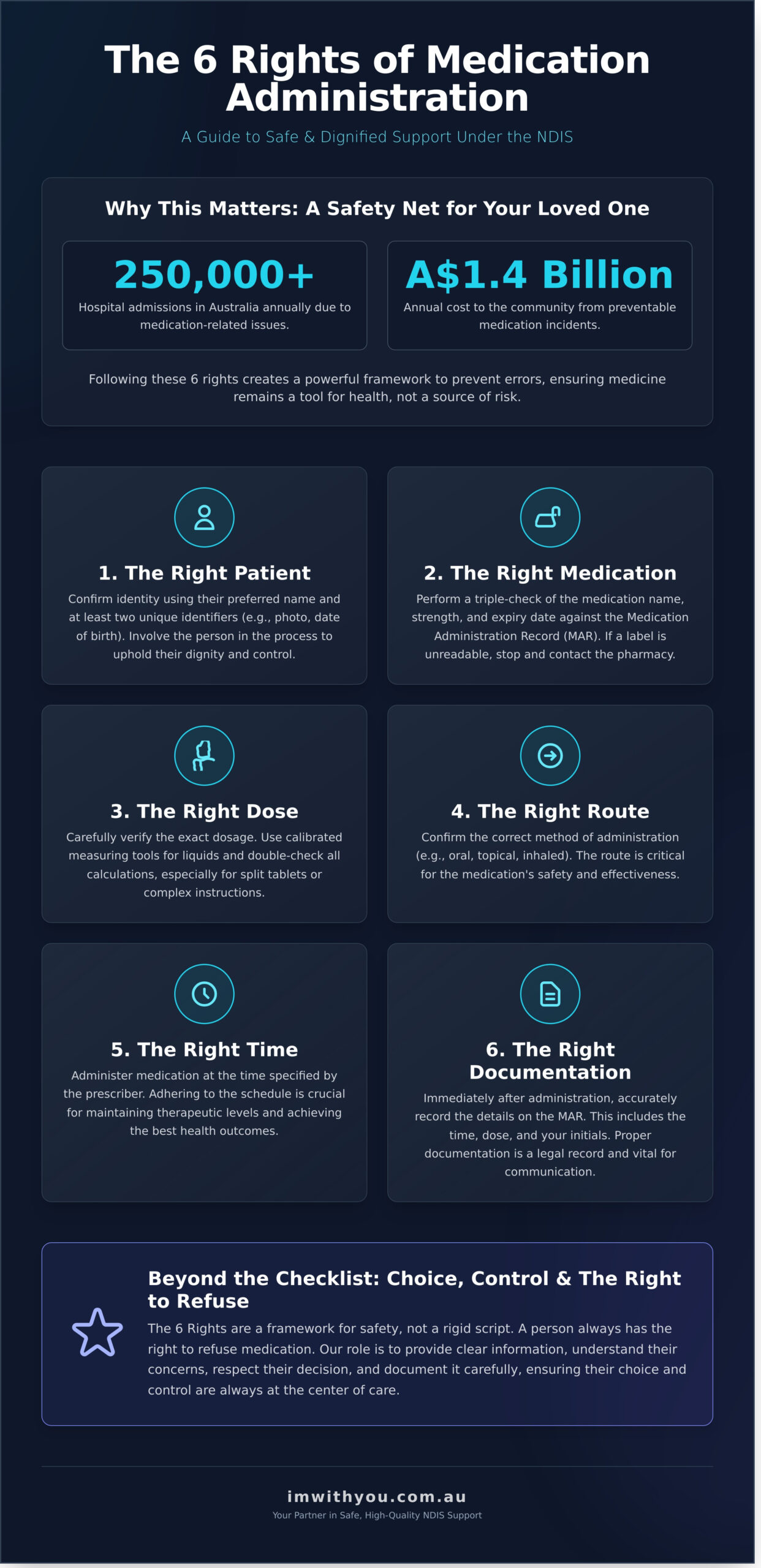
The six rights of medication administration represent a vital safety framework designed to stop mistakes before they happen. At its heart, this system is a simple, reliable way to make sure the right person gets the right support at the right time. We use this framework to turn complex clinical tasks into safe, everyday routines that protect your wellbeing. These steps are built upon global patient safety principles, which emphasize that strong systems are the best way to prevent human error. By following these checks, we ensure that medicine remains a tool for health rather than a source of risk.
For many years, these protocols lived almost exclusively in sterile hospital wards. However, the landscape of care in Australia has changed significantly. As of 2026, more than 610,000 Australians are participating in the NDIS, with a large percentage receiving complex medication support in their own homes. This shift means that clinical excellence must now live where you live. The transition from a hospital ward to a community setting requires a gentle, human touch, but the safety standards must remain just as high. We have adapted these professional tools to fit the rhythm of your home life, ensuring you receive high-quality care without feeling like a patient in your own lounge room.
By 2026, the NDIS Quality and Safeguards Commission has firmly established these rights as the gold standard for all providers. This is because high-quality support isn’t just about being kind; it’s about being consistently safe. When we follow this framework, we are not just ticking boxes. We are honoring your choice and control by ensuring the medicine you take is exactly what your doctor intended. This framework empowers you to ask questions and stay informed about your own health journey. It also gives your support workers the confidence they need to provide care that is both compassionate and technically sound.
The Core Purpose of the 6 Rights
The primary goal of this framework is to reduce the risk of Adverse Drug Events (ADEs) in the home. In Australia, medication-related issues lead to roughly 250,000 hospital admissions annually, which costs our community more than A$1.4 billion each year. Many of these incidents are preventable through better communication and double-checking procedures. By using the six rights of medication administration, we build a culture of transparency where everyone feels comfortable speaking up if something doesn’t look right. The six rights of medication administration serve as a safety net for independence.
Why Jargon-Free Education Matters
We believe that safety shouldn’t be hidden behind complicated medical language. Moving away from a rigid “medical model” toward a “support model” allows us to focus on your life as a whole. When we use clear, accessible language, we make sure that every family member and support worker feels capable and informed. This approach lowers the stress that often comes with managing health needs. We lead with empathy, recognizing that every pill or liquid is part of your daily routine. Following strict safety protocols is an act of respect for your dignity and your future. We are here to walk side-by-side with you, making sure that your journey toward your goals is supported by the highest possible standards of care.
A Detailed Breakdown: Navigating the 6 Rights with Care
Applying the six rights of medication administration is a commitment to the person standing in front of you. It’s about more than just following a clinical checklist. It’s a way to ensure that every participant feels seen, respected, and safe within their own home. By weaving these steps into a daily routine, we create a protective barrier against errors while maintaining the warmth and dignity that every individual deserves.
The First Three: Patient, Medication, and Dose
Confirming the right patient starts with a person-first approach. Instead of simply checking an ID number, we engage with the individual. Use their preferred name and, where possible, involve them in the process. This practice supports their choice and control. If a participant is unable to verbally confirm their identity, we use two unique identifiers, such as a photograph and their date of birth, to remain certain. This level of care is a core part of Patient Safety and Quality, ensuring that no mix-ups occur during a busy shift.
Verifying the right medication requires a triple-check of the label against the Medication Administration Record (MAR). We look at the drug name, strength, and expiry date every single time. If a label is torn, smudged, or unreadable, we don’t guess. We stop immediately and contact the dispensing chemist for a replacement. In Australia, the NDIS Quality and Safeguards Commission reports that medication errors are a leading cause of reportable incidents, so this step is vital. Accuracy in dosing is equally critical. We use specific measuring tools like oral syringes or calibrated cups rather than household spoons. A 2022 study indicated that guesstimating liquid doses can lead to errors of up to 20%, which is a risk we never take when we’re standing beside you.
The Final Three: Route, Time, and Documentation
The right route ensures the medication enters the body exactly as the doctor intended. Whether it’s an oral tablet, a topical cream, or ear drops, the method matters for absorption. We never crush or break tablets without explicit advice from a pharmacist or GP. Some medications are designed for slow release; altering them can lead to a dangerous “dose dump” where the body receives too much medicine at once. Safety is our priority, and that means respecting the science behind the prescription.
Timing is a balance between clinical necessity and the participant’s life. While some medications require strict 8-hour intervals, others offer more flexibility. We work within the standard 30-minute window of the scheduled time, but we also respect the person’s rhythm. If a participant is enjoying a meal or a social outing, we find a way to integrate their health needs without disrupting their joy. If you’re looking for a team that prioritizes these details, our compassionate support workers are here to help you manage these schedules with ease.
Documentation is the final, essential right. If it isn’t recorded, the law considers it not done. We document the administration immediately after the participant has taken the dose. This prevents double-dosing and provides a clear history for healthcare teams. Reliable records are the ultimate act of advocacy, proving that the six rights of medication administration have been met with the highest standard of care. This transparent approach ensures everyone involved in the support circle stays informed and confident.
Beyond the Checklist: Choice, Control, and Medication
The six rights of medication administration provide a vital safety net, but they shouldn’t feel like a rigid set of rules imposed on your life. Within the NDIS framework, Choice and Control mean you have the final say in your health journey. We don’t see medication as something done to a person. Instead, it’s a collaborative process where your preferences guide every step. This shift in perspective transforms a clinical task into an act of empowerment.
A common misconception in disability support is that medication is mandatory or enforced. This isn’t the case. Unless a specific legal framework like a Community Treatment Order exists, every individual has the right to refuse. When a participant says no, we don’t push back with authority. We lean in with curiosity. Is the tablet difficult to swallow? Does the timing interfere with a favourite activity? By exploring the “why” behind a refusal, we uphold your autonomy while looking for safe solutions together.
It’s also important to distinguish between clinical administration and “prompting” or “assisting.” Administration involves a worker taking full responsibility for the dose, whereas prompting is a gentle reminder for someone who can physically manage their own meds. Understanding safe medication administration practices helps us determine which level of support fits your routine. We want to provide the least intrusive support possible to keep you independent.
Respecting the Individual’s Agency
We involve you by explaining what each tablet does and asking how you prefer to take it. For the 30% of NDIS participants who use non-verbal communication, we look for subtle cues like body language or eye contact to ensure consent. Safety never overrides a person’s dignity. We move at your pace, ensuring you feel heard even without words. This approach turns the six rights of medication administration into a shared conversation rather than a one-way directive.
The Carer’s Emotional Journey
Managing complex regimes is heavy work that carries a real emotional weight. Data from the Australian Bureau of Statistics shows that over 2.65 million Australians provide informal care, and many experience high levels of stress. At I’m With You, we view you as a partner. You aren’t a service provider; you’re a person who needs support too. We encourage carers to practice “micro-breaks,” taking five minutes to breathe deeply after a medication round is complete. We’re standing beside you to help share this responsibility, ensuring you never feel alone in the process.
Best Practices for NDIS Medication Management in 2026
We believe that safety in your home starts with a genuine partnership. In 2026, following the NDIS Quality and Safeguards Commission guidelines is about more than just checking boxes; it is about your peace of mind and dignity. Our team uses the six rights of medication administration as a foundational promise to ensure every dose is handled with precision and care. This framework keeps you safe while we walk alongside you on your health journey.
The Medication Administration Record (MAR) is the heartbeat of safe home care. It is not just a piece of paper or a digital log; it is a shared story of your wellbeing. A well maintained MAR prevents 20% of potential dosing errors by providing a clear, real-time history for every support worker who enters your home. If a mistake happens, we handle it with honesty and speed. You can refer to our NDIS Incident Management Procedures to see how we respond. We focus on your immediate health and systemic improvement, never on blame or judgment.
Setting Up a Safe Home Environment
Your home should feel like a sanctuary, not a clinic. We help you find storage solutions that keep medications secure but easy to reach for the right people. In 2026, we often suggest using smart dispensers that sync with mobile apps to support the “Right Time” pillar of care. These tools provide gentle alerts for you and your support team. We also coordinate closely with Australian pharmacists to arrange Webster-paks. These pre-packed folders reduce confusion and ensure that 100% of your pills are organised by day and time, making your daily routine feel effortless and steady.
Training and Capacity Building
Ongoing education for support workers is a non-negotiable part of our commitment to you. We ensure our team stays updated on the latest NDIS High Intensity Support Skills Descriptors. This constant learning means your care is always backed by current best practices. We also want to empower your family. You can often access specific medication training through the “Capacity Building” or “Improved Daily Living” categories of your NDIS plan. This allows your loved ones to feel confident and capable in their roles. At I’m With You, we invest in continuous staff excellence because you deserve a team that is as knowledgeable as they are compassionate.
We are here to support your independence and keep you safe every step of the way. Talk to us about your medication support needs today.
How ‘Im With You’ Stands Beside You in Safe Care
At I’m With You, we don’t just see a prescription list; we see the person. Our 2023 recognition for excellence in disability support reflects our commitment to making safety a standard, not an option. We believe that applying the six rights of medication administration is the foundation of trust. It’s the technical baseline that allows us to focus on the person behind the diagnosis. Our team approaches every dose as an opportunity for a meaningful check-in. It’s a moment to ask how you’re feeling, share a smile, and ensure your day is moving in the direction you choose.
Our approach blends clinical precision with a gentle, human touch. We’ve found that when support workers view medication as a “task” to be ticked off, the person receiving the care can feel like a number. We reject that clinical detachment. Instead, our staff are trained to integrate safety protocols into the natural rhythm of your home life. By strictly adhering to the six rights of medication administration, we remove the anxiety of “what if” from your daily routine, allowing you to focus on your goals and passions.
Understanding the NDIS can be exhausting for many families. With over 646,000 Australians currently supported by the NDIS, the paperwork for medication funding can feel like a maze. We help you manage these complexities by identifying the right budget categories, such as Core Supports or Capacity Building, to ensure your medication assistance is fully funded. Our team stays updated on the NDIS Quality and Safeguards Commission standards so you don’t have to. We advocate for your needs, ensuring your plan reflects the high level of care you deserve.
- Professional Rigour: Our staff undergo regular competency assessments to maintain 100% compliance with safety standards.
- Personalised Documentation: We create easy-to-read Medication Administration Records (MAR) that keep everyone, from doctors to family members, on the same page.
- Collaborative Care: We work directly with your GP and pharmacist to resolve any prescription discrepancies immediately.
Our Commitment to Social Inclusion
Medication should be a tool for independence, not a barrier to it. We ensure that your health requirements never limit your ability to participate in the community. Whether you’re heading to a local sports club or attending a gallery opening, our support workers travel with you to manage your health needs discreetly and professionally. Our holistic support focuses on your strengths. We look at your whole life, ensuring your health routine supports your social goals rather than dictating them. To join our community, we simply start with a conversation about where you want to go and how we can help you get there.
Taking the Next Step Together
You don’t have to manage these responsibilities alone. We invite you to a no-obligation conversation about your support needs, where we can listen to your story and explore how our team can provide the security you’re looking for. Our promise is simple: we walk side-by-side with you on this journey, providing the steady hand and expert knowledge you need to thrive. We’re ready to stand beside you, ensuring every step toward your independence is safe, supported, and filled with respect. Contact our empathic team today to discuss your NDIS journey.
Your Partner in Safe and Empowered Care
Mastering the six rights of medication administration isn’t just about following a clinical checklist; it’s about honoring the dignity and safety of your loved ones every single day. When you focus on the right person, the right dose, and the right time, you’re building a foundation of trust that supports true independence within the NDIS framework. Our Australian-based support team understands that managing complex health needs in 2026 can feel overwhelming, but you don’t have to navigate these responsibilities alone. We’ve dedicated ourselves to person-centered expertise, a commitment that earned our team the 2026 Award for Excellence in Disability Care. Whether you’re a family member or a dedicated carer, your peace of mind is our priority as we walk side-by-side through every step of your journey. We’re here to ensure that choice and control remain at the heart of your support plan, providing the gentle, expert guidance you need to feel confident and secure. You deserve a partner who stands beside you, making sure every detail of care is handled with the warmth and professionalism you expect.
Discover how our award-winning team can support your NDIS journey
We’re ready to start this journey whenever you are; let’s move forward together.
Frequently Asked Questions
What are the six rights of medication administration in an NDIS setting?
The six rights of medication administration include the right person, right medication, right dose, right route, right time, and right documentation. These steps act as a vital safety net that we use every day to protect your health. By following this sequence, your support team ensures that every tablet or liquid is handled with the highest level of care and professional attention.
What should I do if a medication error occurs while supporting a participant?
You must immediately check the participant’s wellbeing and contact a GP or 000 if they show any signs of distress. Once the person is safe, you are required to notify your supervisor and follow the NDIS Quality and Safeguards Commission guidelines for reportable incidents. Most registered providers must submit a report within 24 hours of becoming aware of a significant medication error to ensure full transparency.
Does a disability support worker need specific training to give medication?
Yes, support workers must complete recognized training such as the “Assist with medication” unit (HLTHPS006) before they can help you with your prescriptions. This ensures they have the professional competence to handle your health needs safely. We believe that proper training is the foundation of trust, allowing your team to stand beside you with confidence during your daily routine.
Can an NDIS participant refuse their medication?
Every NDIS participant has the legal right to refuse their medication as part of their fundamental right to choice and control. We respect your autonomy and your dignity of risk, so we will never use force or coercion. If you decide to skip a dose, your support worker will have a gentle conversation with you about the choice, notify your doctor, and record the refusal in your files.
How do the 6 rights apply to PRN (as needed) medications?
The six rights of medication administration apply to PRN doses by requiring a clear, written protocol from a doctor that outlines specific triggers for the medication. We check the “right time” by looking at the last dose given to ensure the minimum time gap has passed. This careful approach keeps you safe and ensures that “as needed” support is never used as a substitute for holistic person-centered care.
What is a Medication Administration Record (MAR) and is it required?
A Medication Administration Record is a formal document used to sign off on every dose given, and it’s a mandatory requirement under the NDIS Practice Standards 2021. This record provides a clear history of your health journey and ensures your entire support team stays on the same page. Keeping an accurate MAR is a key part of how we walk side-by-side with you to maintain your safety.
How can I include medication support in an NDIS plan?
You can include medication support in your NDIS plan under the “Assistance with Daily Life” category within your Core Supports budget. If you have complex needs, you might also use Capacity Building funds for “Therapeutic Supports” to have a registered nurse train your support workers. During your planning meeting, tell the coordinator exactly how much help you need so your budget reflects your specific health requirements.
Why is documentation considered one of the ‘rights’ of administration?
Documentation is a “right” because a medication is not considered safely administered until it’s recorded in writing. This step creates a permanent record that protects your health by preventing double-dosing and providing your GP with accurate data. It ensures that your support is consistent and reliable, moving beyond simple task management to truly supporting your life and your long-term wellbeing.